 Live Chat
 Contact
 Shopping Cart
 Rashid Malla
AI has evolved past being purely theoretical; businesses of all sizes, from small startups to large corporations, are implementing AI solutions to automate processes, reduce costs, and improve customer experience. Two of the biggest forces propelling this trend are multi-agent AI systems and specialist AI models (domain-centric AI).
The purpose of this guide is to explain how these technologies operate, detail where they are currently having a positive impact, and provide the steps your company should take to adopt them, no matter what your industry or financial resources may be.
Quick Answer: Organizationally, Multiagent AI uses many different agents/algorithms working together; each algorithm will handle one job, but they will work in tandem (think assembly line ). On the other hand, specialist-domain AIs utilize data from a single industry and can do so with Expert Level Precision. When combined, both approaches allow for Smart, scalable systems at the enterprise level.
What Is Multiagent AI and How Does It Work?
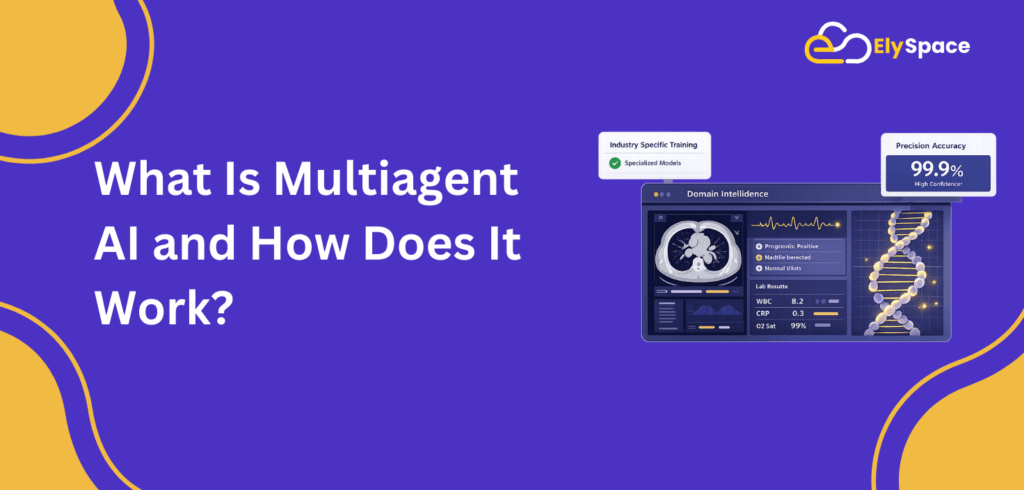
Multi-agent AI Systems consist of individual AIs working in parallel to a common goal. They distribute all the tasks and responsibilities across those AIs in a way that resembles an organized group of specialists, rather than relying on one central AI to handle everything, like in a traditional AI application.
For example, a modern-day hospital has doctors, nurses, pharmacists, and others who all specialize in different areas of expertise. They also work together to share knowledge about patients and provide integrated care. Multi-Agent AI Systems do the same thing as an integrated team, but they operate at machine-speed and scale.
A Simple Business Example
An example of a Multi-Agent artificial intelligence system working behind the scenes of an e-commerce store is as follows:
Agent 1: tracks web page view traffic and identifies unusual behavioral patterns.
Agent 2: receives, organizes, and addresses customer inquiry tickets.
Agent 3: operates the social media scheduling and tracking of social media engagement.
Agent 4: gathers and analyzes sales data and produces performance reports.
These agent systems work independently, yet are interconnected through the sharing of information among themselves, forming a single collective, intelligent back office operation which, before, would have taken an actual team to run.
Research Findings: Google DeepMind and OpenAI studies have shown that Multi-Agent Artificial Intelligence systems are better performers than single agent systems when it comes to solving complex, multi-step processes- frequently by great amounts.
What Is Domain-Specific AI and Why Does It Outperform General AI?
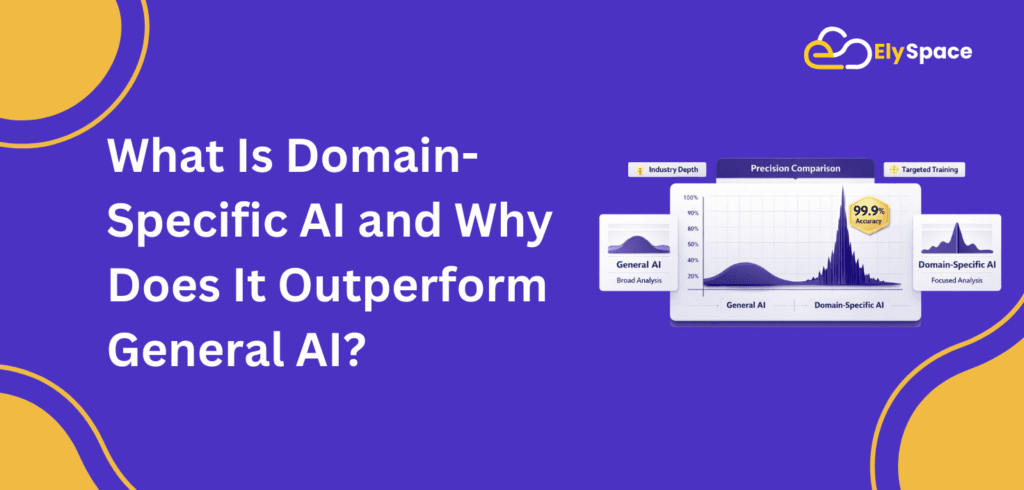
AI systems that are designed to work across different types of industries (general-purpose artificial intelligence) and within a single specific industry (domain-specific artificial intelligence) often yield different levels of performance. Because they have been trained using only domain-specific data, domain-specific AI systems located in one industry (e.g., radiology) have a higher level of comprehension when compared to general AI systems.
For example, if you were to take an image of a tumor or abnormality and provide it to a radiologist, he/she would provide you with a more accurate interpretation of your image than if he/she had attempted to interpret your image using a general-purpose AI application. However, an AI application specifically designed for use in radiology, such as a domain-specific AI application that has been rigorously tested against millions of medical imaging studies, would provide the most advanced diagnostic interpretation of that image. Thus, if you wanted to get an accurate interpretation of your image, you would need to use an application that had been specifically developed to serve the needs of that industry.
Where Domain-Specific AI Is Making the Biggest Impact
The nursing profession is undergoing a significant transformation with the help of technology, and Artificial Intelligence (AI) will play an important role in this evolution.
The innovations happening in our healthcare system are largely due to advancements in AI and machine learning. Several companies are currently using AI technology in specific areas of the healthcare industry.
Healthcare
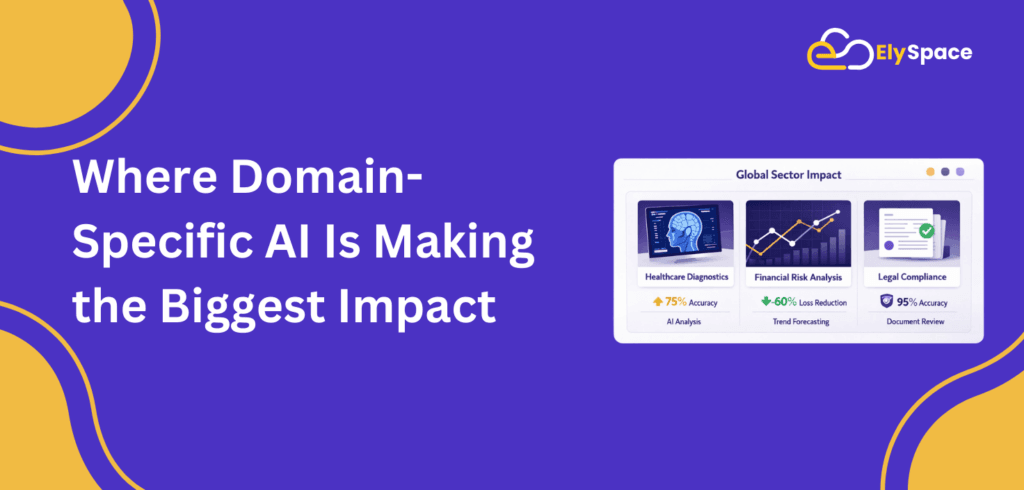
AI diagnostic tools that have been trained on imaging data allow radiologists to identify and diagnose cancer, fractures, and abnormalities more quickly and with more accuracy. Furthermore, IBM Watson Health’s Personalized Treatment Planning systems take a patient’s genetic makeup and medical history and evaluate the best individualized path to care.
Finance/Banking
Banks are utilizing domain-specific AI to complete processes such as loan applications in seconds, assess credit risks using thousands of data points, and monitor transactions for fraud (before it occurs) in real-time. These systems can perform the same services that were once handled by numerous teams of analysts; however, at a much lower cost.
Legal/Compliance
Law firms are using AI trained on legal contracts, regulatory, and case law to review hundreds of documents in the same time as it takes a human lawyer to review just one. The AI systems identify compliance risks, flag unusual clauses, and bring forth relevant legal precedents automatically.
Retail/E-commerce
The product recommendations you see while shopping on the web, “You Might Also Like…”, are a result of domain-specific AI analyzing users’s browsing history, purchasing history, as well as the day and time of their shopping experience. This is resulting in measurable improvements in both conversion and average sale amount.
Real-World Examples of Multiagent AI in Business
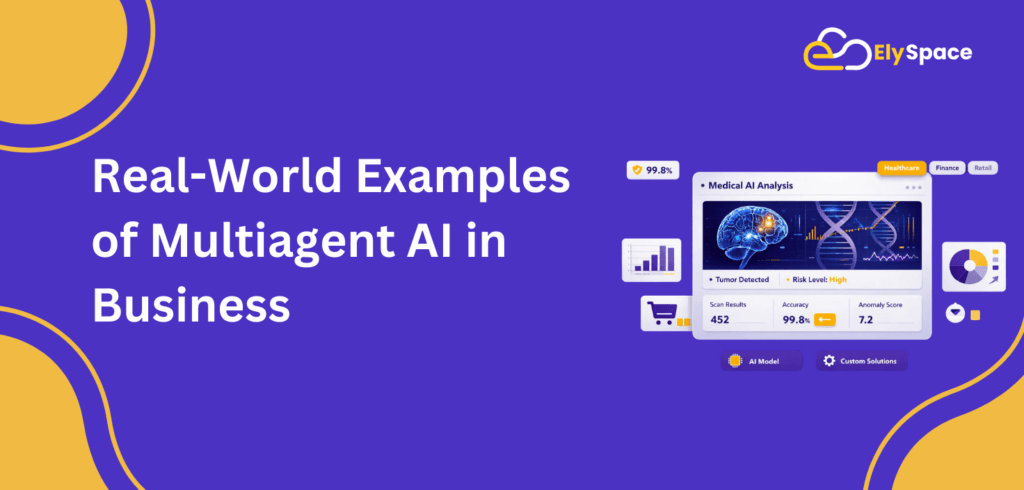
As evidenced by the growing use of Multi-Agent AI within today’s complicated supply chains and logistics systems, such technology is a current reality and not just a future possibility.
1: Supply Chain and Logistics.
Amazon and FedEx currently use Multi-Agent AI systems for coordinating their warehouse robots, optimizing delivery routes in real-time, forecasting demand spikes, and managing supplier relationships simultaneously. The result is shorter delivery times at greatly reduced operational costs.
2: Financial Trading
Wealth management companies currently deploy Multi-Agent systems where individual agents monitor various asset classes, analyze geopolitical developments impacting currency values, and execute trades in 1/1000th of a second; this level of coordination provides a significant competitive advantage when trading in highly volatile markets.
3: Multiagent Systems and Customer Service.
Today, businesses have increasingly begun deploying Multi-Agent systems that encompass the entire customer service lifecycle. Each stage can be handled by an individual agent that specializes in one area of the process (i.e., initial contact and triage, complex escalations, processing refunds, collecting feedback from customers after their interactions). In short, the experience of the customer is of having interacted with a single entity with no disjointed experience.
4: Cybersecurity and Multiagent Systems.
In terms of cybersecurity, Multi-Agent AI manages to monitor many entry points into the network (simultaneously) to detect any threat event in near real-time and automates responses much faster than any human security team can. Each agent has a specific area of expertise (different types of threats and layers on the network).
5: Smart Cities and Multiagent Systems.
Local governments are currently using Multi-Agent systems to manage things such as coordinating traffic flows, use of municipal power, response to emergencies, and real-time monitoring of environmental information simultaneously for an entire city.
Combining Multiagent AI with Domain-Specific AI
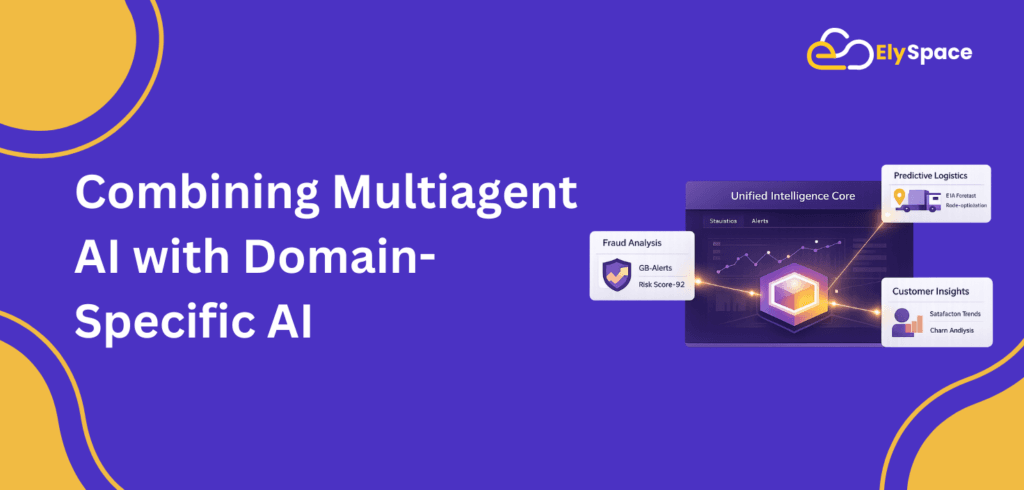
The most advanced applications of artificial intelligence can be thought of as integrating Multi-Agent systems with domain-specific agents. Each of the agents within a Multi-Agent system is an independent domain-specific agent providing its own expertise to the wider system.
As an example of this type of implementation, consider a worldwide e-commerce site. The implementation utilizes both types of agents
A domain-specific recommendations agent based on consumer behavior data provides the user with personal recommendations on any product search.
A domain-specific fraud detection agent based on millions of transactions stops suspicious orders as they come in.
A domain-specific customer support agent using product manuals and Customer Support records solves customer issues in real time.
A domain-specific logistics agent working off carrier performance data selects the best shipping method for each order.
The combination of these specialized agents creates a complete, intelligent, personalized, efficient, and unified shopping experience for the consumer that no individual agent can provide.
Market Opportunity: According to a recent report from McKinsey & Company, the combination of generative and domain-specific AI could generate as much as $4.4 trillion per year in economic value for the world economy. Companies that implement early will capture a significant portion of this economic value.
Key Benefits of Multiagent AI for Your Business
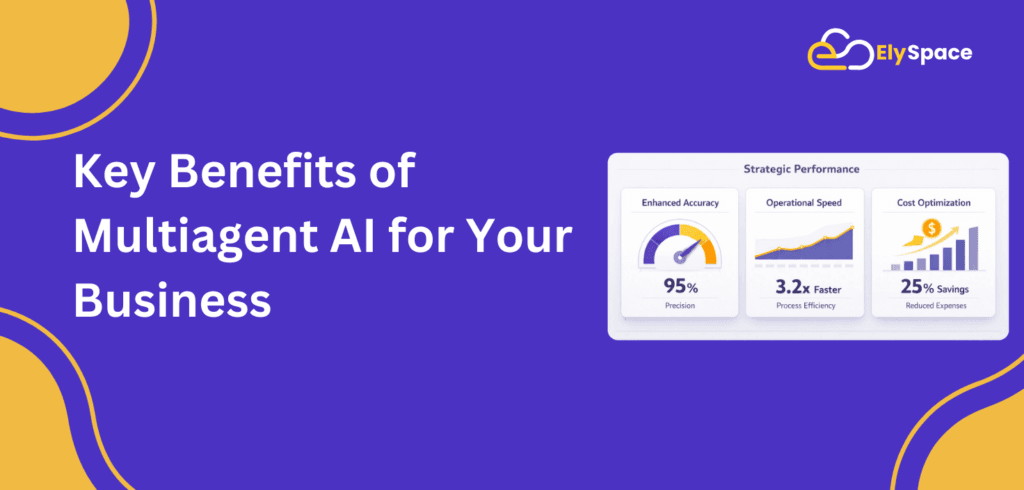
- Higher Accuracy: Domain-trained models reduce errors by learning from industry-specific data, not generalized datasets
- Faster Processing: Multiple agents working in parallel compress days of work into hours or minutes
- Significant Cost Reduction: Automating repetitive, data-intensive tasks reduces dependency on manual labor and human error
- Unlimited Scalability: Multi-Agent systems handle ten times the workload of human teams at the same cost
- Better Customer Experience: Always-on, personalized service increases satisfaction, loyalty, and long-term revenue
How to Get Started: A Practical Step-by-Step Guide
Step 1: Audit Your Current Business Processes
Review your present processes to identify repetitive tasks that require large amounts of data processing, have significant opportunities for reducing human error, and could provide the greatest returns on investment from using AI. Some common functions you might want to consider automating through the use of Ai could include customer service, invoice processing, inventory management, and sales reports.
Step 2: Research Domain-Specific AI Solutions for Your Industry
Once you’ve identified the type of AI solutions that suit your industry, look for companies or vendors who specialise in that area, and see if they offer solutions specific to your needs or already have customers in that sector. After that, you can start to evaluate potential partner companies for implementing Ai in your business, as there are several different platforms available that will integrate with your existing systems, such as IBM Watson, Google Vertex AI, and Microsoft Azure AI.
Step 3: Build a Solid Digital FoundationThe infrastructure supporting your AI system(s) must be reliable, fast, and secure if you want your Ai systems to operate efficiently and effectively; therefore, before you implement any Ai tools into your business processes, ensure that your webpages and hosting environment are ready to handle the extra amount of data processing that AI systems require by providing fast page load times, a high percentage of uptime for your website, the ability to grow as your data usage increases, and SSL certification to protect the sensitive information contained within your website(s).
Step 4: Initiate in Small Scale And Demonstrate the Concept
On your first day at work, you don’t necessarily have to deploy a complete Multi-Agent system in one go; you could create something as simple as an artificial intelligence chatbot (for example), a fraud detection module (for example), or an intelligent recommendation engine. Measure and collect results from this first step so that when you do decide to implement further, there will be less risk, and therefore more confidence in your business.
Step 5: Evaluate Your Strategy, Learn What Works, And Grow It
At each stage, monitor performance metrics such as cost savings, error rate, customer satisfaction scores, and processing time. Use this information to refine your current Artificial Intelligence (AI) capabilities as well as help you decide where else to introduce them.
Conclusion
Multi-agent AI and domain-specific AI are no longer exclusive to technology giants with massive research budgets. These tools are available to any business willing to invest in understanding them, deploying them thoughtfully, and building the digital infrastructure to support them.
The businesses that act now, while adoption is still in its early stages, will build capabilities that define their industries for the next decade. The question is not whether AI will transform your sector. It already is. The question is whether your business will lead that transformation or follow it.
Start with one use case. Measure the results. Scale what works. The competitive advantage you build today will be very difficult for late movers to close tomorrow.