 Live Chat
 Contact
 Shopping Cart
 Rashid Malla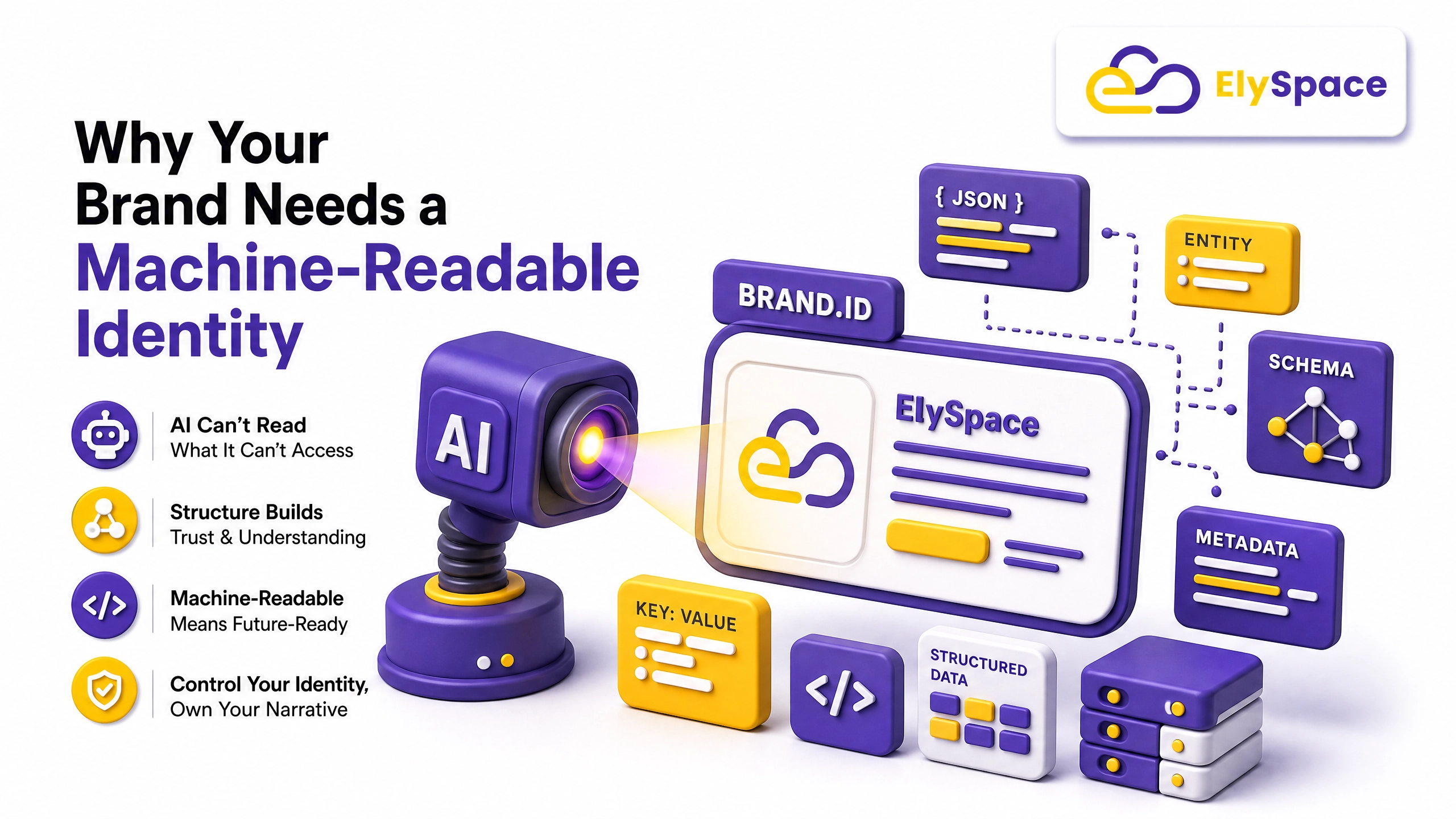
If you have ever asked ChatGPT, Gemini, or Perplexity to recommend a product and noticed your competitor’s name instead of yours, you have already felt the impact of AI Branding. This is not a future problem. It is happening right now, on every query where an AI agent decides which brand deserves to be mentioned. Understanding what is a machine-readable brand identity is quickly becoming as important as having a logo or a tagline, because AI systems don’t “see” your brand the way a human does. They read it, parse it, and either trust it or ignore it.
At Ely Space, we work with brands every day that are strong on paper but invisible to the machines now sitting between them and their customers. This guide breaks down exactly what a machine-readable brand identity is, why AI Branding has become a real business priority, and how to build one step by step. If you want the broader picture first, our complete brand strategy guide is a useful starting point before diving into the technical side below.
What Is a Machine-Readable Brand Identity?
A machine-readable brand identity is a structured, verifiable version of your brand that AI systems and search crawlers can parse without guessing. Think of it as the difference between telling someone your story out loud and handing them a well-organized file with your facts already labeled.
Traditional branding speaks to humans through design, tone, and storytelling. A machine-readable identity speaks to machines through structured data, clear entity information, and consistent facts published in formats AI crawlers can actually process. This is the technical foundation behind modern AI Branding.
In practice, this means your brand name, description, logo, pricing, leadership, and social profiles exist in code-level formats such as JSON-LD schema, not just buried in paragraphs of marketing copy. When an AI agent is deciding whether to mention your company, it is scanning for this exact kind of structured proof.
So when someone asks what is a machine-readable brand identity, the honest answer is this: it is your brand translated into a language that large language models and answer engines can trust, verify, and repeat accurately.
Why AI Branding Is the Next Frontier of Brand Strategy
For two decades, brand visibility meant ranking on Google’s first page. That still matters, but a second layer of discovery has opened up, and it works differently. AI Branding is the practice of making sure your brand is understood, trusted, and cited correctly by AI systems like ChatGPT, Gemini, Claude, and Perplexity.
These systems don’t crawl the web the way Googlebot did in 2015. They extract passages, cross-check entities, and prefer sources with clear, structured signals over vague, unstructured marketing pages. A brand that only “sounds good” to a human reader may be completely invisible to an AI agent that is scanning for hard facts.
This shift is why AI Branding has moved from a nice-to-have to a core part of digital strategy. Brands that ignore it are handing free visibility to competitors who have already structured their identity for machine consumption. We cover the broader shift from traditional SEO to answer-engine visibility in our guide to Generative Engine Optimization, which pairs well with the technical steps below.
How AI Agents Actually Read Your Brand
To understand AI Branding, it helps to know exactly what an AI agent looks for when it lands on your website. There are three layers most brands need to get right.
Schema Markup: The Structured Identity Layer
Schema markup, written in JSON-LD, is the clearest signal you can give an AI system about who you are. Organization schema declares your brand’s canonical name, logo, description, and social profiles, and it functions as the primary entity signal for brand identity in AI systems. Adding Product, Person, and Review schema extends this further, giving AI agents accurate pricing, authorship, and reputation data to work with.
Google’s own Rich Results Test can validate this markup, and it is worth checking regularly, since AI systems and search engines both rely on the same structured vocabulary from Schema.org. If you need a hand implementing this correctly, our schema markup service page walks through how we approach it for clients.
llms.txt: The Content Index for AI Crawlers
A newer standard called llms.txt sits at the root of your website, similar to robots.txt, but instead of blocking bots, it points AI crawlers to clean, markdown-formatted summaries of your key content. This file has become a practical entry point for AI Branding because it tells an AI agent exactly where to find your most important brand facts without wading through unrelated pages.
Content APIs: Live, Queryable Brand Facts
The most advanced layer of a machine-readable brand identity is a content API, a versioned endpoint that returns structured, timestamped answers about pricing, features, or documentation. This matters because AI agents comparing brands are often working from outdated or incomplete crawled text. A live endpoint removes the guesswork and keeps your AI Branding accurate in real time.
The Business Case for AI Branding
Skipping AI Branding has a direct cost. If an AI agent cannot verify your pricing, your services, or your credentials, it will either skip your brand entirely or, worse, describe it inaccurately using outdated or third-party information.
There is also a measurable upside. Pages with valid structured data are reported to be more than twice as likely to appear in AI-generated overviews compared to pages without markup, and research on generative engine visibility has found that clear structural signals can meaningfully increase how often a brand is surfaced in AI-generated responses.
For a brand like yours, this translates into more accurate citations, better representation in AI-driven comparisons, and stronger trust signals across every surface where AI now sits between you and your customer, from voice assistants to smart browsers to conversational search. See our AI visibility case studies for real examples of this in action.
How to Build a Machine-Readable Brand Identity (Step by Step)
Building a strong machine-readable brand identity does not require rebuilding your entire website. It requires a deliberate, layered approach.
Step 1: Audit your current entity signals. Check whether your Organization schema exists, is complete, and matches your visible content exactly. Mismatched schema is treated as a red flag by both search engines and AI systems. Our free brand visibility audit can flag these gaps for you in minutes.
Step 2: Publish an llms.txt file. Keep it concise and accurate, listing your core pages, your product or service summary, and links to your most important brand content, without bloating it with unnecessary detail.
Step 3: Strengthen entity disambiguation. If your brand name overlaps with another company or common term, use sameAs Properties to connect your domain to verified profiles on LinkedIn, Wikidata, or Wikipedia.
Step 4: Keep facts current. Outdated pricing or feature information in structured data is worse than having none at all, since AI systems that cite it will simply be wrong on your behalf.
Step 5: Validate everything. Use Google’s Rich Results Test and monitor how AI systems describe your brand over time, adjusting your structured data as your business evolves.
This is the exact process our team at Ely Space follows when we help brands become AI-ready, and it is the backbone of any serious AI Branding strategy.
Common AI Branding Mistakes to Avoid
Many brands assume that a nice website automatically counts as a strong brand identity. It does not, at least not to a machine. Below are the mistakes we see most often.
Publishing a schema that does not match visible page content is one of the most common issues, and it can flag your structured data as unreliable rather than helpful. Another frequent mistake is treating llms.txt as a one-time task instead of a living document that needs regular updates as your brand grows.
Over-optimizing for machines at the expense of human readers is also a real risk. A machine-readable brand identity should support your human-facing content, not replace it, since real people still need to read, trust, and act on your website. The strongest AI Branding strategies balance both audiences without sacrificing either one.
The Future of AI Branding
AI Branding is still early, but the direction is clear. Search engines and AI systems are converging on the same expectation: brands need to prove who they are through structured, verifiable, and current data, not just persuasive copy.
As more purchase decisions, comparisons, and recommendations pass through AI agents before a human ever visits your website, a machine-readable brand identity stops being a technical detail and becomes a core part of how your brand earns trust. Brands that invest in this now will be the ones AI systems recommend later.
If you are ready to move from theory to execution, our team at ElySpace can help you audit your current brand signals and build a complete AI Branding roadmap tailored to your business.