 Live Chat
 Contact
 Shopping Cart
 Rashid Malla
If you write content for a living, you have probably felt it: the old playbook is not working the way it used to. Traffic is flatter. Rankings move for no clear reason. And somewhere in the background, an AI Overview or a chatbot is answering the exact question your blog post was built to answer, without sending anyone to your site.
This is what people mean when they talk about the AI-first internet, and it is the reason every serious AI content strategy needs a rewrite in 2026. Search has not been replaced. It has been layered. Google, ChatGPT, Gemini, Perplexity, and Claude now sit between your content and your reader, deciding what gets summarized, what gets cited, and what gets ignored.
The good news is that Google has actually told us how this works. On May 15, 2026, Google published its first official guide on optimizing content for generative AI features in Search, and the message was clear: this is still SEO, just with sharper standards. This article breaks down exactly what that means and lays out the new rules of content in an AI-first internet for writers, marketers, and business owners who want to stay visible.
If you are also responsible for the website this content lives on, it is worth pairing this strategy with a look at your web hosting and site performance, since a slow site undercuts even the best-written page.
What “AI-First Internet” Actually Means
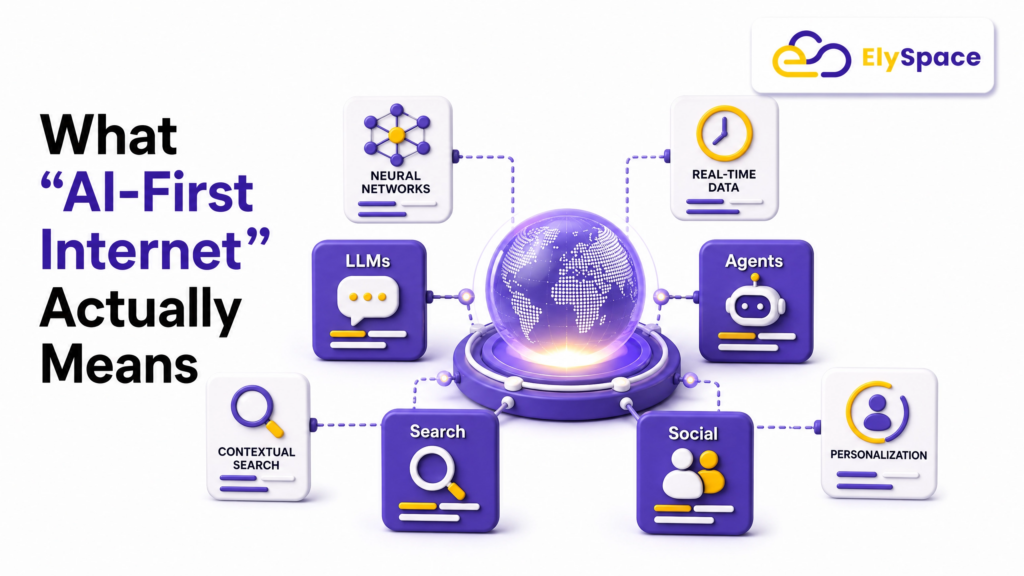
An AI-first internet is one where an AI system, not a list of blue links, is usually the first thing a person sees after they search. That system reads dozens of pages in seconds, pulls out the clearest answer, and presents it directly. Your page only shows up if the AI trusts it enough to quote it.
This does not mean websites are becoming irrelevant. It means the bar for getting noticed just moved. According to Google’s own documentation, its AI features run on retrieval-augmented generation, a technique that pulls relevant, up-to-date pages from the Search index and then reviews them to build a reliable response. In plain language: Google still needs your website. It just processes it differently now.
For anyone building an AI content strategy, this is the starting point. You are no longer only writing for a person scrolling through results. You are writing for a system that needs to understand your page well enough to trust it as a source.
Why Your Old AI Content Strategy Needs a Rewrite
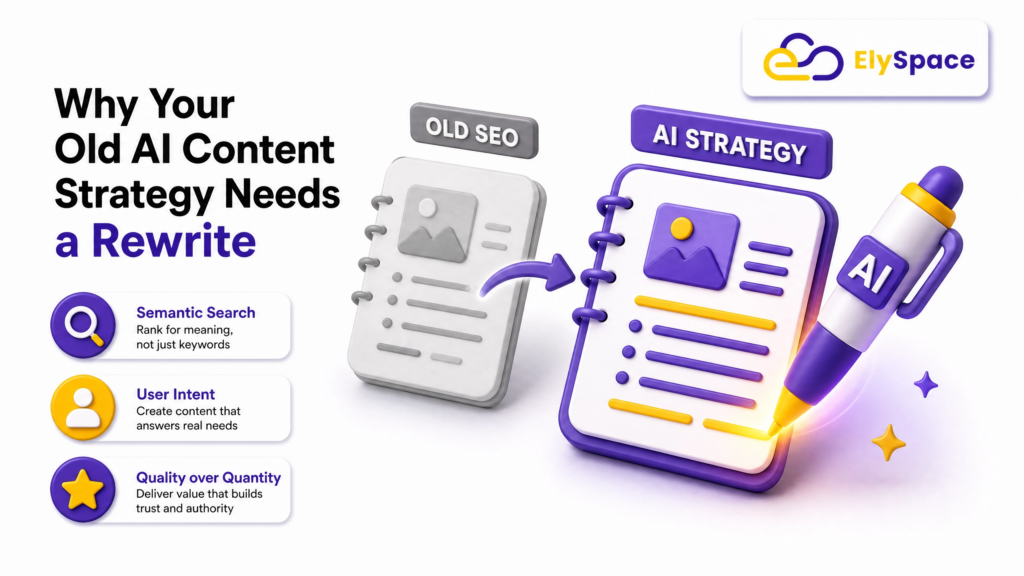
A lot of content written in the last five years followed a familiar formula: a keyword-stuffed title, a bloated introduction, and paragraphs padded out to hit a word count. That approach is now actively working against you.
AI systems are built to reward precision, not padding. They read the opening lines of a page first to figure out what it covers, then decide whether to keep reading. If the first few sentences are vague or generic, the page gets skipped rather than summarized. Filler content, recycled advice, and thin “me too” articles are exactly the kind of pages these systems are designed to filter out.
There is also a trust problem. Google has expanded content verification tools like SynthID and C2PA labeling, which means low-effort AI-generated content published at scale carries real risk instead of a shortcut to rankings, a shift that outlets covering Google I/O 2026 have flagged as a real downside risk for brands. Brands leaning on unreviewed, mass-produced content are already seeing that risk play out in their traffic.
The takeaway is simple. Any modern content or AI content strategy has to be rebuilt around depth, accuracy, and a real point of view, not around volume.
What Google Actually Says: AEO and GEO Are Still SEO
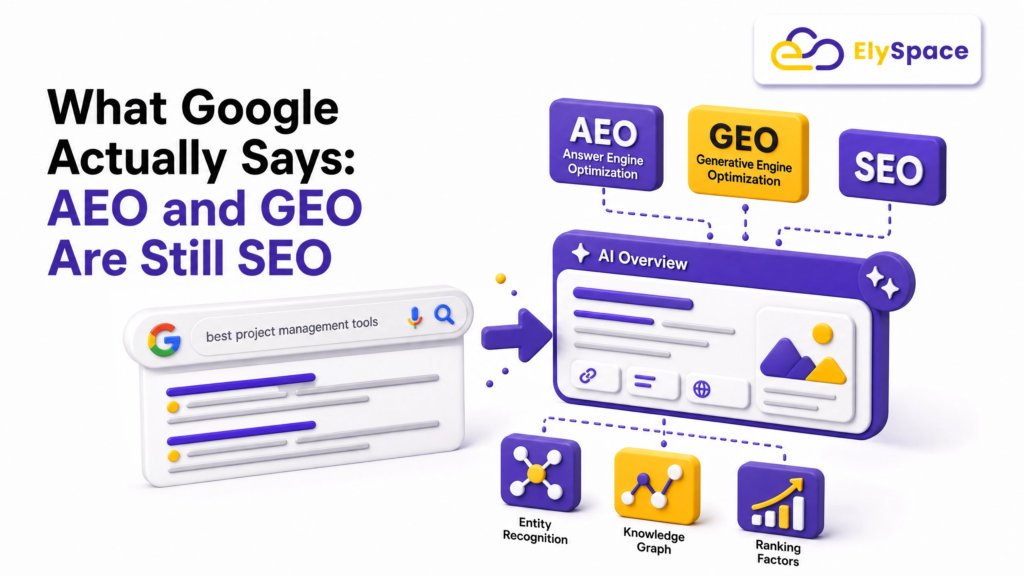
You have probably seen the terms AEO (Answer Engine Optimization) and GEO (Generative Engine Optimization) floating around as if they are brand-new disciplines. Google has now settled that debate directly.
In its May 2026 guide, Google stated plainly that optimizing for generative AI search is optimizing for the search experience and is therefore still SEO. There is no separate, secret playbook for showing up in AI Overviews or AI Mode. The same signals that earn rankings in classic search- crawlable pages, genuine expertise, and a clear user experience are what earn visibility inside AI-generated answers.
Google also used the guide to push back on a few popular shortcuts. It confirmed there is no need to create special machine-readable versions of your content, and that chunking your pages into oddly short fragments does not help. Its systems are already built to understand the nuance of a full page and extract the relevant part on their own.
For content writers, this is genuinely good news. It means the fundamentals you already know, useful topics, clear structure, and honest writing still matter more than any AI-specific trick.
The New Rules of Content in an AI-First Internet
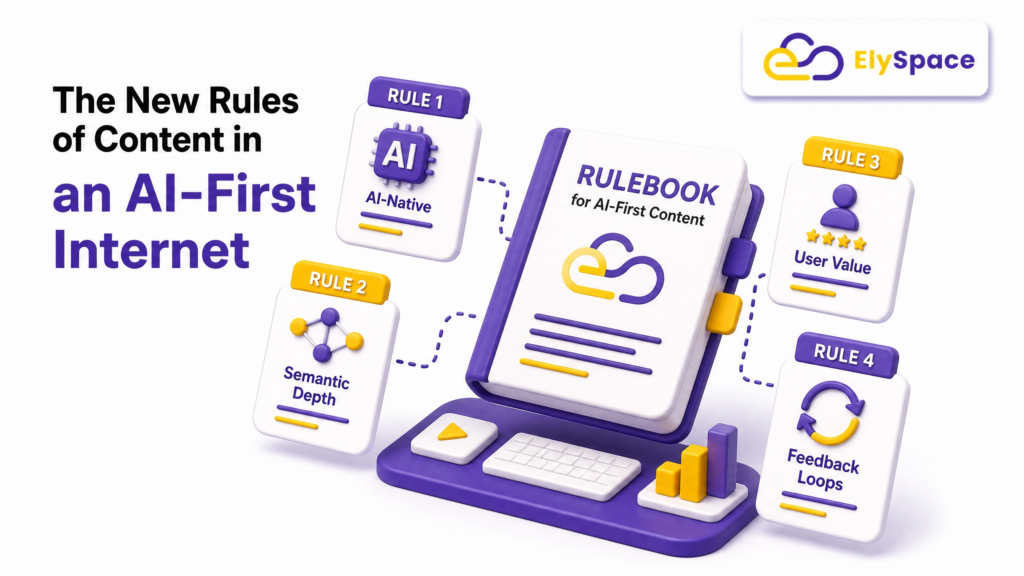
Here is where theory turns into a working AI content strategy. These are the practical shifts that separate content built for an AI-first internet from content that quietly disappears.
Rule 1: Write for the Human Who Has a Real Problem
Search intent has not changed just because AI is reading the page first. Before you write a single line, ask what the person actually needs when they type that query. A reader searching “AI content strategy” wants a usable plan, not a definition they could get from a dictionary.
Every section should answer a question a real person would ask out loud. If a paragraph does not move the reader closer to solving their problem, cut it.
Rule 2: Demonstrate Experience, Not Just Knowledge
AI systems and human readers both respond to specifics. Anyone can describe what a content strategy is in general terms. Far fewer people can describe what happened when they tested one, what broke, and what they changed as a result.
Naming actual tools, sharing a real process, or referencing a specific outcome signals lived experience. That is the “experience” layer of E-E-A-T, and it is very hard for generic AI-written content to fake convincingly.
Rule 3: Structure the Page Like a Map, Not a Story
Older SEO writing often built slowly toward a point. AI systems do the opposite: they scan headings first to understand what a page is about before deciding whether to use it. If your headings are vague, out of order, or missing entirely, your content becomes harder to extract and harder to trust.
Use a clear H1, followed by logical H2 and H3 headings that describe exactly what each section covers. Put the answer near the top of each section instead of building up to it.
Rule 4: Build Topical Depth, Not Just Word Count
A single 3,000-word article rarely beats a well-connected set of shorter, focused pages that together cover a topic completely. This is what search engines call topical authority, and it applies directly to any content or AI content strategy aimed at ranking in 2026.
Cover the core topic thoroughly, then link out to related pages on your site that go deeper into specific parts of it, the same way this article links to ElySpace’s hosting services and about page rather than making a passing mention. That structure tells both readers and AI systems that your site understands the subject fully, not just one slice of it.
Rule 5: Keep a Human in the Loop
AI tools are excellent for research, drafting, and structure. They are not a substitute for editorial judgment. Content that is generated in bulk and published without a real edit tends to read as generic, and generic content is exactly what AI Overviews are built to skip in favor of something more specific.
The most durable approach is to use AI as a drafting assistant, then have an experienced writer fact-check, sharpen, and add the kind of detail only a person with real knowledge would think to include.
E-E-A-T in Practice: Proving You Are a Real Expert
E-E-A-T stands for Experience, Expertise, Authoritativeness, and Trustworthiness, and it is less an abstract concept than a set of concrete signals you can build into every page.
Experience shows up in first-person detail: a specific result, a mistake you corrected, a tool you actually use. Expertise shows up in accuracy: correct terminology, current examples, and claims that hold up under scrutiny. Authoritativeness builds over time through consistent, well-linked content and recognition from other credible sites. Trustworthiness comes from transparency: clear authorship, accurate information, and no exaggerated claims.
A practical way to strengthen all four at once is to publish under a named author with real credentials, keep an about page current, and correct outdated information the moment it changes. These are small details, but they are exactly what separates content that looks written by an expert from content that only sounds like it.
On-Page SEO Checklist for AI-First Content
Strong writing still needs solid technical execution behind it. Before publishing, run every article through this checklist.
- Title tag: Lead with your focus keyword and keep it concise and specific.
- Meta description: Summarize the page’s value in one clear sentence, keyword included.
- URL slug: Short, readable, and built around the focus keyword.
- Heading structure: One H1, followed by properly nested H2s and H3s that describe each section accurately.
- First paragraph: Introduce the focus keyword naturally within the opening lines.
- Internal links: Connect the article to related pages on your own site, such as a web hosting or about us page, so both readers and crawlers can explore further.
- Outbound links: Reference original, authoritative sources like Google Search Central to back up claims.
- Paragraph length: Keep paragraphs short, ideally under six lines, so the page is easy to scan on any device.
- Freshness: Update statistics, examples, and dates whenever the underlying facts change.
Mistakes That Get Pages Skipped by AI Overviews
A few habits consistently keep otherwise decent content out of AI-generated answers. Broken heading structure is one of the biggest, since AI systems use your HTML outline as a map of the page, and a confusing map gets ignored.
Vague openings are another common problem. If the first two or three sentences do not clearly state what the page covers, the system may not read far enough to find the good part. Thin, unoriginal content is filtered out just as aggressively because AI systems are specifically built to prefer information they could not simply assemble from ten other pages.
Finally, chasing outdated “hacks” like unnecessary schema stuffing or awkwardly chunked paragraphs tends to hurt readability without any real ranking benefit, since Google has confirmed its systems do not need these workarounds.
Building an AI Content Strategy That Lasts
The brands that will keep winning visibility in an AI-first internet are not the ones publishing the most content. They are the ones publishing the most useful content, backed by real expertise, structured clearly, and kept current.
A durable AI content strategy treats every article as a long-term asset rather than a one-time post. That means revisiting older content regularly, strengthening internal links as new pages go live, and always asking whether a piece of content would still be useful if an AI system read it aloud to someone in a hurry.
If your website’s technical foundation, speed, uptime, and crawlability are not solid, none of this content work can perform at its best. That is exactly why fast, reliable hosting from a provider like ElySpace matters as much as the writing itself; a slow or unstable site undermines even the strongest content.
Content in an AI-first internet is not about outsmarting an algorithm. It is about being genuinely useful enough that both a human reader and an AI system agree your page deserves the click or the citation.