 Live Chat
 Contact
 Shopping Cart
 Eshan Riyaz
Most people who want to start an online business from home spend their first three months doing everything except the one thing that matters, getting a paying customer.
They spend weeks choosing a business name. They obsess over their logo. They research website builders at midnight. They watch YouTube videos about passive income. And then, when it’s finally time to actually talk to a potential customer, they’re not ready or they’ve already given up.
This guide skips all of that. It focuses on the decisions and steps that actually determine whether your online business makes money, in the right order, without the fluff.
Step 1: Pick a Direction, Not a Dream
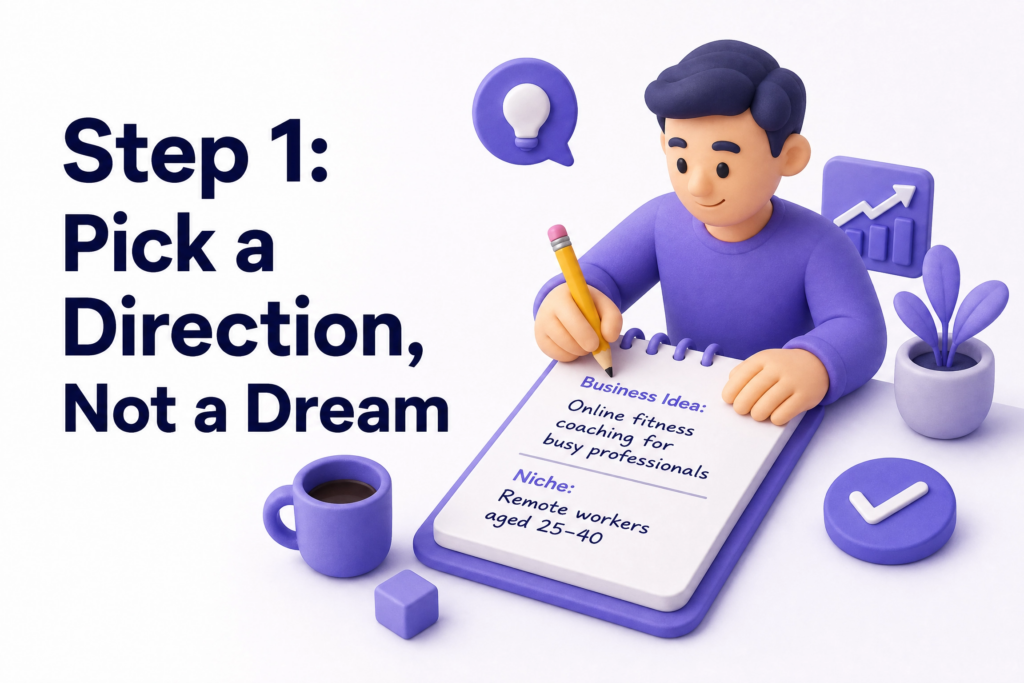
The most common mistake people make before they even start an online business from home is choosing something too vague.
“I want to sell online” is not a business idea. “I want to help small businesses in Kashmir manage their social media” is. “I want to sell handmade products” is not enough. “I want to sell handmade Kashmiri jewellery to buyers in Delhi and Mumbai through Instagram” is a real starting point.
The narrower your focus at the start, the easier everything else becomes. You know who to talk to. You know where to find them. You know what to offer.
A useful three-part test for any online business idea:
Does it solve a problem someone is already willing to pay to fix? Do you have the skills, knowledge, or access to actually deliver it? Can you realistically reach the people who need it?
If the answer to all three is yes, you have something worth testing. If the answer to any of them is “maybe” or “I’ll figure it out later,” figure it out now, before spending money on a website.
Popular starting points that genuinely work for people operating from home: freelance services (writing, design, marketing, development), digital products (templates, guides, courses), local service businesses with an online presence (travel planning, consulting, tutoring), and reselling or eCommerce with a specific niche.
Today, the winners are niche brands with a distinct point of view, not generic stores. The “proof economy” rewards specialists. If you can show you are genuinely better at one thing than the average person, you can charge for it.
Step 2: Validate Before You Build
This is the step most people skip, and it’s the one that determines whether you’ll make money or waste six months building something nobody wants.
Validation means confirming that real people will actually pay for what you’re planning to offer, before you invest significant time or money into it.
Test demand cheaply: build a landing page, run a pre-order, post a product demo, or sell through a marketplace before building your own store. The goal is proof before commitment.
Practically, this looks like:
- Posting about your service or product on social media and seeing whether people ask about it
- Reaching out directly to five to ten potential customers and offering to solve their problem
- Selling your first one or two units before building a full website or store
- Running a simple paid ad to a basic landing page and watching whether anyone clicks through and enquires
If nobody responds positively during validation, that’s not failure, that’s free information. You’ve learned that either your offer, your audience, or your message needs adjusting. The alternative is building everything first and discovering this six months later.
Most beginners spend weeks obsessing over logos, colour palettes, and website themes, then wonder why nobody’s buying. The real work happens before any of that: choosing the right niche, proving demand exists, and building simple systems that don’t collapse the moment orders pick up.
Step 3: Understand the Business Model You’re Choosing
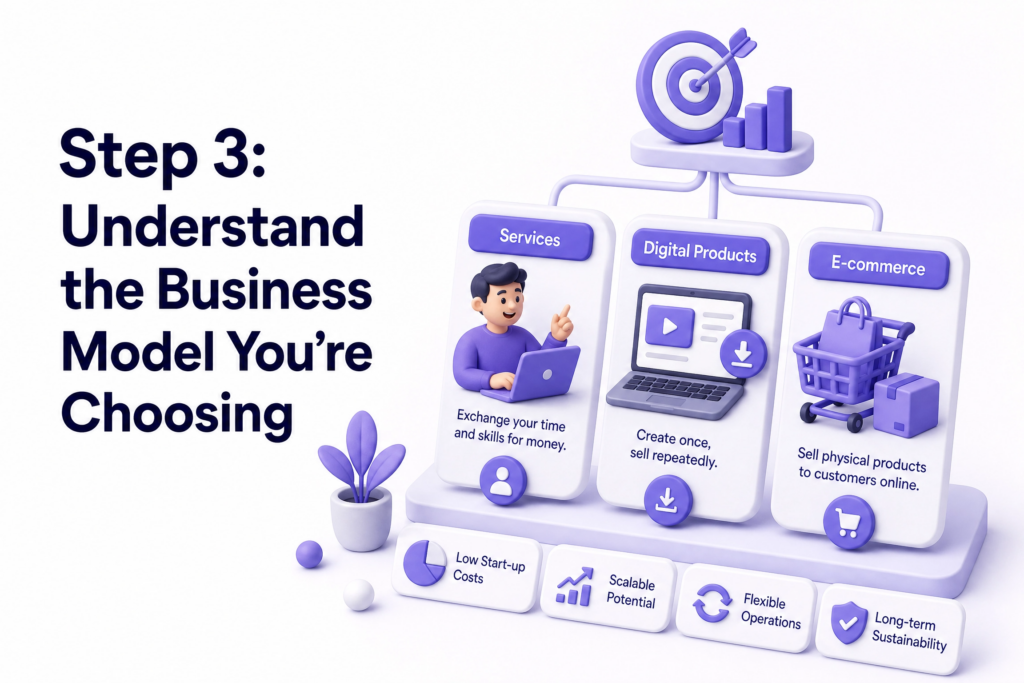
Not all online businesses work the same way. How you make money determines everything, your marketing approach, your costs, your time commitment, and your growth ceiling.
The main models worth understanding:
Service business: you sell your time and skills directly to clients. Freelancing, consulting, coaching, agency work. Fastest to revenue, hardest to scale without hiring.
Digital products: you create something once (a course, template, ebook, preset pack) and sell it repeatedly. Best margins, slower to build an audience for.
eCommerce: you sell physical products online. Online sales reached $304.2 billion in the second quarter of 2025, a 5% jump from the previous year, showing the market is real and growing but competition is intense and upfront costs exist for inventory or supplier relationships.
Dropshipping and print-on-demand: you sell products without holding inventory. Lower risk, lower margin, and requires strong marketing to stand out.
Content and affiliate income: blogging, YouTube, newsletters, podcasts that earn through ads, sponsorships, or affiliate links. Longest path to income but creates durable, compounding assets over time.
Most people who successfully start an online business from home begin with a service, because it requires no upfront investment, validates immediately through real client conversations, and generates income while you’re still figuring everything else out.
Step 4: Set Up Your Online Presence Properly
Once you’ve validated your idea, your online presence becomes the tool that helps you scale beyond word of mouth and direct outreach.
At minimum, you need:
A professional website. Not a template you threw together in an hour — a site that clearly explains what you do, who it’s for, why someone should choose you, and what to do next. Your website is your 24-hour salesperson. A poorly built one actively loses you customers. According to Google’s guidance on helpful content, websites that clearly demonstrate expertise and answer visitor questions perform best in search, which directly affects how many people find you organically.
A domain email address. [email protected], not [email protected]. This single change affects how seriously people take your enquiries. It costs almost nothing and signals that you’re operating as a real business.
Google Business Profile. If you serve local customers or want to be found in Google searches, a free Google Business Profile is one of the fastest ways to establish visibility.
Consistent social presence. You don’t need to be on every platform. Pick one or two where your target customers spend time and show up there consistently.
The website is where everything else points. Social media posts, Google searches, referrals, ads, they all eventually land someone on your site. That’s where the decision to contact you (or not) gets made. Invest in getting it right.
If building a professional website feels overwhelming or outside your skill set, ElySpace builds websites for home-based and small businesses that are designed to convert visitors, not just look good. A proper website from the start saves you from rebuilding in 12 months.
Step 5: Sort the Basics: Payments, Communication, Operations
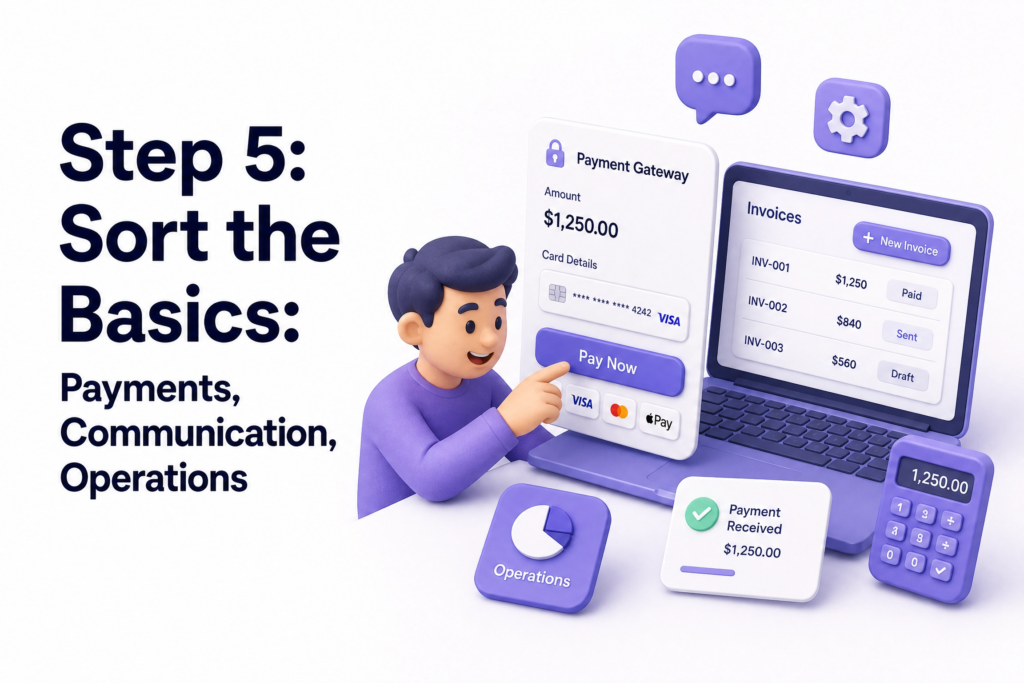
Before you take your first customer, make sure you can actually deliver and get paid.
Payments: how will customers pay you? For service businesses starting out, a simple bank transfer or UPI payment works. As you grow, payment gateways like Razorpay (for India) or Stripe integrate cleanly with most websites and allow card payments, EMI options, and automated invoicing.
Contracts or agreements: even a simple one-page document confirming scope, timeline, and payment terms, protects you and sets professional expectations. Many early business problems come from unclear agreements, not bad clients.
Communication: a dedicated WhatsApp Business account separate from your personal number, a business email, and a simple system for tracking enquiries and follow-ups. You don’t need CRM software on day one, a shared Google Sheet works fine.
Invoicing: tools like Zoho Invoice or Wave are free and let you send professional invoices, track payments, and maintain basic financial records from the start.
None of this needs to be perfect. But having it in place before your first paying customer means your first impression as a business is professional not improvised.
Step 6: Get Your First Customer Before Perfecting Anything
This is the most important instruction in this entire guide.
Don’t wait until your website is perfect. Don’t wait until you’ve posted 30 times on Instagram. Don’t wait until you’ve figured out your pricing structure completely. Get your first paying customer first, then refine everything else with real feedback.
Your first customer teaches you more about your business than six months of planning ever will. They tell you what your offer actually means to them, what made them say yes, what they were worried about, and what they needed to hear before deciding to buy.
That information is worth more than any market research you can do from home.
How to get that first customer:
- Tell everyone you know what you’re now doing and who you help
- Post directly on social media with a specific offer and a clear call-to-action
- Reach out personally to five people you think could benefit from your service
- Offer a discounted or free first project in exchange for a detailed testimonial, only at the very start, and only once
One paying customer is proof. Two is a pattern. Five is a business.
Step 7: Build Your Content and SEO Foundation
Once you have your first few customers and your basic systems are running, it’s time to start building the long-term engine that brings customers to you automatically.
Blogging and SEO are the most cost-effective marketing channels available to a home-based business with a limited budget. SEO, email, and organic social reward niche voices with real expertise. Customer acquisition through paid ads has gotten significantly harder, with big brands paying 30–60% more for ads than they were in 2023. That’s your opening.
What this means practically:
- Write blog posts that answer the real questions your customers are searching for
- Optimise every page of your website with clear titles, meta descriptions, and relevant keywords
- Build your Google Business Profile and ask early customers for reviews
- Share content consistently on one or two social platforms where your audience actually is
This takes time. Three to six months before you see meaningful organic traffic is realistic. But the business that starts this in month two will be receiving free, consistent enquiries by month eight, while the business that skips it entirely remains dependent on referrals and paid promotion indefinitely.
You can track how your website is performing in search for free using Google Search Console, it shows exactly which queries are bringing people to your site and where you’re ranking.
Step 8: Treat It Like a Business From Day One
This is the step most guides leave out entirely because it’s not about tools or tactics. It’s about mindset.
When you start an online business from home, the biggest risk isn’t competition or the economy or a bad product. It’s treating the whole thing as a side project indefinitely. Working on it when you feel motivated. Skipping the uncomfortable parts, the follow-ups, the sales conversations, the financial tracking, because there’s no boss watching.
54% of small business owners rank the freedom to set their own schedule among the biggest benefits of entrepreneurship. That freedom is real and worth having. But it requires a level of self-discipline that’s harder to maintain than most people expect before they try.
A few things that help:
- Set specific working hours and hold them, even if you’re working from a bedroom
- Track your revenue and expenses from the first rupee, not later
- Review your numbers weekly, are you moving toward your goals or drifting?
- Take client commitments as seriously as you would a job with a manager watching
The businesses that make it aren’t always the ones with the best idea. They’re the ones run by people who keep showing up when it’s inconvenient.
Common Mistakes People Make When Starting Online
Spending weeks on the brand before getting a customer. Your logo doesn’t matter until you have revenue.
Trying to do everything at once. Pick one platform, one offer, one type of customer. Expand only after that’s working.
Pricing too low out of fear. Low prices don’t build a sustainable business, they attract clients who don’t value your work and create a ceiling on your income.
Building a website before validating the idea. A website for an unvalidated business is a good-looking waste of money.
Giving up after three months. Most online businesses that eventually succeed looked like failures in the first 90 days. Consistent effort over six to twelve months is what separates the ones that make it.
Ignoring legal and financial basics. Even a home-based business should maintain basic financial records, understand its tax obligations, and have written agreements with clients. Skipping this creates larger problems later.
What You Can Do This Week
- Write down your business idea using the three-part test from Step 1
- Have five conversations with potential customers about the problem you’re solving, before building anything
- Register a domain name and a business email address
- List the five people most likely to become your first customers and reach out to each of them this week
- Set up Google Search Console so you can track your online presence from day one
If you’re at the stage where your idea is validated and you’re ready to build a proper online presence, ElySpace works with home-based and early-stage businesses to create websites that look professional, load fast, and actually bring in enquiries. We understand what a first business website needs to do, because we’ve built them for businesses at exactly this stage.
FAQs (Frequently Asked Questions)
How much money do I need to start an online business from home? It depends on the model. A service business, freelancing, consulting, coaching, can be started with almost nothing: a domain, an email, and a basic website can cost under ₹5,000 to set up. eCommerce and product businesses require more upfront investment for inventory or supplier relationships. Start with a model that matches your current budget and scale from there.
Do I need a registered company to start an online business from home? Not immediately in most cases. Many people start as sole proprietors and formalise the business structure later as revenue grows. Check the specific requirements in your state or region, in India, a GST registration becomes necessary once turnover exceeds a certain threshold, and it’s worth getting professional accounting advice early.
How long does it take to make money from an online business? Service businesses can generate their first income within days or weeks, as quickly as you can reach your first paying client. Product businesses and content businesses typically take longer, often three to twelve months before consistent revenue. The most important factor is consistently taking action rather than waiting for the perfect moment.
Do I need a website to start? Not on day one. Many successful online businesses started with nothing more than a WhatsApp Business account and social media presence while they validated their idea. But once you’re beyond validation and have paying customers, a professional website becomes essential for credibility, SEO, and scaling beyond your personal network.
What online businesses work well for people in Kashmir or smaller cities? Service businesses with remote delivery work especially well, digital marketing, web design, content writing, tutoring, and consulting can all be delivered to clients anywhere in India or globally. Local tourism and travel businesses have a natural niche advantage. Handmade and artisanal products have strong demand in metro markets and can be sold through Instagram and dedicated eCommerce sites. Location is less of a barrier than it’s ever been.
How do I get customers for my online business without a big marketing budget? Start with your existing network, tell people what you do. Use free platforms: Instagram, LinkedIn, YouTube, a Google Business Profile. Focus on SEO and blog content which generates free, consistent traffic over time. Ask every satisfied customer for a referral. Paid ads are useful but should come after you’ve validated your offer organically, not before.
Is it too late to start an online business? No. Three things changed in the last few months that make “TODAY” the best time in a decade to start something online: AI removed the technical barriers that used to require expensive specialists; organic channels like SEO and email reward niche expertise over ad spend; and the proof economy means demonstrated skill in a specific area commands real premium pricing. The opportunity is real. The question is whether you’ll start this week or keep waiting for the right moment.