 Live Chat
 Contact
 Shopping Cart
 Rashid Malla
If you type a question into ChatGPT, Perplexity, or Google’s AI Overview today, you probably don’t click a single blue link. You just read the answer. That shift is why every site owner now needs to know how to optimize a website for AI search, and the discipline behind it has a name: GEO, or Generative Engine Optimization.
This guide walks through exactly what GEO is, why it matters right now, and the concrete steps Ely Space uses to help websites get cited inside AI answers instead of getting skipped over. No fluff, no recycled theory, just what actually works in 2026.
What Is GEO?
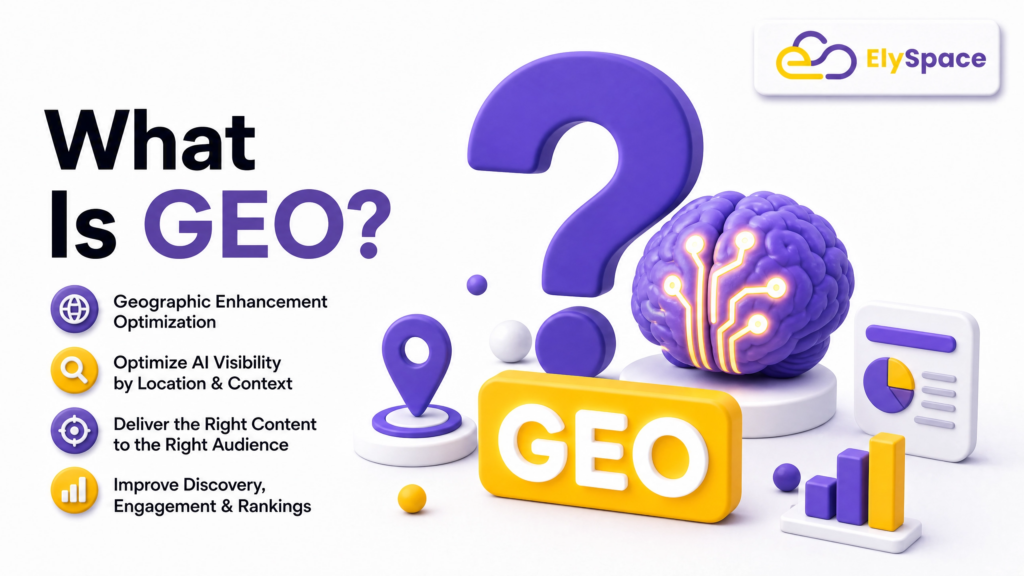
GEO stands for Generative Engine Optimization. In simple terms, it’s the practice of shaping your content so that AI systems like ChatGPT, Google AI Overviews, Perplexity, and Gemini can read it, trust it, and quote it inside their answers.
The term isn’t marketing hype. Six researchers led by Princeton University published the first academic paper defining GEO back in November 2023. Since then, it has grown from a niche experiment into a core part of how content teams plan their work. If you’re still building out your foundational SEO strategy, this is a good moment to start layering GEO on top of it rather than treating them as separate projects.
Here’s the mental shift that matters: traditional search sends people to your page. GEO gets your information used inside someone else’s answer, often without a click at all. The goal shifts from earning a click to having your information included in the AI’s response. That’s a fundamentally different game, and it needs a different strategy.
At Ely Space, we treat GEO as an extension of good content practice, not a replacement for it. You’re still writing for a human. You’re also just writing for the system that hands your words to that human.
Why You Need to Optimize a Website for AI Search Now
Some site owners still treat GEO as optional. The data says otherwise. 47% of B2B buyers now use AI for vendor research, and AI-referred visitors convert at 23 times higher rates than organic search. If your content isn’t visible to AI systems, you’re invisible to nearly half your potential audience before they ever reach your homepage.
The competitive landscape has also changed shape. Traditional SEO was about earning a spot among ten blue links, while GEO is about earning a place among the two to seven domains that large language models typically cite in a single response. Fewer spots, higher stakes, and a real first-mover advantage for brands that act early.
There’s also a growing gap between who ranks in Google and who gets cited by AI. Research from GEO firm Brandlight suggests the overlap between top Google links and AI-cited sources has dropped from 70% to below 20%. In other words, ranking well on Google no longer guarantees you’ll show up in an AI answer. These are becoming two separate games that happen to share some rules.
The upside is real, too. A Princeton study found that combining GEO techniques can improve AI visibility by 30 to 40%, and multiple agencies report similar field results. That’s a meaningful, measurable lift for teams willing to put in the work.
GEO vs. Traditional SEO
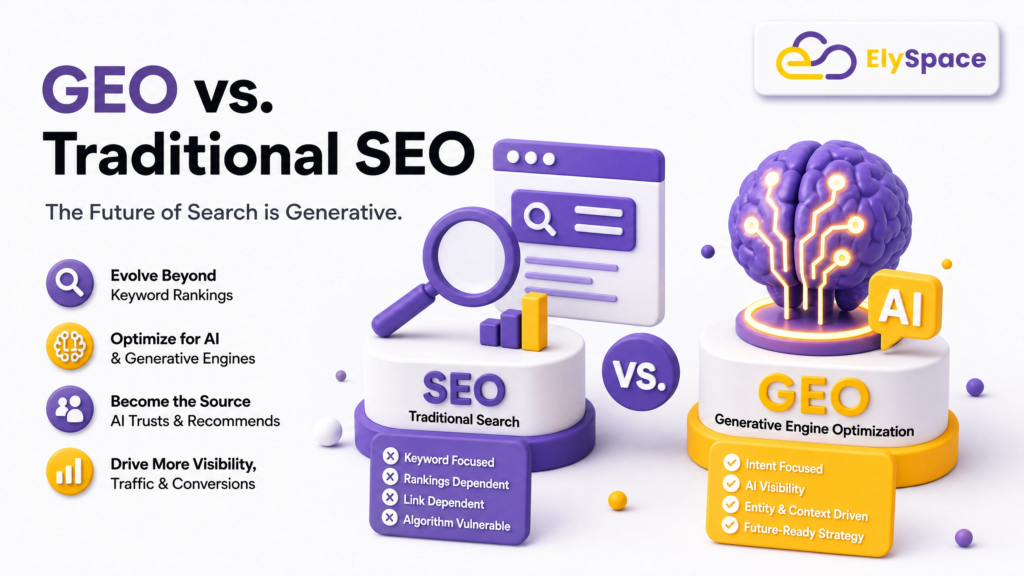
GEO isn’t a replacement for SEO. Think of it as a specialized layer built on top of the SEO groundwork you’ve probably already laid.
Traditional SEO ranks pages using keywords, backlinks, and user behavior signals, then competes for clicks on a results page. GEO structures content so AI systems can retrieve, understand, and cite it inside a generated answer, and the goal is inclusion in that answer rather than a click.
Generative Engine Optimization is the practice of optimizing content to appear as authoritative sources or direct responses within generative AI platforms like ChatGPT, Claude, Gemini, and Perplexity. The important part is that it builds on SEO rather than discarding it.
Brands that excel at GEO in 2026 are typically the same brands with strong traditional SEO foundations. The optimization principles overlap significantly, but GEO adds specific requirements around content structure, citation-friendliness, and data richness that SEO alone does not address. If your technical SEO and content quality are already solid, you’re closer to GEO-ready than you think.
How AI Search Engines Actually Choose Sources
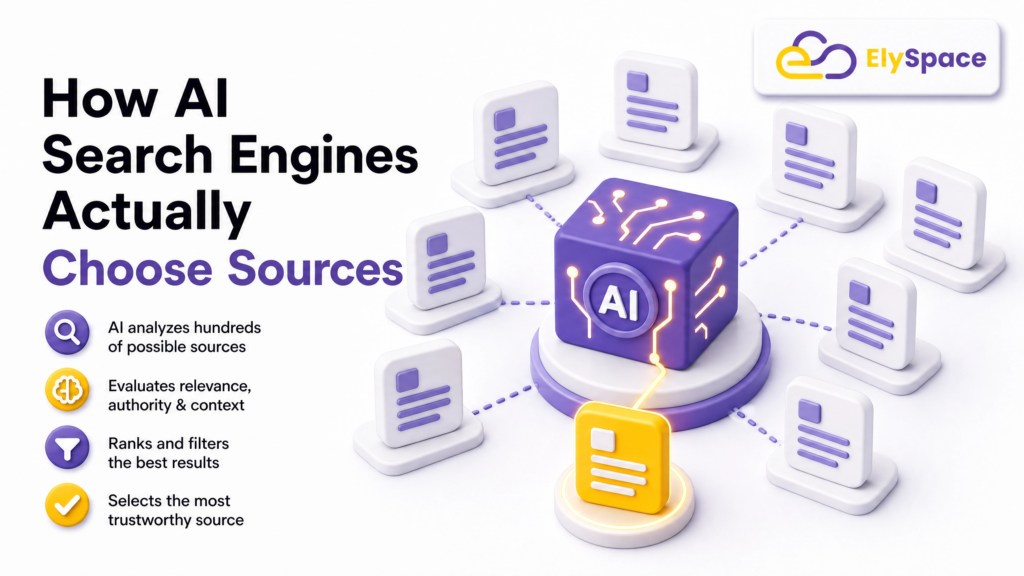
Before you can optimize a website for AI search, it helps to understand what happens the moment someone types a question into an AI tool.
Most AI search systems don’t process your query as one single search. The AI breaks the question into smaller sub-queries and searches for each one separately, a process known as query fan-out. If someone asks what the best VPN for streaming Netflix in Europe is, the AI might search “best VPN 2026,” “VPN Netflix streaming,” and “VPN Europe servers” as three separate queries.
This matters because it means your page needs to answer specific sub-questions clearly, not just the broad topic. A page that only nails the general theme but skips the granular details will lose out to a page that covers every angle.
Speed to the point matters too. AI systems that use real-time retrieval, including Perplexity and Google AI Overviews, evaluate a page’s relevance primarily on its opening content, and the first 200 words of any article should directly and completely answer the primary query rather than build up to the answer. If your intro rambles for three paragraphs before answering anything, you’re handing the citation to a competitor.
Step-by-Step: How to Optimize a Website for AI Search
Here’s the practical framework we use at Ely Space when a client asks how to optimize a website for AI search. Each step builds on the last, so work through them in order.
1. Make Sure AI Crawlers Can Actually Read Your Site
This sounds basic, but it trips up more sites than you’d expect. Many sites unintentionally block AI crawlers through their robots.txt file, and Cloudflare recently changed its default configuration to block AI bots automatically. If you’re on Cloudflare, check your bot settings before doing anything else.
Audit your robots.txt file for GPTBot, PerplexityBot, ClaudeBot, and Google-Extended. If any of these are disallowed and you want AI visibility, remove the block. No amount of great content matters if the crawler never reaches the page.
2. Answer the Question in the First 200 Words
Lead with the answer, not the build-up. State what the reader came for immediately, then use the rest of the article to add depth, nuance, and context. This single change often does more for AI citation than any other tactic on this list.
Structure each major section the same way. Ask the question as a heading, answer it plainly in the first sentence or two, then expand with specifics, examples, or data.
3. Structure Content for Extraction
AI systems favor content that’s easy to pull apart into standalone chunks. Use clear H2 and H3 headings that match real user questions. Use numbered steps for processes, bullet points for lists, and short tables for comparisons.
Avoid dense walls of text. Keep paragraphs short, ideally no more than five or six lines, so that any single chunk can be lifted out and still make sense on its own.
4. Add Real Data, Original Insight, and Expert Quotes
Proven strategies for AI synthesis include citing sources, adding statistics, including expert quotes, and structuring content specifically for synthesis. Generic advice that repeats what’s already on page one of Google won’t earn a citation, because the AI already has ten other sources saying the same thing.
Original research, case studies, first-hand results, or a genuinely new angle on a familiar topic are what separate a cited source from an ignored one. If you’ve run a test, tracked a result, or solved a real problem, that experience is your competitive edge.
5. Build Author Authority and E-E-A-T Signals
The E-E-A-T framework developed by Google consists of the following elements: Experience, Expertise, Authoritativeness, and Trustworthiness. These elements directly affect the possibility of AI systems citing your content. According to Google’s guidelines on how to make content useful for readers, the quality of the content is assessed according to “who, how, and why,” as opposed to being given a set number. The credibility of the content is based on its ability to provide first-hand experiences with clear, specific details, reliable outcomes, and fully displayed information about the author.
You need to have a real author biography showing all author qualifications, with a photo included and the author’s link to their professional profile. The sites that added structured author pages that vividly demonstrate author qualifications and affiliations witnessed quick changes in their ranking only a few weeks after the core update that took place in March 2026. Anonymous content has become obsolete today.
6. Use Structured Data and Schema Markup
The schema markup assists the artificial intelligence systems in understanding the structured data on your webpage content. To take advantage of schema markup, make sure you add Article, FAQ, HowTo, and Organization schema to your content where relevant to ensure that both conventional search engines and AI-based search engines understand your content appropriately. Our guide on technical SEO discusses schema implementation in much detail.
Although the visual FAQ rich snippets disappeared from the Google search results as early as May 2020, using the FAQPage schema helps Google to grasp a better idea about your content, as the pages featuring it are much more likely to appear in AI Overviews.
7. Keep Content Fresh
When AI systems choose sources, they consider how old the material is: for example, an article that has not undergone any revisions will eventually be sidelined when compared to more current publications dealing with similar topics. Therefore, it is a good idea to introduce quarterly checks on your most important pages.
Update numbers and dates, make sure that the date of the last update is visible, and delete any information that is no longer accurate. Out-of-date information is an issue of credibility as well as correctness.
8. Build Internal and Outbound Links That Add Value
Link internally to related guides on your own site so both users and AI systems can trace your topical depth. For example, if you’re reading this, you might also want our guide on content strategy fundamentals or our breakdown of technical SEO basics.
Outbound links to primary sources, like the original GEO research paper from Princeton, Georgia Tech, and IIT Delhi, signal that your content is well-researched rather than self-referential. Both link types improve user experience and reinforce trustworthiness.
9. Cover the Topic Comprehensively, Not Just the Keyword
Sites that publish comprehensively within a single subject area, covering every angle, every sub-topic, and multiple content formats, outperformed broad sites that touched many topics at shallow depth. Don’t just answer “what is GEO.” Answer how it works, how to measure it, what mistakes to avoid, and how it compares to SEO, all in the same piece or a connected content cluster.
Common GEO Mistakes to Avoid
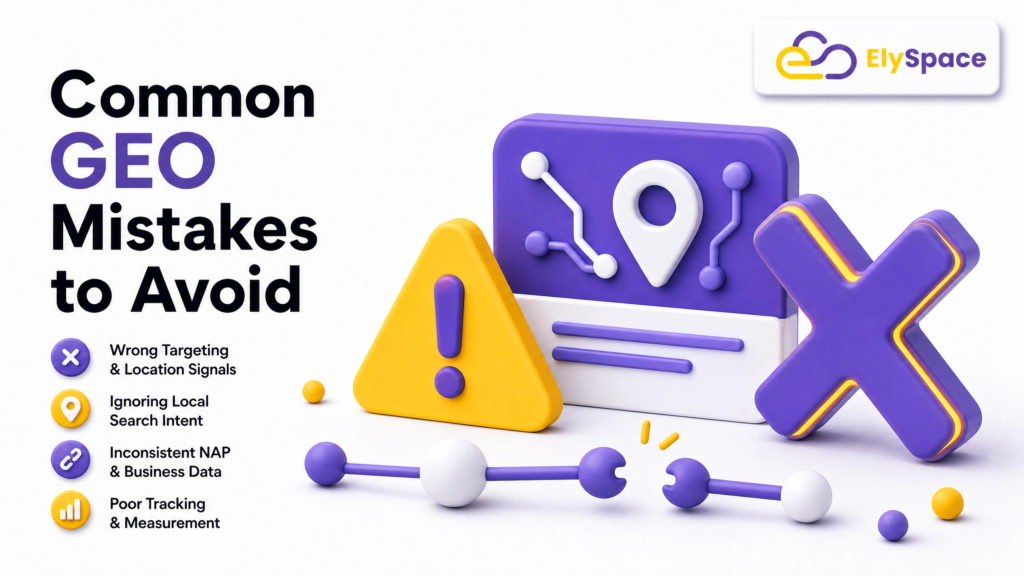
Even well-intentioned teams stumble on the same handful of issues. Watch for these:
- Blocking AI crawlers by accident, often through a default CDN or plugin setting nobody reviewed.
- Burying the answer under long introductions instead of leading with it.
- Publishing generic, unoriginal advice that adds nothing beyond what’s already ranking.
- Skipping author bios, which leaves your content looking anonymous and unverifiable.
- Treating GEO as a one-time project. Plan for a three- to six-month timeline with ongoing optimization rather than expecting overnight results.
- Keyword stuffing. Repeating a phrase unnaturally doesn’t help AI citation or Google rankings; it does the opposite, since both systems are built to detect and demote manipulative writing.
How to Measure GEO Results

GEO doesn’t reward you with a familiar keyword ranking, so measurement looks a little different.
Track brand mentions and citations directly inside ChatGPT, Perplexity, and Google AI Overviews by running your target queries manually on a regular schedule. Some teams call this a “Share of Model” audit, since it tracks how often your brand shows up relative to competitors across the same set of prompts.
Watch your GA4 referral data for traffic tagged from chat.openai.com, perplexity.ai, and similar AI domains. It’s a smaller number than organic search traffic today, but AI-referred visitors convert at meaningfully higher rates, so even modest volume can carry outsized business value.
Final Thoughts
Learning how to optimize a website for AI search isn’t about chasing a new algorithm trick. It’s about doing the fundamentals so well that both a human reader and an AI system trust what you’ve written. Answer the question clearly, back it with real evidence, credit a real expert, and keep it current.
GEO rewards the same thing good content has always rewarded: clarity, honesty, and genuine expertise. Get those right, and the citations follow.
If you’d like help building a GEO strategy for your own site, the ElySpace content team can walk you through a full audit and roadmap tailored to your niche.