 Live Chat
 Contact
 Shopping Cart
 Rashid Malla
Recently, on LinkedIn or YouTube, you might have noticed many articles with the phrase “AI will take over every job by next year.” However, when you returned to work the following week, nothing different had happened regarding technology. Your company still had the same spreadsheets, CRM system, and possibly one chatbot that had gotten forgotten by most workers in your office.
This blog is all about the gap between AI hype and the actual usage of AI in their day-to-day work. At ElySpace, we develop websites as well as handle the backend of various companies located within the Srinagar and Jammu & Kashmir area; therefore, we have sometimes seen this lack of connection firsthand. Clients will come to us asking to “add AI” onto their website or web server, not knowing really what this actually means, whilst there are others simply automating a current workflow without saying anything about it. In this post, we will look at the differences between the amount of interest in Artificial Intelligence for implementation versus the number of people implementing Artificial Intelligence today, as well as explain what real-world implementation is for Artificial Intelligence at present, using verified research data statistics.
Why “AI Hype vs Reality 2026” Is a Real Conversation in 2026

AI has been prevalent in the world of conversation since the inception of ChatGPT, yet the discussions have become somewhat divisive in the years between 2003 and 2006, with one group claiming “AI is already managing the world,” while the other group insists that “AI has been exaggerated, there is virtually nothing that can be accomplished by using AI with anything other than creating e-mail messages.” Both groups are incorrect.
The data will provide the answer; however, the data supports a more balanced and honest position than either of the two groups would like to agree to. The “big corporates” are in the process of truly rolling out Artificial Intelligence as an operational component of their organisation within certain divisions, while smaller businesses are using AI only as a trial and rarely as part of their primary operations. There is also a significant amount of the so-called AI roll-out to be viewed as simply employees from these larger organisations providing their own free chatbot services on a personal basis, without any aspect of a strategic implementation by the respective organisation. Understanding this differential point will assist you in demonstrating a sound understanding in either managing a small web hosting operation in Srinagar or running a larger, nationally oriented brand.
AI Adoption Statistics 2026: What the Data Actually Shows
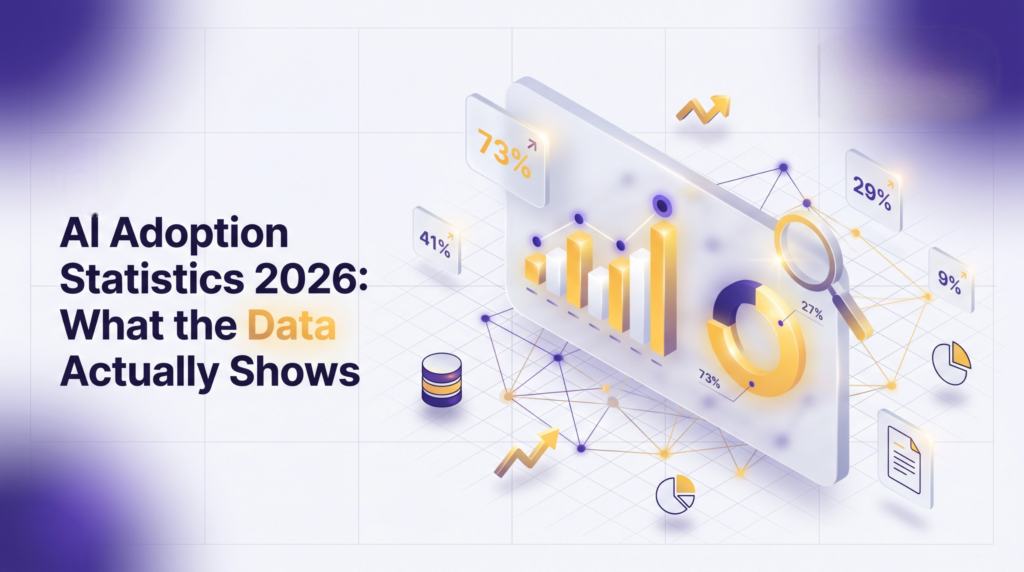
Numbers help cut through the noise, so let’s look at where things actually stand this year.
Global adoption is rising, but slower than the headlines suggest. According to Microsoft’s Global AI Diffusion Report, the percentage of working-age people globally using AI increased from 16.3% to 17.8% in the first quarter of 2026. This represents real growth, but it also shows that 80% of working-age individuals worldwide do not use generative AI frequently. In terms of countries with higher percentages of generative AI adoption among working-age populations, the UAE comes in first on Microsoft’s leaderboard at 70.1%, while the US has only 28.3% of its working-age population using generative AI, according to the Stanford AI Index Report.
Business adoption depends heavily on how you measure it. Confusion arises over the proportion of businesses that have adopted AI technology into their operations. Self-reported executive surveys indicate that organizations are using AI to a much larger degree than government statistics would indicate. For example, Stanford’s HAI shows that 78% of organizations utilized AI in 2024 as compared to just 55% in 2023, while Eurostat reported only 19.95% of EU businesses adopted AI technologies and the OECD found 20.2% of firms to have adopted it in 2025, versus just 8.7% in 2023.
So which is correct? Depending on which report you reference, businesses have either adopted AI technology at an adoption rate of “everyone” or “one out of every five.” The overall numbers reflect both statements as valid; however, they were measuring different items. For example, one survey only counted one employee using ChatGPT once, but another measured the number of procedures created around them using that same technology.
ROI is not guaranteed just because a company adopts AI. This is the most neglected statistic by all hype writers. pwC’s Global CEO Survey conducted in January 2026 showed that 56% of all CEOs had zero measurable ROI on AI over a 12-month span, even after deploying some amount of it. In addition to this, Gartner estimates that 60% of organizations will abandon their AI projects if their project does not have AI-capable data available to support it. When organizations adopt an AI technology but do not have a well-defined plan for leveraging it, that organization is one of the main culprits for the AI project’s silent demise.
Trust is dropping even as usage rises. According to a report from 2026, the number of developers who trust the output from AI-based coding has dropped from 40% in 2024 to just 29% today. More developers are using AI tools but have less confidence in the results, indicating that while use of the tools is increasing, their overall confidence has decreased.
The real barrier isn’t the technology; it’s the skills gap. The same problem has been observed in nearly all reports generated over the last year: EU companies report being held back from adopting AI due to insufficient knowledge about it (70.9%). Additionally, the percentage of companies that are unable to adopt AI because of a shortage of qualified personnel to use AI tools has remained steady. The primary obstacle for businesses in adopting AI is not a shortage of AI tools but rather a lack of qualified personnel to utilize those tools effectively.
Where the Hype Comes From
Hype is never spontaneous; rather, hype always originates from a small number of sources, and as soon as you’re able to identify these sources, diminishing the volume of hype quickly becomes plausible.
The marketing materials produced by AI vendors are primarily aimed at persuading you to subscribe; therefore, it is highly unlikely that these materials will help you receive a balanced view of all the solutions currently available to you. Almost every vendor claims their product will be a “game-changer” for your business; this is most likely because this is what their selling pitch has described. Social media promotes the “extremes” because clicks and views come from bold claims and the recognition that they do not lend themselves well enough to gaining the attention of the masses; therefore, there will be very little trending with nuance. Executive surveys frequently reflect exaggerated numbers due to the pressure executives feel to state that they are “doing AI” when, in reality, the only way they are using or testing AI within their organisation is by having a couple of employees quietly test a small number of AI tools.
This is not to say that AI isn’t real or helpful; it simply indicates that the noisiest claims being made about AI by organisations have an underlying motivation to persuade you of how much larger AI is than what we presently know it to be.
Where Real-World AI Adoption Is Actually Happening
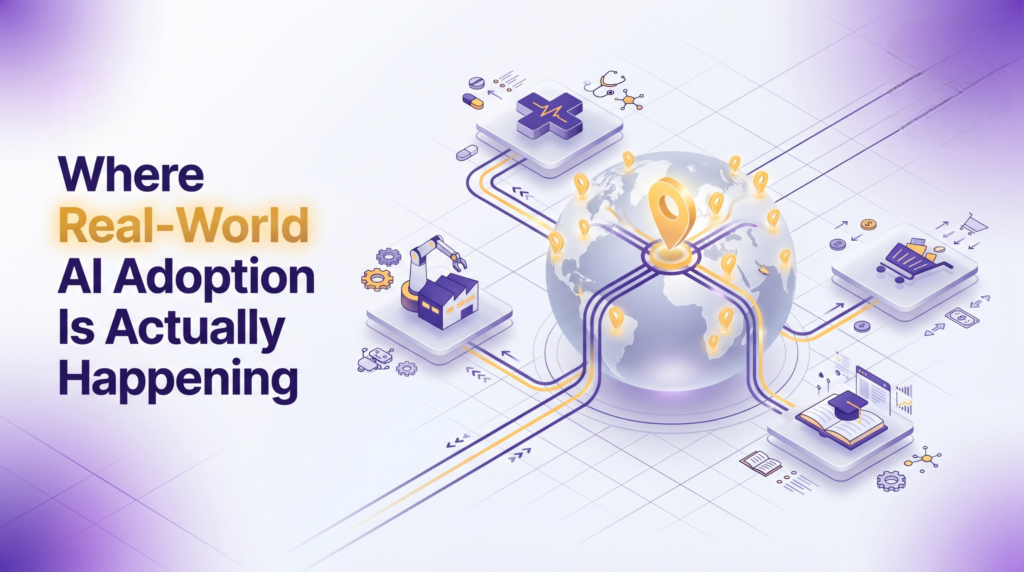
If you strip out the noise, you will find there are indeed specific locations where AI is being adopted and making a difference, not just generating headlines. One of the best examples of this can be found in the areas of coding and software development. AI-driven tools for developers have gone from being a new thing to something developers use every day, and the job numbers reflect that as well. According to Microsoft, the number of software developers in the U.S. will increase to about 2.2 million by 2025, an 8.5% increase from 2024. This shows that AI is changing developers’ work experience, but it is not eliminating the role of software developers.
In the area of marketing content, we’ve almost reached a point of saturation. According to the Salesforce State of Marketing Report 2026, 87% of marketers use generative AI in some part of their workflow. ElySpace sees the same phenomenon across the board. Companies are more willing to allow AI to create captions or outlines for blogs than to have it make direct customer-facing decisions.
The speed of growth in the healthcare sector is unprecedented. According to research conducted in 2025, 80% of healthcare practitioners agree that AI has produced revenue increases for their companies. Furthermore, cite the fact that the number of domain-specific AI tools adopted in the US increased over seven times between 2024 and 2025, and AI is being used to solve particular and measurable issues such as D2 (diagnostic assistance) and reducing the burden on administrative departments rather than making ambiguous claims about improving productivity rates.
The area that has benefited most from AI has been customer service. For example, in the telecommunications industry, approximately 65% of initial customer inquiries are now handled by virtual assistants managed by leading telecom companies, marking a real change in operations for this industry as opposed to being the result of hype.
Agentic AI (also known as autonomous or self-directed AI) is mainly at the enterprise level currently; enterprises account for approximately 25% of total agentic AI use as a result of their financial and technical capabilities, whereas smaller firms are only beginning to consider employing readily available solutions to support their operations.
The Biggest Gap: Adoption vs Measurable Return
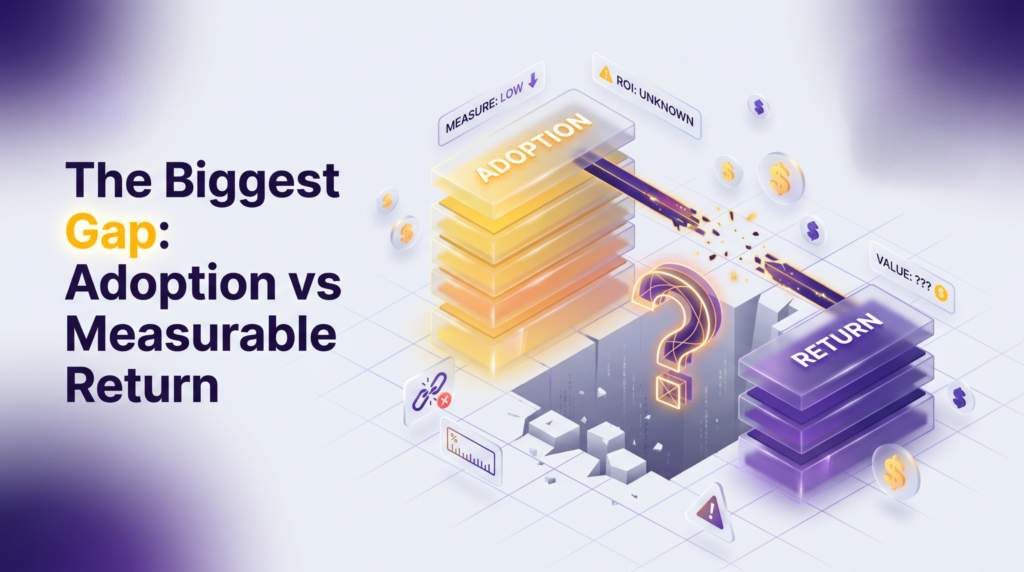
The most important thing for you to understand about AI in 2026 is the distinction between using and deriving value from AI. The confusion between hype and reality surrounding AI is largely due to an inability to differentiate between these two concepts.
For instance, an organization can technically “adopt AI” simply by providing employees with ChatGPT access, which is usually sufficient for survey responses indicating AI adoption, but that does not mean that the organization redesigned its work processes so that it actually saves time and/or money due to AI. This is why 56% of CEO’s report measuring zero ROI after implementing AI; however, other organizations reported a 3.7x return on their investment in generative AI. The key factors differentiating these sets of organizations are clearly defined use-case, clean data, and a properly trained team to properly implement the tool.
What This Means for Small Businesses in Kashmir
For local businesses in Jammu & Kashmir and particularly in Srinagar, these figures are encouraging news. You don’t need to compete with the massive AI budgets of Silicon Valley before you can see measurable benefits of real-world AI implementations. What you do need to do is be deliberate and intentional about how you deploy AI.
An example of how a local business could employ AI would be for an AI agent send out an email query for product price evaluations from suppliers, but rather an example of practical win (ways in which AI would assist) would be for the AI to assist through web site functions (customer support, etc.) outside of regular business hours, automatically respond to email messages associated with frequently asked questions, and/or help first time users of a website navigate your company and available services. These types of small wins match the accumulated data on successful use cases, showing that narrow and distinct use cases are more likely to lead to success than the collectivity of a never-defined “let’s just use AI for everything” approach.
One example of how we build and/or manage websites for clients at Elyspace is by focusing on where a small, yet highly impactful AI will actually create time savings; to us, then, deploying AI is more about checking the box as a service being provided to clients, but rather, to us, utilising AI technology is about building more than an immediate success.
How to Tell Hype From Reality Before You Invest

As you evaluate an AI tool, take a moment to think about the following:
– Does it provide a solution to one specific problem (A measurable problem) rather than just giving vague promises (e.g., to “increase productivity”)?
– Can evidence such as real numbers be provided instead of just anecdotal evidence?
– Does your team have the requisite skills to use the tool (the data clearly shows that gaps in skills, not gaps in technology, are the main obstacles)?
– Finally, take a phased approach. Before implementing the tool throughout the company, use it on a single workflow to determine if there are improvements in productivity and how long it takes for your company to see an actual return on investment compared to other companies that took their time to roll out new tools.
If the tool or trend fails one or more of the above tests, then it likely falls under hype rather than reality for now.
Final Thoughts
AI’s future impact has been exaggerated by social media; instead of miracles or myths, there is an overall trend of slow, inconsistent adoption across three primary industries: healthcare, customer service, and marketing (which includes coding). While many industries beat the competition based on performance, many lag behind because of a lack of established ROI(s) and enterprise-wide implementation.
At ElySpace, we follow the same principles of developing sustainable solutions for our clients throughout Kashmir: We focus on fulfilling the unique business needs of each client by designing, developing, deploying, and supporting website solutions based on problems that will generate tangible value for the client/customer regardless of current technology trends.
Our team has experience working with hundreds of business owners to evaluate their current needs versus market trends and help them create websites that will help them meet their objectives. If you’re looking to evaluate how AI relates to your existing online presence or discuss AI within your current company, our team can assist you.