 Live Chat
 Contact
 Shopping Cart
 Shahid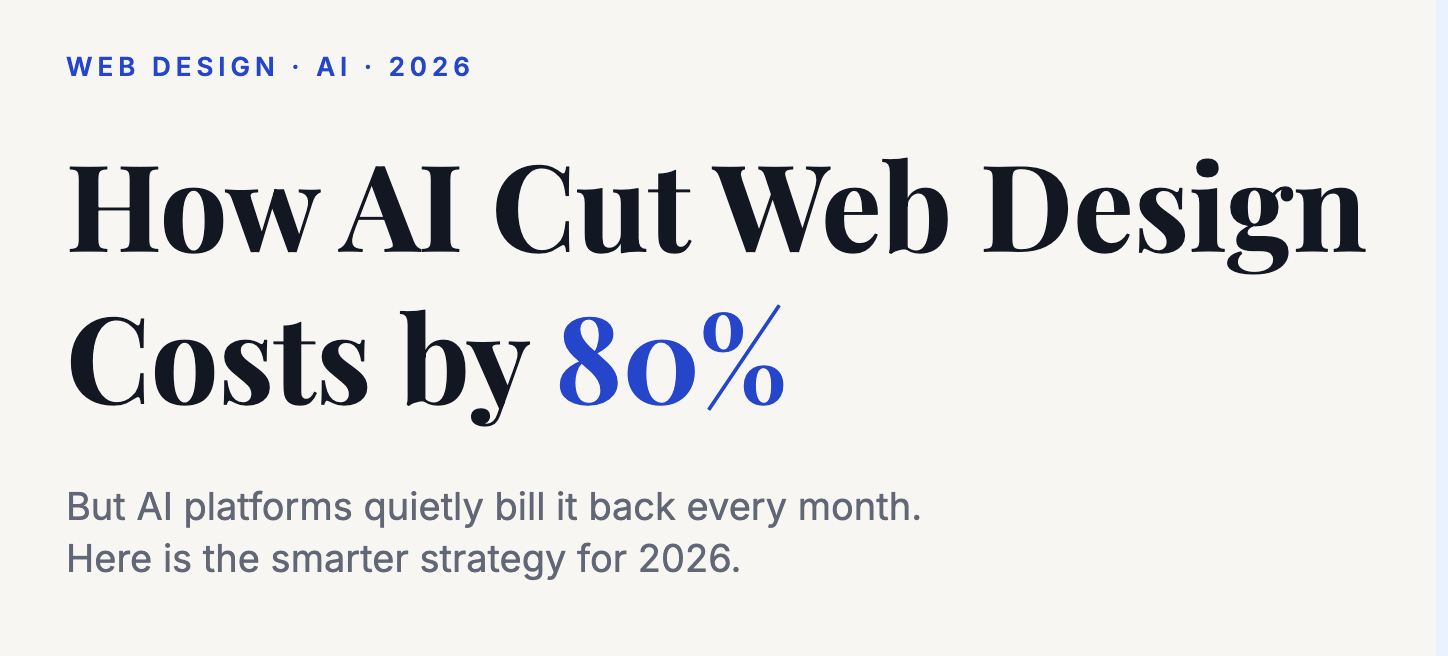
The AI web design cost for a small business website has collapsed in the last two years. Sites that used to take weeks and cost thousands are now shipping in days for a fraction of the price. Developers using AI assistants are delivering work at speeds that would have seemed impossible two years ago.
And yet — we keep talking to website owners whose monthly bills haven’t dropped. In many cases, they’ve gone up. This article is a closer look at why, and what to do about it.
In short : AI tools have genuinely slashed the cost of building a website. But a wave of “AI-powered” hosting platforms are quietly rebuilding the bill on the other side, charging $20–$200/month for a site that should cost $2–$10/month to host. Build with AI. Own the output. Host it like a normal website.
Something interesting is happening across the small business web. Sites that used to take weeks and cost thousands are now shipping in days for a fraction of the price. Developers using AI assistants are delivering work at speeds that would have seemed impossible two years ago.
And yet we keep talking to website owners whose monthly bills haven’t dropped. In many cases, they’ve gone up.
This article is a closer look at why, and what to do about it.
The 80% Revolution is Real
Let’s be honest about the numbers.
A typical small business website — five pages, contact form, basic SEO, mobile-responsive layout — used to take a freelancer 20 to 40 hours of work. At a healthy freelance rate, that’s $800 to $1,600 in labor. Agencies routinely charged $3,000 to $8,000 for the same scope.
With AI-assisted development, the breakdown today looks more like this:
- Component scaffolding 30 minutes instead of 6 hours
- Copywriting drafts 20 minutes instead of 4 hours
- Image placeholders and graphics 10 minutes instead of $200 in stock photos
- Basic SEO meta and schema 15 minutes instead of 2 hours
- Bug hunting and refactor roughly half the time it used to take
A site that took 30 hours now takes 6. Across the industry, that’s roughly 80% off the labor side of building a website. The savings are real and they’re not going away.
So Why Are Customers Paying More?
Here’s the trap that’s catching people right now.
The same ecosystem selling AI tools that reduced your build cost is also selling you the hosting that quietly steals that saving back. Look at the current pricing landscape:
| Platform type | Typical monthly cost |
|---|---|
| AI website builder (hosted) | $19–$49/month |
| AI app platforms with bundled hosting | $20–$100/month |
| Traditional shared hosting (cPanel) | $2–$10/month |
| Standard VPS | $5–$15/month |
A small business website doesn’t need a $40/month “AI-powered” hosting plan. It needs a stable web server, an SSL certificate (free with Let’s Encrypt), decent uptime, email, and backups. That’s the whole list. Nothing about hosting changed because the site was built with AI.
You used AI to write the code. You don’t need AI to serve the bytes.
Those are different problems. They should be priced like different problems.
The Math That Should Make You Pause
Run a three-year cost comparison on a brochure website for a small business.
Scenario A — AI builder + AI host (the trap)
- Build cost: bundled into subscription
- Hosting: $29/month × 36 months = $1,044
- Lock-in: difficult to migrate
- In many cases, the customer doesn’t own the source code
Scenario B — Developer using AI + normal hosting (the smart stack)
- One-time build by a developer who uses AI properly: $300–$600
- Hosting: $5/month × 36 months = $180
- Full ownership of code, database, and domain
- Three-year total: $480–$780
The difference is $300–$600 saved over three years per site — and full ownership of everything. Scale that across a portfolio of sites or a small agency’s client base and the gap gets serious fast.
“I’ll Just Build It Myself With AI”
This is where things get nuanced. Yes, non-developers really can ship a passable landing page with AI today. We’ve seen it.
But there’s a meaningful gap between a page that loads and a website that holds up in production. From the hosting side, we see what breaks:
- Security defaults. AI happily generates code with exposed API keys, missing CSRF protection, no rate limiting, and
.envfiles in public directories. We clean up the fallout from this almost weekly. - Performance under traffic. AI tends to write code that works. It rarely writes code that scales. Image optimization, query caching, asset bundling — these get skipped.
- SEO that actually ranks. Generating meta tags is easy. Building site architecture that Google rewards is not.
- The 20% that breaks everything. Forms that don’t validate. Emails landing in spam. SSL renewals quietly failing. Backup strategies nobody tested.
- Maintenance. A site isn’t a product, it’s a relationship. PHP versions deprecate. Plugins update. Hosting policies change.
As one developer in our partner network, Shahid Malla — a Top Rated WHMCS developer who’s shipped 900+ projects on Fiverr and Upwork — put it to us recently:
“AI is a power tool, not a replacement for the person holding it. I use AI on almost every project now, and it saves my clients a lot of money. But the parts that decide whether a site survives — security, scale, the boring stuff — still need someone who’s been burned a few times.”
That matches what we see on our servers every day.
The Sweet Spot: Developer + AI + Standard Hosting
This is where the savings actually land in the customer’s pocket.
Tell your developer explicitly — to use AI. Don’t pretend it’s still 2019. Don’t pay 2019 rates either. A skilled developer using AI properly delivers production-grade work in a fraction of the old timeline.
A reasonable arrangement looks like this:
- Build cost 50–70% lower than pre-AI rates, because the work is genuinely faster
- Quality higher, because AI handles boilerplate while the developer focuses on architecture, security, and the parts that break
- Hosting standard shared hosting at $2–$10/month, or a VPS if there’s real scale
- Ownership 100% yours: code, database, domain, email
- Portability change providers anytime
That last point matters more than people realize. The platforms charging $40/month for AI hosting know exactly what they’re doing they’re betting customers won’t leave. Migration friction is the moat.
A Checklist Before You Pay for Anything
Before signing up for any “build and host” AI platform, ask:
- [ ] Can I export the full source code anytime?
- [ ] Can I take my database with me?
- [ ] Is my domain registered in my name?
- [ ] What happens to my site if I cancel?
- [ ] How much does it cost to host this same site elsewhere?
- [ ] Am I paying for “AI features” I’ll never use?
- [ ] Does the subscription quietly increase after year one?
If you can’t get clean answers, you’re not buying a website. You’re renting one.
Where AI Hosting Genuinely Makes Sense
To be fair, AI-bundled hosting isn’t a scam across the board. It makes sense in specific cases:
- Dynamic AI features your site actually uses — chatbots, real-time generation, embeddings search. You’ll legitimately pay for those API calls.
- Solo founders with zero plans to hire anyone. The convenience may be worth it.
- Short-lived projects, MVPs, validation tests. Pay the premium for speed, kill it later.
For everything else — brochure sites, business sites, portfolios, blogs, small e-commerce, SaaS marketing pages — there’s no honest reason to pay $30/month when $5/month does the same job better.
The Action Plan
- Hire a developer who openly uses AI. Not someone hiding it. Not someone refusing it. The middle path.
- Negotiate based on the AI-era timeline, not 2019 rates. You should see real savings.
- Demand source code, database access, and full ownership. No exceptions.
- Host on a standard provider — cPanel shared hosting, a small VPS, or any managed platform with predictable pricing.
- Pay for AI API calls only when your site genuinely uses AI features. Not as a hosting tax.
- Set up backups. Even $3 plans usually offer this. Use it.
- Review your stack yearly. Prices shift. Better providers emerge. Don’t get comfortable.
One Sentence to Remember
Use AI to build cheaper. Don’t let AI host you back into the same bill you were trying to escape.
If this saved you even one month of an overpriced “AI website” subscription, pass it on to someone about to sign up for one. That’s the whole point.
Need a developer who works this way?
The approach in this article AI-assisted development, full ownership, standard hosting — isn’t theoretical. It’s how good freelance developers operate now.