 Live Chat
 Contact
 Shopping Cart
 Mehran Majeed
The digital skills vs degrees question has been asked more times in the last three years than the previous decade combined and for good reason.
There are people right now no degree, no MBA, no fancy university on their LinkedIn earning more than doctors. Not because the system is broken. Because the system changed, and they noticed before most people did.
That said, there are also people right now with impressive portfolios and zero formal education who are getting passed over for roles they’re genuinely more qualified for because the company they applied to still cares about credentials. Both things are true at the same time.
The “degrees are dead” crowd oversimplifies it. So does the “a degree is always worth it” camp. The real picture is messier, more industry-specific, and honestly more interesting.
Whether you are a student, a career-switcher, or a professional wondering whether to upskill or go back to school, the digital skills vs degrees question matters more now than it ever has. This piece is going to walk through what’s actually happening in the digital skills vs degrees debate right now: why digital skills have started carrying so much weight, where degrees still genuinely matter, and what a smart person does when they’re trying to build a career that holds up for years to come.
What We Actually Mean by “Digital Skills”
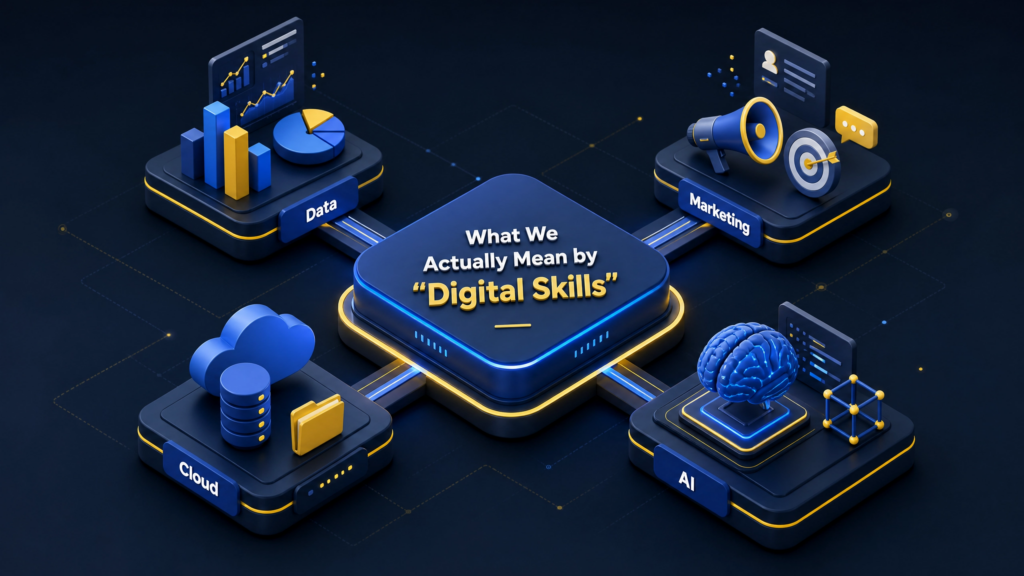
Before getting into the digital skills vs degrees debate properly, it’s worth being specific because “digital skills” gets thrown around loosely.
To have a proper digital skills vs degrees discussion, you first need to know what digital skills actually are. At the basic end, it means things like knowing your way around spreadsheets, using project management tools, or writing a professional email that doesn’t make the recipient wince. Most working professionals have some version of this.
The skills that are actually changing hiring conversations sit a level or two above that:
- Running paid ad campaigns and knowing how to read the data behind them
- SEO not just “using keywords” but understanding how search actually works
- Web development, whether that’s full-stack or just enough front-end to be dangerous
- Data analysis and the ability to turn numbers into decisions
- UX and product design
- Video production scripting, filming, editing, the whole chain
- AI tool integration knowing which tools exist, when to use them, and how to get consistent output from them
- Cybersecurity fundamentals
- Cloud infrastructure (AWS, Azure, Google Cloud)
What makes them central to the digital skills vs degrees conversation is that they produce something measurable. A business can look at the output of someone with these skills and put a number on it traffic, revenue, conversion rate, time saved. That directness is a big part of why employers have started treating them differently from a generalist qualification. If you want to explore which of these are most worth pursuing, our guide on the top digital skills to learn this year breaks it down by industry and earning potential.
Why Digital Skills vs Degrees Is a Debate Worth Taking Seriously
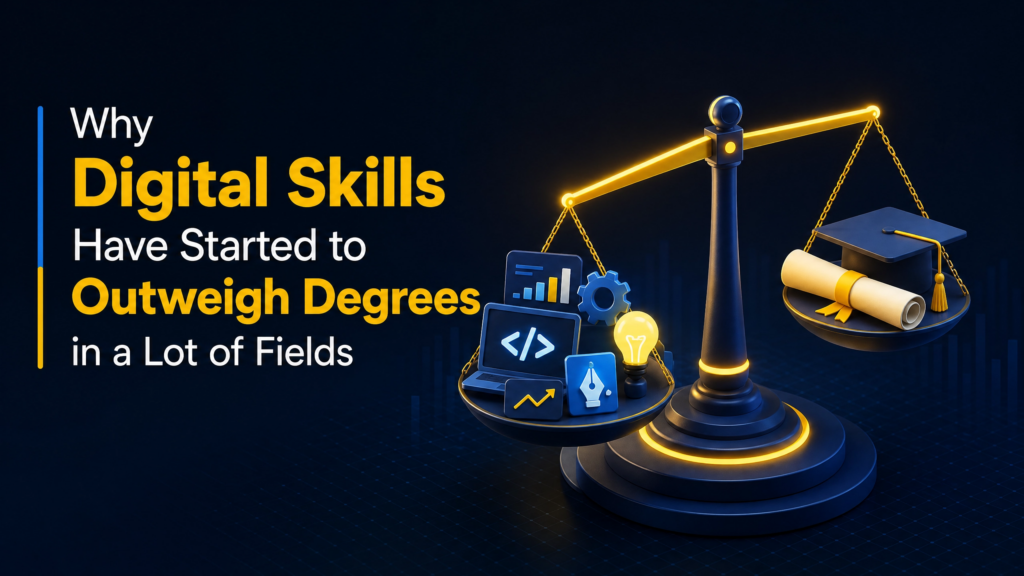
University moves slowly. Industries don’t wait for it.
One of the central arguments in the digital skills vs degrees conversation is speed. A degree programme typically takes two to four years to design, get approved, and start teaching. Then students spend three years going through it. By the time someone graduates from a digital marketing or software development programme, significant chunks of what they learned may already be outdated.
This is not an attack on universities it is simply a structural reality that shapes the digital skills vs degrees conversation in very practical ways. Academic institutions are built for depth and rigour, not speed. The problem is that some industries now move faster than the academic calendar allows for.
Digital marketers who learned primarily on Facebook Ads in 2019 had to completely relearn their approach when the platform changed. SEOs who optimised purely around keyword density were made irrelevant by algorithm updates years ago. AI changed content production in about eighteen months.
This is one of the strongest arguments on the digital skills vs degrees scale. People who learn through doing through online courses, real projects, and constant experimentation can adapt to those shifts quickly. Someone sitting in a three-year programme often can’t.
Employers increasingly care what you’ve built, not where you studied
This is the part that has actually shifted employer behaviour most.
Look at how hiring actually works: when a company hires a web developer, they typically ask to see a GitHub profile or portfolio before they ask about qualifications. The digital skills vs degrees dynamic plays out in real time at the application stage. When they hire a graphic designer, they look at a portfolio before they look at a CV. When they hire a content strategist, they read the content that person has published.
This isn’t unique to startups. IBM removed degree requirements from around half its US job listings years ago. Apple, Google, and Tesla have all done similar things in various departments. These companies didn’t do this to be progressive they did it because they found that skills-based hiring produced better employees.
The World Economic Forum’s Future of Jobs Report flagged that over half of employers surveyed were planning to prioritise skills assessments over educational credentials in their hiring processes. That’s not a fringe position anymore.
For the person being hired, the implication is straightforward: your portfolio is now often your most important document. Not your degree certificate. In the digital skills vs degrees debate, this shift in employer behaviour is the single biggest change of the last decade.
Remote work globalised the competition for roles
This one gets underappreciated. When hiring went remote, it didn’t just give people more flexibility it fundamentally changed who companies could compare you against.
A digital marketing role that previously attracted applicants from one city now attracts applications from dozens of countries. In that environment, local university prestige means less. What matters is whether your work stands up against a global field.
Someone with strong demonstrable skills and a well-documented track record can compete in that environment regardless of geography or academic background. Remote work made the digital skills vs degrees question global rather than local. Someone relying purely on a credential that is respected locally but unknown internationally faces a much harder challenge.
AI changed what “valuable” looks like
Automation has been eliminating certain types of work for decades. But recent AI tools accelerated that process dramatically and in unexpected directions affecting not just manual work but knowledge work.
The tasks that remain valuable are ones that require judgment, creativity, adaptability, and the ability to work with technology rather than be replaced by it. Someone who knows how to use AI tools to increase their output a writer who uses them to research and structure faster, a developer who uses coding assistants to ship quicker, a designer who uses generative tools to iterate faster is more valuable than someone who doesn’t, regardless of their educational background.
When you factor in AI, the digital skills vs degrees scales tip even further toward practical ability. AI literacy is increasingly a baseline expectation in digital roles. Understanding which tools exist, how to prompt them effectively, and where they fail is now a skill in itself.
Digital Skills vs Degrees: Are Degrees Still Important?
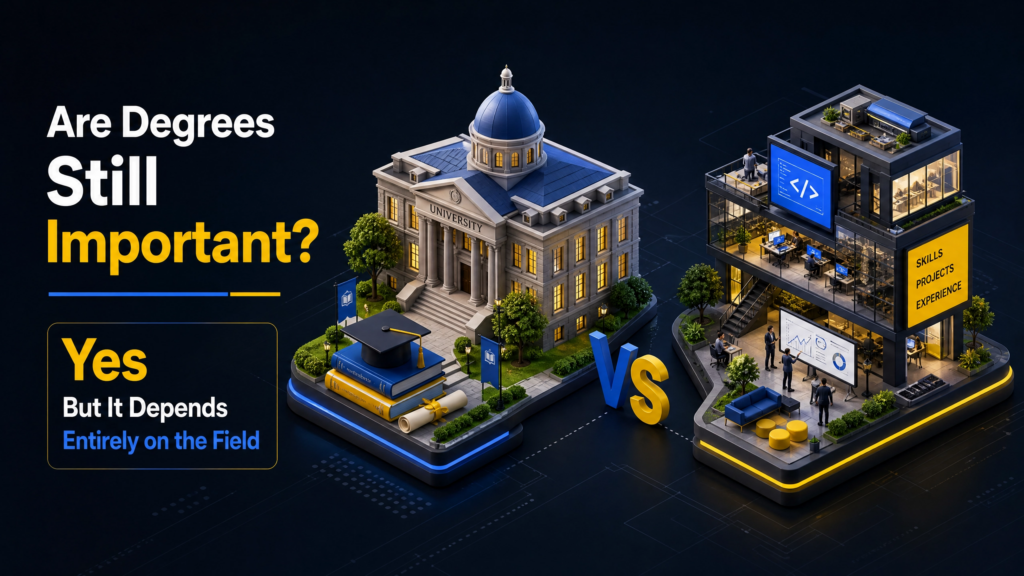
Here’s where a lot of takes on the digital skills vs degrees discussion go wrong: they generalise. People hear “skills beat degrees” and apply it everywhere. Or they hear “degrees still matter” and assume that settles it. Neither is right.
Some professions have no legitimate alternative to a formal degree. Medicine, law, structural engineering, architecture, pharmacy these fields exist the way they do because the cost of getting it wrong is severe, and formal education plus licensing exists to create a reliable floor of competence. No amount of self-teaching replaces that, and nobody reasonable is arguing otherwise.
Beyond regulated professions and this is the nuanced side of the digital skills vs degrees discussion degrees still offer real advantages that aren’t always obvious:
Structured thinking. A good degree especially in disciplines like philosophy, economics, or mathematics trains people to reason carefully, argue clearly, and spot flawed logic. That’s valuable in almost any senior role, even if the degree itself isn’t directly relevant.
Network. Uncomfortable but true: who you met at university still opens doors in finance, consulting, law, and traditional corporate environments. That network effect is real and hard to replicate through online learning alone.
Credibility in conservative industries. Banking, consulting, public sector, academia these sectors still use degrees as a serious filter. Fighting that from the outside is possible but difficult.
Baseline signal. For some employers, a degree simply demonstrates that you can commit to something for several years and finish it. It’s a low bar, but it’s a signal.
The honest summary in any digital skills vs degrees comparison: a degree alone is rarely enough anymore. But a degree combined with practical digital skills is still a very strong combination in most fields. And in some fields, a degree is still non-negotiable.
Here’s a rough digital skills vs degrees breakdown of where things actually stand by field:
| Field | Does the Degree Matter? | Do Digital Skills Matter? |
|---|---|---|
| Medicine / Law / Engineering | Non-negotiable | Secondary |
| Software Development | Helpful but not required | Critical |
| Digital Marketing | Rarely a deciding factor | Critical |
| UX / Product Design | Low importance | Critical |
| Data Science | Helpful | Critical |
| Finance & Accounting | High | Growing |
| Content & Media | Low | Very high |
| Cybersecurity | Medium | High |
| E-commerce | Low | High |
| Academic Research | Essential | Varies |
Digital Skills vs Degrees: Why the Smartest People Choose Both
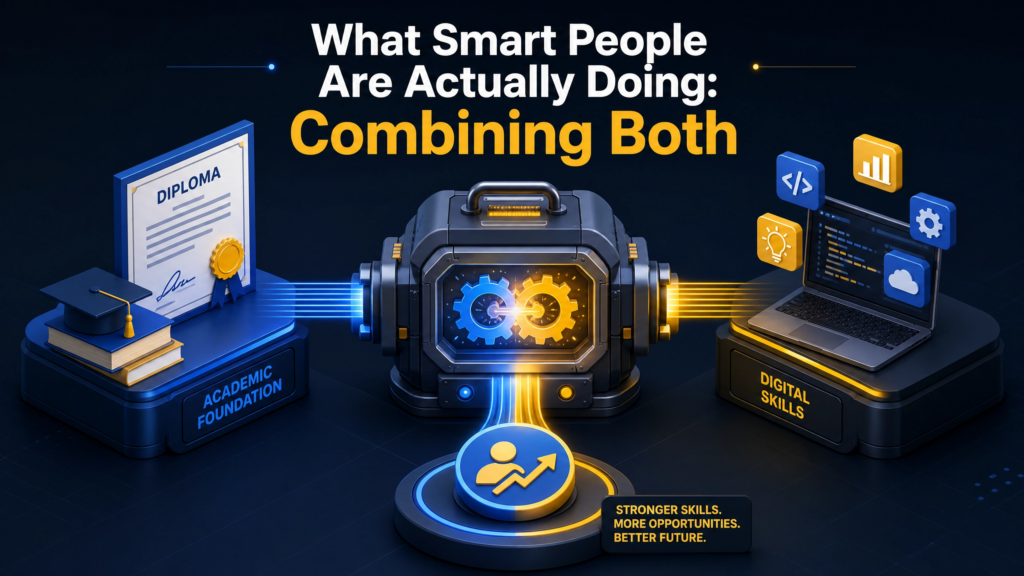
When people finally stop treating digital skills vs degrees as a binary choice, something shifts they’re treating them as parallel tracks rather than alternatives.
A business degree becomes significantly more powerful when paired with a real understanding of digital marketing or data analytics. A computer science degree becomes easier to monetise when you’ve also built things publicly and have GitHub contributions to show. A journalism background becomes far more commercially valuable with solid SEO and content strategy skills.
The logic is simple: credentials open certain doors and provide a foundation. Skills let you actually do something once you’re through them. Thinking about digital skills vs degrees this way as a combination rather than a competition is what separates the most career-resilient people from the rest.
Some combinations that tend to work particularly well:
- Business or economics degree + digital marketing or data analytics: strong fit for growth roles, brand strategy, or product
- Computer science + cloud certifications (AWS/Azure) + open source contributions: well-rounded for engineering and DevOps
- Humanities degree + SEO and content strategy: counterintuitively effective; strong writers with search knowledge are genuinely rare
- Design degree + motion graphics and UI tools: opens doors in product, advertising, and video
None of these require doing everything at once. Most people navigating the digital skills vs degrees question add competencies gradually, often while working full time.
That is the real answer to the digital skills vs degrees question for most people not either/or, but both, built over time.
How to Actually Build Digital Skills That Matter
Once you have settled the digital skills vs degrees question for your own situation, the next step is execution. A few practical thoughts, because “take online courses” as advice is about as useful as “exercise more.”
Start with one skill and go deep before going wide. Not sure which skill fits your goals? Read our breakdown of which digital skills are highest in demand before you decide. The temptation is to learn a bit of everything. The problem is that a bit of everything doesn’t get you hired or paid for anything specific. Pick the skill most relevant to your target role and get genuinely good at it before branching out.
Build things in public. A certificate from Udemy is nice. A website you built and documented is better. A social media account you grew from zero with a process you can explain is better still. Evidence beats credentials in almost every digital field. Our guide on how to build a digital portfolio walks through exactly how to do this from scratch.
Get certifications from sources employers actually recognise. Google Career Certificates in data analytics, digital marketing, and UX design carry real weight with hiring managers. So do AWS certifications, HubSpot’s marketing credentials, and Meta Blueprint. These aren’t shortcuts they’re structured programmes that employers have learned to trust.
Treat AI tools as part of your skill set, not a cheat code. Knowing how to use AI effectively and knowing its limits is now a skill in itself. The people who figure this out early have a significant productivity advantage.
Find a community. Learning alone is slow and demoralising. Online communities around specific skills whether that’s Reddit threads, Discord servers, or LinkedIn groups accelerate learning dramatically and often surface job opportunities before they’re publicly listed.
Frequently Asked Questions
In the digital skills vs degrees debate, which side wins?
In many industries, digital skills win particularly anything technology-driven, creative, or digital-first. Employers in these fields have increasingly shifted toward evaluating candidates based on demonstrated ability rather than academic history. In regulated professions like medicine, law, or engineering, formal degrees remain essential and that is unlikely to change.
Can I get a well-paying job without a degree if I have strong digital skills?
Genuinely, yes and this is one of the most important practical outcomes of the digital skills vs degrees shift. It depends on the field and how strong your evidence of ability is. Roles in software development, UX design, digital marketing, data analysis, content strategy, and cybersecurity are regularly filled by people without traditional degrees. What matters is whether you can show your work. A strong portfolio and industry certifications close most of the gap.
Which digital skills are employers looking for most right now?
Currently, when employers weigh digital skills vs degrees, the skills they most want to see include AI tool integration, data analysis, full-stack development, UX/UI design, SEO and content strategy, cloud computing, and cybersecurity. AI literacy knowing how to use and manage AI tools effectively has shifted from a niche skill to a broad expectation across most knowledge work roles.
Have major companies actually stopped requiring degrees?
Many have, yes. IBM, Google, Apple, Accenture, and Tesla are among the well-documented examples. According to LinkedIn’s Workplace Learning Report, skills-based hiring has grown significantly year on year. Skills assessments, portfolio reviews, and trial projects are replacing academic filters at a growing number of organisations.
How long does it realistically take to build marketable digital skills?
It varies significantly by skill. Most people can reach a working level in digital marketing, content writing, or basic data analysis within three to six months of consistent, structured practice. Web development typically takes closer to a year before most people feel genuinely job-ready. Data science and cybersecurity can take eighteen months to two years to reach a credible professional level though many people land entry roles before they feel fully ready.
Where This Leaves You
The digital skills vs degrees debate is a bit of a false choice when framed as one or the other. The more useful question is: given the specific role and industry you’re targeting, what combination of credentials and demonstrated ability makes you most competitive?
In a lot of fields, the answer is shifting toward: a degree still helps, but it’s not enough on its own and in some fields, it’s genuinely optional if everything else in your profile is strong.
If you are still weighing up whether a course or certification is worth it, our guide on free certified digital courses from Google might help you decide.
Whatever your starting point in the digital skills vs degrees conversation, the one thing that’s consistent across almost every field right now is that continuous learning is no longer optional. The professionals who stay valuable aren’t the ones who learned the most in school. They’re the ones who kept learning after.
If you’re not sure where to start, pick the skill most relevant to your next career step and spend three months actually working on it not just reading about it. The gap between knowing something and being able to show you know it is where most people stall. Don’t stall there. The digital skills vs degrees debate has one practical conclusion: the people who act on it earliest tend to come out furthest ahead.
Ready to take the next step? The digital skills vs degrees debate ultimately ends the same way for most people: they stop debating and start building. Read our guide on free digital marketing certifications from HubSpot Academy and begin this week.