 Live Chat
 Contact
 Shopping Cart
 Rashid Malla
Retrieval-Augmented Generation is quietly solving one of the biggest problems in AI today: language models that sound confident but are simply wrong. If you have ever asked a chatbot a question and received an answer that felt outdated, made up, or disconnected from your actual data, you have already experienced why Retrieval-Augmented Generation exists. This guide breaks down what Retrieval-Augmented Generation actually is, how it works under the hood, and why so many production AI systems in 2026 are built around it rather than relying on a model’s memory alone.
I have spent time building and evaluating retrieval pipelines, and one thing becomes clear fast: Retrieval-Augmented Generation is not a buzzword; it is an engineering pattern that fixes a structural weakness in every large language model. This article covers the concept end to end, from the original research behind it to the tools teams use to deploy it today.
What Is Retrieval-Augmented Generation?
Retrieval-Augmented Generation, commonly shortened to RAG, is a technique that connects a language model to an external knowledge source before it generates an answer. Instead of relying only on what it learned during training, the model first retrieves relevant information from a document store, database, or search index, then uses that retrieved content to produce its response.
The idea was formally introduced by Patrick Lewis and a team of researchers in a 2020 paper titled “Retrieval-Augmented Generation for Knowledge-Intensive NLP Tasks.” The paper combined two types of memory: parametric memory, meaning the knowledge baked into a model’s weights during training, and non-parametric memory, meaning an external index of documents the model could search on demand. This hybrid approach lets models answer knowledge-heavy questions far more accurately than relying on parametric memory alone.
In simple terms, Retrieval-Augmented Generation gives an AI model an open book instead of forcing it to answer from memory. That single shift changes everything about how reliable, current, and verifiable an AI-generated answer can be.
How Does Retrieval-Augmented Generation Work?
A Retrieval-Augmented Generation system is built from two core components working together: a retriever and a generator. Understanding how they interact is the key to understanding RAG itself.
Step 1: The Retriever Finds Relevant Information
When a user submits a query, the retriever searches an external knowledge base for content related to that query. This knowledge base is usually stored as vector embeddings inside a vector database, which allows the system to find passages that are semantically similar to the question, not just ones that share the same keywords.
Step 2: The Generator Produces the Answer
Once the retriever returns the most relevant passages, those passages are inserted into the prompt alongside the user’s original question. The generator, typically a large language model, then reads both the question and the retrieved context and produces a response grounded in that real information.
Step 3: The Response Is Delivered With Context
Because the generator’s answer is anchored to retrieved documents, the output can often include citations or source references. This is one of the most valuable outcomes of Retrieval-Augmented Generation: users and developers can trace an answer back to its origin instead of trusting a black box.
This retrieval-then-generation loop is what makes Retrieval-Augmented Generation fundamentally different from a standard chatbot response, and it is why the architecture has become the default for production AI systems handling private or fast-changing data.
Why Retrieval-Augmented Generation Matters
Retrieval-Augmented Generation solves several problems that plague standalone language models, and each one has real business consequences.
- Reduces hallucination. Because the model answers using retrieved facts rather than guessing, Retrieval-Augmented Generation significantly lowers the rate of fabricated information.
- Keeps answers current. A model’s training data has a cutoff date, but a retrieval index can be updated daily, hourly, or in real time without retraining the model itself.
- Enables private data access. Companies can let an AI model answer questions about internal documents, support tickets, or product manuals without exposing that data during training.
- Improves trust and transparency. Retrieval-Augmented Generation systems can show the exact source passage behind an answer, which matters enormously in regulated industries like healthcare, finance, and law.
- Lowers cost compared to retraining. Updating a search index is far cheaper than fine-tuning or retraining an entire model every time information changes.
Each of these benefits explains why Retrieval-Augmented Generation has moved from an academic idea to a standard architecture pattern across the AI industry.
Retrieval-Augmented Generation vs Fine-Tuning
A common question is whether Retrieval-Augmented Generation or fine-tuning is the better approach, and the honest answer is that they solve different problems.
Fine-tuning changes a model’s internal weights so it behaves differently or absorbs new patterns of language, tone, or task-specific behavior. It is useful when you need a model to follow a very specific style or perform a narrow task extremely well. However, fine-tuning is expensive, needs to be repeated whenever information changes, and does not reliably teach a model new facts.
Retrieval-Augmented Generation, on the other hand, leaves the model’s weights untouched and instead supplies fresh, factual context at the moment of the query. It is the better choice when the priority is factual accuracy, frequently changing information, or the need to cite sources. Many production systems in 2026 actually combine both: a fine-tuned model for tone and task behavior, paired with a Retrieval-Augmented Generation pipeline for factual grounding.
Real-World Use Cases of RAG
Retrieval-Augmented Generation is already powering a wide range of applications across industries.
- Customer support assistants that answer questions using a company’s actual help center articles and policy documents instead of generic training knowledge.
- Internal knowledge search tools that let employees ask natural-language questions across thousands of internal documents, wikis, and reports.
- Legal and compliance research assistants that retrieve exact clauses or case law before generating a summary, keeping answers traceable to a real source.
- Healthcare information systems that pull from current clinical guidelines rather than static training data, which can be months or years old.
- Coding assistants that retrieve relevant sections of a codebase or documentation before suggesting a fix, rather than guessing based on general programming patterns.
Across every one of these examples, the common thread is the same: Retrieval-Augmented Generation grounds the model’s output in a verifiable, current source of truth.
Popular Tools and Frameworks for Building RAG Systems
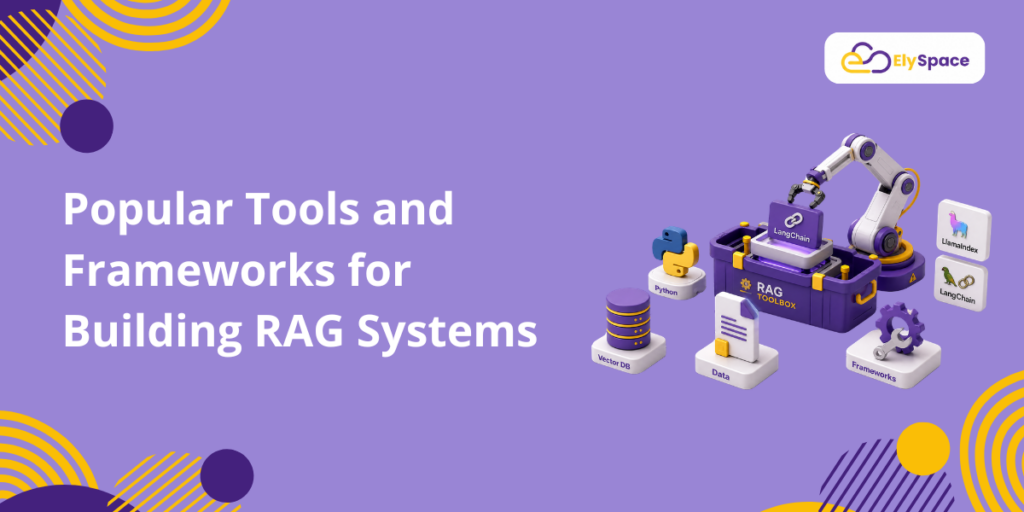
Building a production-grade Retrieval-Augmented Generation pipeline usually involves an orchestration framework paired with a vector database. As of 2026, a few names dominate this space.
Orchestration frameworks:
- LangChain remains one of the most widely deployed frameworks, offering flexible retrievers, agent orchestration, and broad ecosystem integrations.
- LlamaIndex is known for deep document ingestion, hierarchical chunking, and strong retrieval accuracy on document-heavy workloads.
- Haystack offers a stricter pipeline abstraction favored by teams that want production stability and built-in evaluation tooling.
Vector databases:
- Pinecone, a fully managed option favored for zero-ops production deployments.
- Weaviate and Qdrant, popular open-source options for teams that want to self-host.
- Milvus, frequently chosen for large-scale enterprise workloads.
Choosing between these tools depends on your document volume, need for agent-style orchestration, and whether you prefer a managed service or self-hosted infrastructure. Most teams prototype quickly with one framework and later swap components as their Retrieval-Augmented Generation pipeline matures.
Challenges and Limitations of Retrieval-Augmented Generation
No architecture is perfect, and Retrieval-Augmented Generation comes with real engineering challenges worth understanding before you build one.
- Retrieval quality bottlenecks everything. If the retriever pulls irrelevant or poorly chunked passages, the generator will produce a poor answer no matter how capable the underlying model is.
- Chunking strategy is harder than it looks. Splitting documents into passages that preserve meaning while staying small enough for accurate retrieval requires careful tuning.
- Latency increases. Adding a retrieval step before generation adds processing time compared to a direct model response.
- Context window limits. Retrieved passages still need to fit within the model’s context window alongside the user’s question and any conversation history.
- Data governance matters. A retrieval index built on outdated, duplicate, or poorly permissioned data will produce unreliable or even inappropriate answers, regardless of how good the framework is.
Understanding these limitations early prevents teams from treating Retrieval-Augmented Generation as a plug-and-play fix rather than a system that needs ongoing tuning.
Best Practices for a Reliable RAG Pipeline
Based on how production teams approach this in 2026, a few practices consistently separate reliable Retrieval-Augmented Generation systems from fragile ones.
- Invest in a chunking strategy. Test different chunk sizes and overlap percentages rather than defaulting to arbitrary splits.
- Use hybrid search. Combining keyword-based search with vector similarity search often outperforms either approach alone.
- Add a reranking step. A lightweight reranker applied after initial retrieval can meaningfully improve which passages actually reach the generator.
- Evaluate continuously. Tools built specifically for measuring retrieval and answer quality help catch silent regressions before users notice them.
- Keep your index fresh. Schedule regular re-indexing so the retrieval layer reflects your latest documents, not a stale snapshot.
- Log retrieved sources. Always store which passages were retrieved for each answer, since this makes debugging and building user trust far easier.
These practices apply regardless of which framework or vector database you choose to build your Retrieval-Augmented Generation stack on.
The Future of Retrieval-Augmented Generation
Retrieval-Augmented Generation continues to evolve well beyond its original 2020 design. Agentic RAG, where an AI agent decides which index to query, when to rerank results, and when to fall back to a different retrieval strategy, has become increasingly common in 2026 production systems. Multi-hop retrieval, where a system performs several retrieval steps to answer complex questions, is also gaining traction for research and analytical use cases.
As context windows in large language models continue to grow, some have asked whether Retrieval-Augmented Generation will become unnecessary. In practice, the opposite has happened: larger context windows and retrieval work together, since retrieval still reduces cost, improves precision, and keeps answers traceable to a specific source, something a massive unfiltered context dump cannot reliably guarantee on its own.
Frequently Asked Questions
Is Retrieval-Augmented Generation the same as fine-tuning? No. Retrieval-Augmented Generation retrieves external information at query time without changing the model’s weights, while fine-tuning permanently adjusts the model itself.
Does Retrieval-Augmented Generation eliminate hallucination? It significantly reduces hallucination by grounding answers in retrieved facts, but it does not guarantee perfect accuracy, especially if retrieval quality is poor.
What is the difference between RAG and simply using a longer context window? A longer context window lets a model read more text at once, but Retrieval-Augmented Generation selectively finds the most relevant information first, which is usually faster, cheaper, and easier to trace back to a source.
Which vector database should I use for Retrieval-Augmented Generation? It depends on your scale and hosting preference. Pinecone suits teams wanting a managed service, while Weaviate, Qdrant, and Milvus are strong open-source or self-hosted options.
Can small businesses use Retrieval-Augmented Generation, or is it only for large enterprises? Small teams can absolutely build Retrieval-Augmented Generation systems using open-source frameworks like LangChain or LlamaIndex, often without heavy infrastructure investment.
Conclusion
Retrieval-Augmented Generation has become one of the most practical architecture patterns in modern AI because it directly addresses the two biggest weaknesses of language models: outdated knowledge and unreliable, unverifiable answers. By pairing a retriever with a generator, Retrieval-Augmented Generation lets AI systems answer questions using real, current, and traceable information rather than relying purely on what was learned during training.
Whether you are building a customer support assistant, an internal knowledge tool, or a research application, understanding Retrieval-Augmented Generation is now a baseline requirement for building AI systems people can actually trust. As the tools and frameworks around Retrieval-Augmented Generation continue to mature in 2026, the gap between experimental AI demos and production-grade, source-grounded systems will keep closing.