 Live Chat
 Contact
 Shopping Cart
 Eshan Riyaz
Search “best web design company in the USA” and you’ll get lists of agencies with polished portfolios, impressive client logos, and award badges from platforms you’ve never heard of. Most of those lists are paid placements. The agencies paid to be there.
That doesn’t make them bad, but it makes the lists useless for actually choosing a partner.
Finding the right web design company in the USA isn’t a ranking problem. There are thousands of excellent agencies across New York, Austin, Chicago, Los Angeles, and every city in between. The challenge is knowing how to evaluate them against your specific needs, before you’ve signed a contract and discovered the mismatch six weeks into a project.
The differences that actually matter, how a team handles scope changes, who owns your code, what happens six months after launch, rarely show up on a homepage.
This guide gives you the framework to find those answers before you commit.
What a Web Design Company Actually Does And What It Should
Before evaluating any agency, be clear on what you’re buying.
A web design company; at minimum, creates the visual and structural experience of your website. Layout, typography, colour, navigation, and how information is presented to a visitor. The goal of design isn’t aesthetic; it’s clarity, trust, and conversion. A well-designed website gets visitors to do something: call, submit a form, buy, book.
A full-service web design company also handles development (turning designs into functional code), SEO foundations (ensuring Google can find and rank the site), performance (fast loading across all devices), and post-launch support (maintaining what they built).
Web development today goes far beyond design and code. It directly impacts revenue, brand credibility, user trust, and scalability.
The distinction matters because many agencies sell “web design” but deliver only aesthetics, beautiful sites that load slowly, rank nowhere on Google, and convert visitors at a fraction of their potential. You’re not buying a visual. You’re buying a business tool that should generate measurable return.
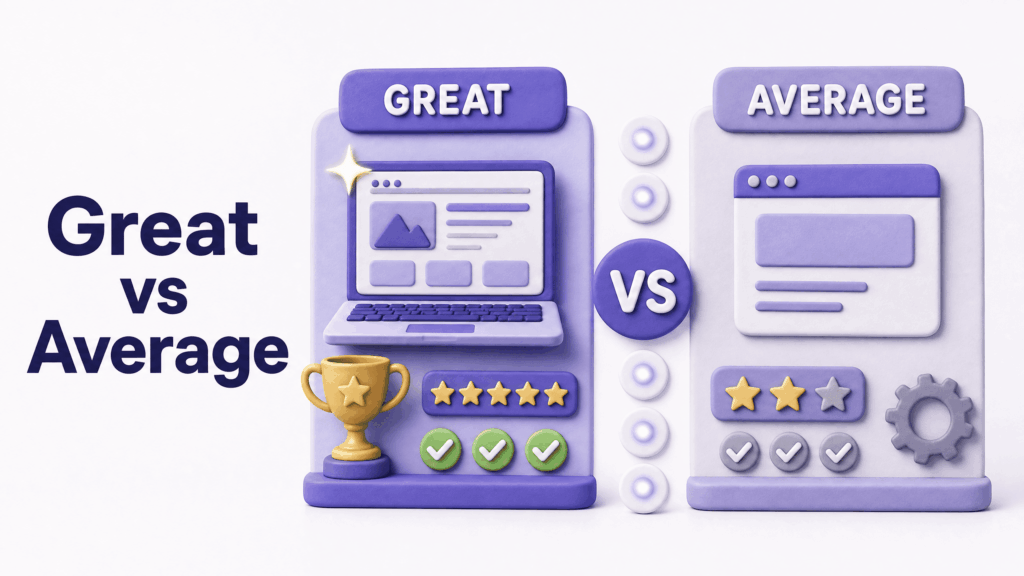
The 6 Things That Separate Great US Web Design Companies From Average Ones
1. They ask about your business before talking about design. A company that starts by showing you design trends and portfolio pieces before understanding your goals, your customers, and your competitive landscape is leading with output instead of strategy. The best partners start with questions. Lots of them.
2. They show live work, not just screenshots. You can’t pick the best website design company until you know what problem the site has to solve. And you can’t evaluate a company’s ability to solve that problem from mockups and Behance presentations. Live websites; open on your phone, run through Google PageSpeed Insights, show real performance, not curated images of it.
3. They’re specific about SEO. Any agency claiming to “do SEO” without specifics is not doing SEO seriously. Ask what’s included: on-page optimisation, site speed, mobile performance, Core Web Vitals, Google Search Console setup, URL structure. A company that can’t answer these specifically isn’t thinking about them systematically.
4. They have a defined post-launch process. Selecting a web design partner is not merely a transaction, it’s the beginning of a crucial business relationship. Agencies without clear post-launch support, maintenance plans, or ongoing availability are vendors, not partners. A website needs continued attention to stay effective.
5. They give you ownership. Your code, your files, your domain, your hosting; you should own all of it. If an agency builds on a proprietary platform you don’t control, or structures hosting so that leaving them means losing your website, that’s not a design relationship. That’s a dependency.
6. They can explain what results look like. Not just “we build great websites”, but what metrics improve, over what timeline, and how they measure success. Leads generated, search rankings improved, conversion rate changes, time on site. The best web design companies in the USA track outcomes, not just deliverables.
Questions You Must Ask Before Signing Anything
“Can you show me three live websites you’ve built in the last 12 months?” Open them. On your phone. Submit the contact form. Run the PageSpeed test. Ask yourself: would I trust this website with my business? The live experience tells you what the portfolio page won’t.
“Who specifically builds my project, in-house or subcontracted?” Define your requirements and try to be as specific as possible to find the right project partner. Many agencies win clients with senior strategists in the sales room and hand the project to junior designers or offshore contractors. Know who’s actually doing the work.
“What is your SEO approach during the build?” The answer should include specific mentions of site speed, mobile-first design, page titles, meta descriptions, heading structure, image compression, and Google Search Console setup. A vague answer means it’s not being done properly.
“What does the relationship look like six months after launch?” Support structure, response times, maintenance plans, content update process, all of this should be defined before you sign, not discovered after.
“Who owns the website when the project is done?” The answer should be: you do. All of it. If there’s any hesitation or qualification, keep asking until you have a clear, written answer.
“What results have you achieved for businesses similar to mine?” Traffic growth, lead volume improvement, ranking changes, conversion rate improvement, any agency that has produced real results can point to specific, verifiable examples. If the answer is portfolio aesthetics rather than business outcomes, adjust your expectations accordingly.
Red Flags That Signal You Should Walk Away

Lists they can’t explain. Award badges from obscure platforms, claimed rankings on directories you haven’t heard of, testimonials without verifiable names or companies. None of these are evidence of quality.
Guaranteed first-page Google rankings. Organic SEO takes months of consistent work. Any guarantee of rapid ranking is either misleading or relies on techniques that eventually trigger penalties.
No written scope before payment. A professional engagement has a detailed written scope specifying deliverables, timeline, revision policy, payment schedule, and post-launch terms. Verbal assurances don’t protect you when expectations diverge.
Beautiful portfolio, live sites that perform poorly. Open portfolio URLs on your phone. Check PageSpeed scores. If the sites they’re proudest of load in six seconds on mobile and score 40 on Google’s performance test, your site will likely fare similarly.
Pressure to decide quickly. “This rate is only available until Friday” from a web design company is a sales tactic, not a business reality. The right partner doesn’t need to pressure you, the quality of their work is convincing.
No clarity on hosting. Where will your site live? What’s the server infrastructure? Is SSL included? What’s the uptime guarantee? A company that doesn’t discuss hosting quality is building on a foundation they haven’t thought about, and that foundation determines your site’s speed and reliability.
US Agency vs Remote Agency: The Honest Comparison
This is a real decision for many US businesses, and it deserves an honest treatment rather than a predictable answer.
Leading U.S. web development companies now offer AI-driven experiences, performance-first design, and UX-led growth as standard, but so do skilled remote agencies operating at significantly lower cost structures.
The case for a US-based agency:
- Time zone alignment for synchronous communication
- In-person meetings possible when needed
- Familiarity with the US market, US consumer behaviour, and US regulatory context
- Easier legal recourse if something goes wrong
The case for a remote or international agency:
- Significantly lower cost for equivalent or superior technical skill
- Access to specialised talent not limited by geography
- Global perspective that can be valuable for businesses serving diverse markets
- The best remote agencies have refined communication processes that match or exceed what local agencies provide
The honest answer: The US market has many excellent agencies. It also has many mediocre ones charging premium rates. Remote agencies; particularly those with strong portfolios, clear processes, and verifiable client results, consistently deliver quality work at lower cost structures. The decision should be based on quality, process, and accountability, not geography alone.
According to Google’s guidance on evaluating web professionals, what matters for your website’s success is technical quality, content depth, and user experience, all of which are achievable regardless of where your agency is based.
What Web Design Should Cost in the USA
With $61.23 billion in web design services in 2025 and over 1.38 billion websites live by the end of that year, the range of what a website costs reflects the range of what’s actually being built.
Basic business website (5–8 pages): $3,000–$10,000 Mobile-responsive design, on-page SEO, contact forms, SSL. The lower end typically involves template customisation; the higher end involves more custom design work.
Professional business website: $10,000–$30,000 Custom design, stronger conversion architecture, more pages, content strategy, advanced SEO foundations, Google Analytics setup, and meaningful post-launch support.
eCommerce website: $15,000–$75,000+ Product catalogue, payment processing, order management, mobile performance. Complexity and number of products drive the range significantly.
Custom web application: $50,000–$250,000+ Booking systems, member portals, CRM integrations, SaaS platforms. Requires genuine development expertise, not just design skill.
Enterprise redesign: $75,000–$500,000+ Multi-stakeholder projects involving brand strategy, global site architecture, compliance, and ongoing retainer relationships.
The most important pricing principle: the question isn’t “what’s the cheapest website I can get?”, it’s “what’s the minimum investment that builds a website that actually generates a return?” Those are very different questions.
The Types of Businesses That Need Different Partners
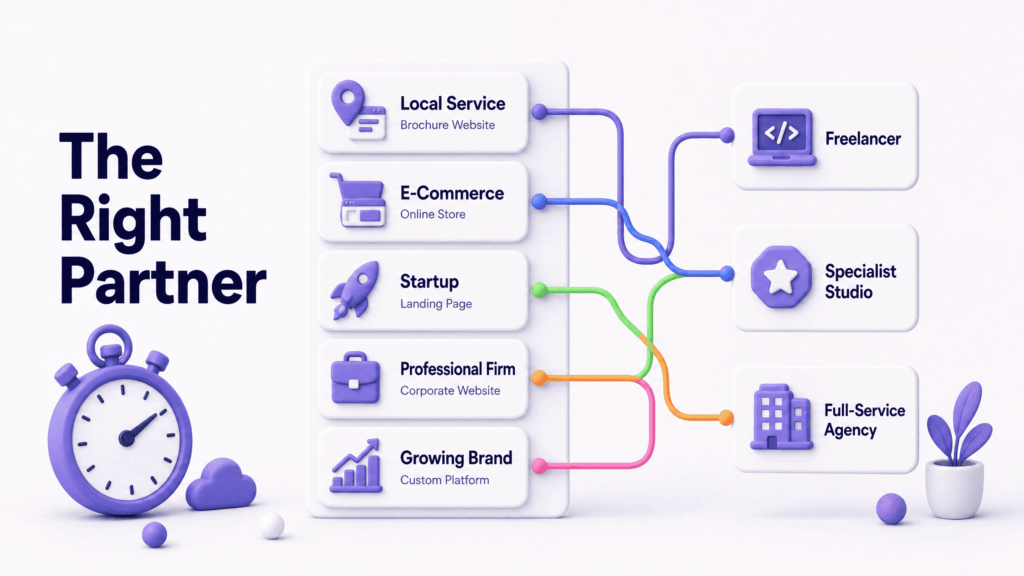
Small and mid-size businesses generating leads: Need a partner who understands conversion, not just aesthetics. The website’s job is to turn visitors into enquiries. Every design decision should serve that goal. Look for agencies with specific experience in your industry and verifiable lead generation results.
eCommerce businesses: Need technical depth in addition to design skill; payment security, mobile checkout experience, page speed on product pages, inventory management integration. Design alone isn’t enough.
SaaS and tech companies: While some agencies try to be everything to everyone, the best fit for SaaS companies is an agency that has built their entire business around creating websites that help B2B companies generate leads and credibility. Specialisation matters here more than generalism.
Local service businesses: Need local SEO expertise as much as design skill; Google Business Profile optimisation, location-specific content, review management integration. A nationally-focused agency may not prioritise these.
Startups: Need speed to market and flexibility more than polish. A partner who can deliver a strong MVP site quickly, built on a scalable platform that grows with the business, is more valuable than an agency that takes six months to deliver perfection.
Why ElySpace Works for US Businesses
ElySpace is a full-service web design, development, and digital marketing agency. While we’re based in Kashmir, we work with businesses across the US, and we build websites that perform to the same standard regardless of where the client is located.
What we offer US clients specifically:
Cost advantage without quality compromise. Our cost structure allows us to deliver professional, SEO-ready, performance-optimised websites at significantly lower rates than equivalent US agencies, without cutting the corners that matter. A $25,000 project with a large US agency is often comparable in scope and output to a project we’d deliver at a fraction of that cost.
Communication built for international clients. We work asynchronously across time zones with a structured project process; clear milestones, regular updates, and defined feedback loops. You never have to wonder what’s happening.
Full ownership, always. Every client owns their domain, hosting, code, and files. No proprietary systems, no lock-in.
Post-launch accountability. We offer ongoing website management, SEO content, and digital marketing, because a website that doesn’t evolve doesn’t keep delivering results.
Verifiable results. We can point to specific websites we’ve built, the performance improvements they delivered, and the clients who can confirm it. We don’t rely on award badges or paid directory placements.
If you’re a US business looking for a web design partner that delivers professional-quality work at a cost structure that makes financial sense, and you’re open to working with a remote team with a strong process and clear accountability, reach out and we’ll give you a straight assessment of whether we’re the right fit for your project.
Common Mistakes US Businesses Make When Choosing
Choosing the agency with the most impressive client logos. Enterprise clients in a portfolio tell you an agency can work at scale. They don’t tell you how they handle a $15,000 project for a mid-size business. Ask for examples at your budget level, not their ceiling.
Treating the proposal as the product. Beautiful proposals with professional layouts, detailed timelines, and inspiring case studies are sales documents; not deliverables. Evaluate the live work, not the presentation about the live work.
Not asking who does the actual work. Many agency principals sell the relationship while junior team members or offshore contractors do the build. Ask specifically who will be working on your project and review their individual portfolios if possible.
Optimising for speed over fit. Pressure to “just get something live” leads to choosing a partner quickly without proper evaluation. A two-week delay to choose correctly is worth significantly more than six months working around a mismatched partner.
Ignoring the post-launch conversation entirely. Choose a web design firm that doesn’t just launch a website, but supports where your business is headed next. Most client dissatisfaction happens in the months after launch; when updates are slow, support is unresponsive, and the site starts degrading without maintenance. Make post-launch accountability a primary evaluation criterion.
Choosing based on portfolio aesthetics without testing performance. A beautiful website that loads in seven seconds on mobile and scores 45 on Google PageSpeed is not a good website. Open every portfolio URL on your phone before you make any decision.
What You Can Do Right Now
- Open three portfolio websites from any agency you’re considering on your phone and run them through Google PageSpeed Insights, note the mobile scores and Time to First Byte
- Write down your specific business goal for the website before any agency conversation, not “I need a website” but “I need a website that generates X enquiries per month from Y type of customer”
- Prepare your five non-negotiable questions and ask them in every first conversation, the quality of the answers tells you more than any portfolio
- Get two or three written scopes with detailed deliverable lists so you’re comparing equivalent offerings rather than headline prices
- Ask specifically about post-launch support: response times, maintenance plans, content update process, before any contract is signed
If you’d like to discuss your specific project with ElySpace, without a sales pitch and without commitment, visit elyspace.com and reach out. We’ll give you an honest assessment of what your website needs, whether we’re the right fit, and what it would look like to work together.
FAQs (Frequently Asked Questions)
How do I find the best web design company in the USA for my business? Start by defining what your website needs to achieve; leads, sales, credibility, bookings. Then evaluate agencies specifically on their experience with that goal: ask for live examples of similar projects, test those sites on mobile, check their PageSpeed scores, and ask specific questions about SEO approach and post-launch support. The best partner is the one who matches your specific needs, not the one with the most awards.
How much does a professional website cost in the USA? A professionally built business website in the USA typically costs $3,000–$10,000 at the entry level and $10,000–$30,000 for more custom, conversion-focused work. eCommerce and custom applications range from $15,000 to well over $100,000 depending on complexity. Remote agencies offer comparable quality at significantly lower cost structures.
Is it safe to hire a web design company outside the USA? Yes, with proper due diligence. Verify live portfolio work, check client references, ensure a written contract specifying ownership and deliverables, and confirm the communication process. The best international agencies have refined processes specifically for working with US clients across time zones.
What should be included in any web design package? Mobile-responsive design, SSL certificate, on-page SEO setup, speed optimisation, contact form with reliable delivery, Google Analytics and Search Console setup, and at least 30 days of post-launch support. Any package missing these fundamentals is not a complete professional deliverable.
How long does a professional website project take in the USA? A standard business website with a clear brief and responsive client feedback typically takes three to six weeks. Custom designs, complex functionality, or large content volumes extend this. Agencies promising a full custom website in under two weeks are almost certainly cutting meaningful corners.
Should my web design company also handle SEO? The technical SEO foundations; site speed, mobile performance, URL structure, page titles, meta descriptions, heading hierarchy, should be built into the website from day one, not added after. Ongoing SEO (content, link building, rank monitoring) is a separate engagement but works best when the technical foundation is right from the start.
What questions reveal the most about an agency’s quality? “Can you show me three live websites you’ve built in the last 12 months?” followed by actually testing those sites. And “what does the relationship look like six months after launch?” The answers to these two questions tell you more about an agency’s real quality than their entire proposal.