 Live Chat
 Contact
 Shopping Cart
 Eshan Riyaz
Most guides about the best web development company in the USA are written for enterprise clients with six-figure budgets, in-house project managers, and months to spend on evaluation.
That’s not you.
You’re a small business owner; a service provider, a local retailer, a startup, a consultant, who needs a website that works. One that loads fast, shows up on Google, converts visitors into enquiries, and doesn’t require a technical degree to update. You need a partner who understands that your $10,000 or $20,000 project deserves the same level of strategic thinking as an enterprise engagement, just at a scale that makes sense for your business.
Finding the right web development company in the USA for small businesses is harder than it sounds. Most agencies are built around larger clients and treat small business projects as filler work between the contracts that actually matter to them. Others charge enterprise prices for template work. And the cheapest options often deliver the kind of websites that look fine on launch day and quietly fail every business goal they should be serving.
This guide helps you find the ones that genuinely deliver for small businesses, and gives you the framework to evaluate them before committing.
What Small Businesses Actually Need From a Web Development Company
Small business web needs are specific, and different from what enterprise clients require. Before evaluating any company, be clear on what actually matters at your scale.
A website that generates enquiries or revenue. Not a digital brochure. Not a portfolio of your team. A site built around what your customer needs to see, feel, and do to take the next step. Every design and development decision should serve that goal.
Mobile-first performance. The majority of your potential customers will find you on a phone. A website that performs well on desktop but breaks on mobile is failing most of its visitors.
Search visibility from day one. On-page SEO, proper site structure, fast loading, and Google Search Console setup should be built into the project, not sold as a separate package six months after launch when you’re wondering why nobody’s finding you.
A platform you can actually use. You should be able to update your own content, add a service, change your hours, and publish a blog post without calling a developer. If you can’t, you’re dependent on someone else for every small change, which gets expensive and frustrating fast.
A partner who stays after delivery. The web development relationship doesn’t end when the site goes live. Plugins need updating, content needs changing, things break. A company with no post-launch structure isn’t a partner, they’re a vendor who’s moved on.
The U.S. web development market reached approximately $18.25 billion in 2024 and is growing consistently. Most of that spend is concentrated in large enterprise projects. Small businesses get what’s left, which is why choosing carefully matters.
The 7 Qualities That Define a Great Small Business Web Partner
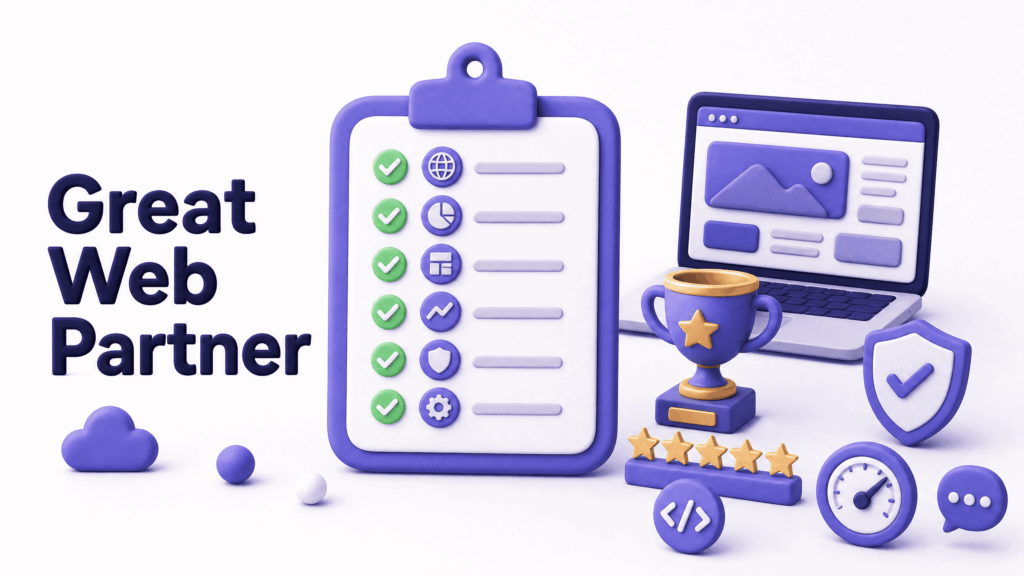
1. They size the solution to the problem. A small service business website doesn’t need a custom-built React application with headless CMS architecture. It needs a clean, fast WordPress site with proper SEO and a working contact form. The best web development company for your small business recommends the simplest solution that solves your actual problem, not the most technically impressive one.
2. They show live work in your budget range. A portfolio full of Fortune 500 redesigns tells you nothing about how an agency handles a $12,000 project for a plumbing company or a florist. Ask specifically for examples at your budget level, and open those URLs on your phone rather than viewing screenshots.
3. They treat SEO as part of development. A well-developed website improves SEO rankings, increases conversions, and strengthens brand credibility. These aren’t separate services. They’re built into every good web development project from day one. Any company that positions SEO as an add-on is building a site that won’t get found on Google by default.
4. They communicate in plain language. Jargon-heavy proposals full of technical terminology you don’t recognise are often designed to justify higher prices rather than clarify value. A good partner explains what they’re doing and why in language that lets you make informed decisions.
5. They give you full ownership. Your domain, your hosting account, your website files, your database, all of it should belong to you when the project is done. If an agency builds on a platform you don’t control or structures hosting so that leaving them means losing your site, that’s a dependency you can’t afford.
6. They’ve done it before at your scale. Experience with small business clients specifically, not just experience in general, matters. The workflow, communication style, budget management, and expectations are different from enterprise projects. Companies that primarily serve large clients often struggle with the pace and flexibility that small business projects require.
7. They have a defined post-launch process. Ask specifically: what happens after the site goes live? Who do you contact when something breaks? What’s the response time? Is there a maintenance plan? The answers reveal whether this is a genuine partnership or a completed transaction.
Questions You Must Ask Before Hiring
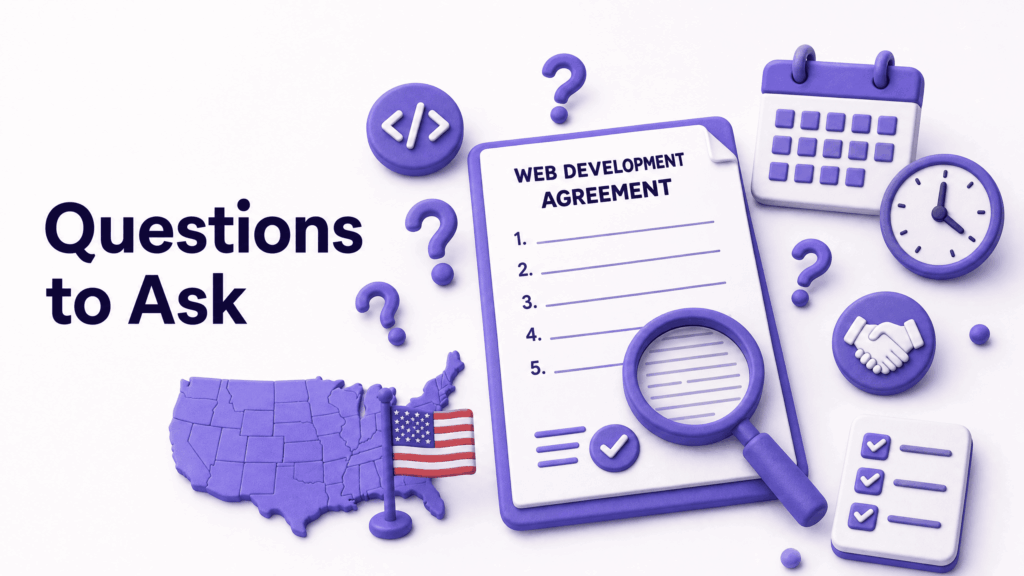
“Can you show me three live websites you’ve built for small businesses in the last 12 months?” Then open them. On your phone. Run them through Google PageSpeed Insights. Check whether the contact forms work. A mobile score below 70 on a portfolio site tells you everything you need to know about how seriously they take performance.
“Who will actually be working on my project?” Many agencies sell with senior strategists and build with junior contractors. Know who’s doing the work. Ask for the specific developer’s background and recent projects if possible.
“What platform will my website be built on, and can I update it myself?” WordPress is the right answer for most small business websites; it’s widely supported, easily maintainable, and gives you full ownership. A proprietary platform or a system requiring the agency to make every change locks you into a dependency that gets expensive quickly.
“What’s included in terms of SEO when the site launches?” The answer should mention: page titles and meta descriptions on every page, proper heading structure, image alt text, Google Analytics and Search Console setup, mobile performance, and site speed optimization. If the answer is vague, those things aren’t being done.
“What does post-launch support look like?” Response times, support channels, what’s covered, what’s charged extra. Get this in writing before the project starts.
“What’s the renewal cost on any platform or hosting you’re setting up?” Introductory pricing disguises ongoing costs. Know what you’ll pay in year two before you commit to year one.
Red Flags Specific to Small Business Clients

They upsell features you don’t need. A small local service business doesn’t need a custom booking engine built from scratch when a $29/month plugin does the same job. A web development company that recommends complex custom solutions for simple problems is either padding their invoice or doesn’t understand your actual needs.
They can’t tell you where your site will be hosted. Hosting quality directly determines your website’s speed and reliability. A company that puts your site on the cheapest available shared hosting without mentioning it is compromising your performance from day one.
Guarantees they can’t keep. First-page Google rankings in 30 days. Guaranteed traffic increases. These aren’t promises a legitimate company can make, and making them signals that the company either doesn’t understand SEO or doesn’t care about accuracy.
No written scope document before payment. Every professional web development engagement should have a detailed written scope specifying what’s included, what’s excluded, the timeline, revision policy, payment schedule, and post-launch terms. Starting without this creates disputes, scope creep, and unmet expectations.
Communication slows dramatically after the deposit. Ask references specifically about communication during the project, not just the final result. The most common complaint about web development companies among small business clients isn’t quality of work, it’s disappearing mid-project after payment has been made.
They don’t ask about your customers. A web development company that starts with design trends and technologies before asking who your customers are, what they need, and what action you want them to take on your website is building something for themselves, not for your business.
US-Based vs Remote Web Development: What Small Businesses Should Know
This is one of the most practically important decisions a small business makes when choosing a web development partner, and it deserves an honest treatment.
The U.S. web development market is strong but expensive. US-based agencies typically charge $100–$200+ per hour. For a small business project, this translates to $8,000–$30,000 for work that an equally skilled remote agency can deliver at $3,000–$15,000. The quality difference, when you choose the right remote partner, is often minimal to zero.
Remote agencies, particularly those based in India, Eastern Europe, or Southeast Asia, have built sophisticated collaboration processes specifically for working with US clients. Dedicated developers align with US business hours, sprint processes, and communication workflows to ensure smooth coordination and faster project execution.
The risks of remote development are real but manageable. Time zone differences require structured communication. Quality varies more widely than in the US market. And the legal recourse for a poor outcome is more limited. These risks are addressed by thorough evaluation upfront; live portfolio testing, client references, and written contracts, rather than by defaulting to local agencies at higher prices.
The right question is not “US or remote?” it’s “does this company’s portfolio, process, and accountability meet my standards?” Location is a factor, not the deciding one.
According to Google’s Search Essentials documentation, what determines your website’s search performance is technical quality, content depth, and user experience, all of which a skilled development team can deliver regardless of geography.
What Web Development Costs for Small Businesses in the USA
Understanding realistic pricing prevents both overpaying and the false economy of the cheapest option.
Basic business website (5–8 pages): $3,000–$8,000 Template-based or lightly customised WordPress build. Mobile-responsive, SSL, basic on-page SEO, contact form. At the lower end, corners are typically cut on design customisation and SEO depth.
Professional small business website: $8,000–$20,000 Custom or heavily customised design, stronger conversion architecture, thorough on-page SEO, Google Analytics and Search Console setup, performance optimisation, and meaningful post-launch support included.
Small eCommerce store: $10,000–$40,000 Product catalogue, payment processing, mobile-optimised checkout, order management. Complexity and number of products drive the range significantly.
Custom functionality (booking systems, portals, integrations): $15,000–$75,000+ Anything requiring backend logic beyond what off-the-shelf plugins provide. Requires genuine development expertise, not just WordPress customisation.
The median hourly rate across reviewed US web development companies sits around $37–$150 depending on the agency type and specialisation. For small business projects, the total budget matters more than the hourly rate, what you need is a partner who scopes your project correctly rather than padding hours.
The most important pricing principle for small businesses: the cheapest option is rarely the most cost-effective option when you factor in the business value of a site that actually generates leads versus one that sits unused.
Technologies That Matter And What to Ignore
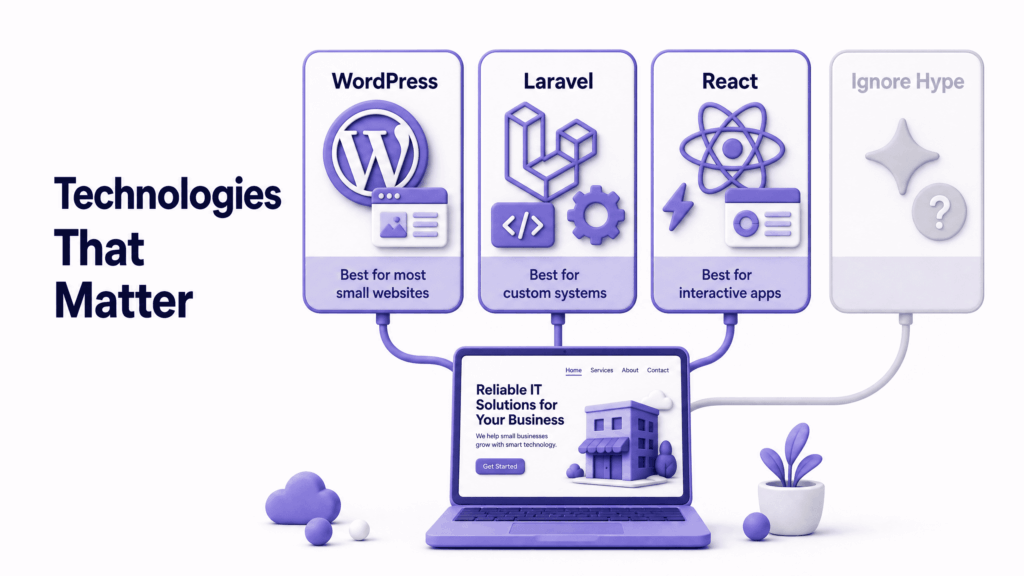
You don’t need to become a developer, but understanding a few key terms helps you evaluate what you’re being recommended.
WordPress: the right platform for the overwhelming majority of small business websites. Widely supported, easily maintainable by non-technical owners, excellent SEO capability when configured correctly, and no lock-in to any single agency. WordPress, along with established CMS and eCommerce platforms, remains the dominant choice for content sites and online stores.
Laravel: a PHP framework for custom web applications requiring complex backend logic. A legitimate choice for genuine custom development needs. Not appropriate for a standard small business website, if it’s being recommended for your five-page service site, ask why.
Headless or composable CMS architecture: increasingly standard for content-heavy sites that need flexibility between the content layer and front-end presentation. Likely overkill for most small businesses unless you have specific content management requirements.
Low-code or no-code tools: increasingly used alongside custom code for smaller builds or rapid prototyping. Useful for the right situations; the concern is when they’re used as the primary solution for a project that needs a proper development approach.
What to be cautious about: proprietary platforms built by the agency you’re hiring. If your website runs on a system only that company supports, leaving them means losing your website. Always ask: if I decide to move to a different agency in two years, can I take my website with me?
Why ElySpace Works for US Small Businesses
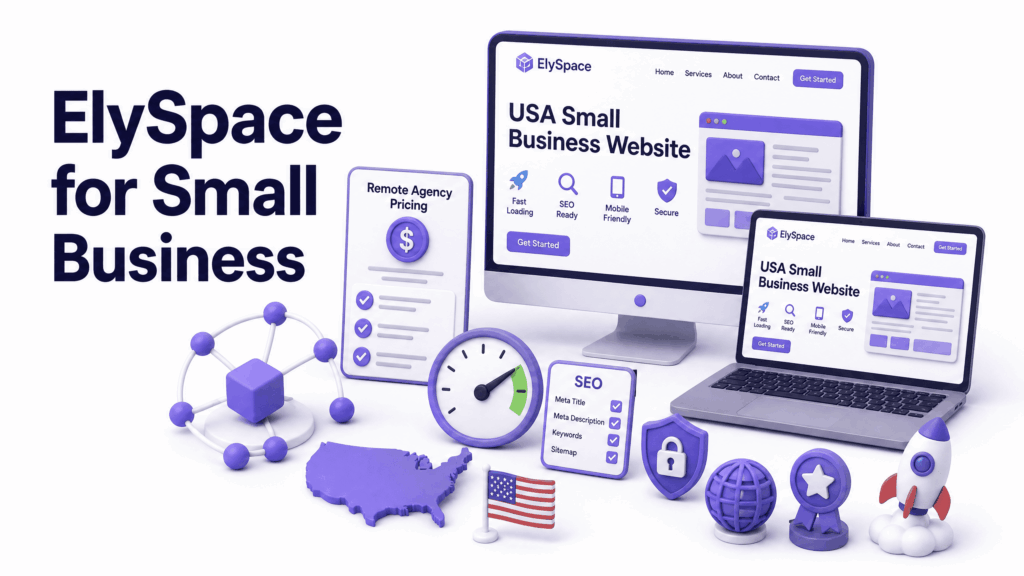
At ElySpace, we work with small businesses across the US; service providers, local businesses, agencies, consultants, and growing brands, and our approach is built specifically around what small businesses actually need from a web development partner.
We build what the project actually requires. We don’t recommend Laravel applications when WordPress solves the problem. We don’t add features to inflate scope. We build the simplest solution that genuinely serves your business goals, then suggest additions only when they create real value.
We optimise for performance and search from day one. Speed, mobile experience, on-page SEO, and Google Search Console setup are built into every project as standard, not sold separately. A website that doesn’t get found on Google hasn’t done its job regardless of how good it looks.
You own everything. Your domain, your hosting account, your code, your files. No proprietary systems, no lock-in. If you ever want to move to a different agency, you can take your website with you without any complications.
We communicate clearly across time zones. We work with US clients through structured project processes; regular milestone updates, defined feedback loops, and response commitments, so you’re never left wondering what’s happening with your project.
We stay involved after launch. We offer ongoing website management, SEO content, and digital marketing, because a website that doesn’t evolve eventually stops delivering results. The launch is the beginning, not the end.
Our cost structure works for small business budgets. Our operational structure allows us to deliver professional-quality work at rates that make financial sense for small businesses, typically 40–60% below comparable US agency rates for equivalent scope and quality.
Reach out through elyspace.com and we’ll give you an honest assessment of what your project needs, what it would cost, and whether we’re genuinely the right fit.
Common Mistakes Small Businesses Make When Hiring a Developer
Choosing on price alone without questioning scope. A $3,000 quote and an $8,000 quote for “a website” are almost certainly not for the same thing. Get written scopes from both and compare what’s actually included; SEO setup, performance optimisation, post-launch support, before making a price-based decision.
Not testing portfolio sites on mobile. Screenshots look the same on any screen. A live website tested on a phone reveals loading speed, layout quality, mobile usability, and whether the contact forms actually work. This is the single most revealing evaluation step, and the one most small business owners skip.
Treating the website as a one-time purchase. Your website is not a finished product on launch day. It needs content updates, security maintenance, performance monitoring, and gradual SEO improvement to stay effective. A partner who structures the relationship to end at delivery isn’t set up to help you get the maximum value from your investment.
Not asking about who owns the hosting. Some agencies set up hosting in their own accounts, which means if you ever stop working with them, they control your website’s continuity. Always confirm that your hosting account is in your name and that you have full admin access.
Comparing agencies without a defined brief. Three quotes for “a website” with no specification of pages, features, SEO requirements, and post-launch expectations are impossible to compare meaningfully. Write a brief, even a one-page document describing what you need, before approaching any agency. It improves the quality of proposals you receive and makes comparison straightforward.
Ignoring the post-launch conversation. Ask every agency: what happens after my site goes live? Who do I contact? What’s the response time? Is there a maintenance plan? The quality of this answer is one of the most reliable indicators of how the overall relationship will feel, because this is exactly the phase where most small business clients get let down.
What You Can Do Right Now
- Write a one-page brief describing what your website needs to do, who your customers are, and what action you want visitors to take, this single step dramatically improves every conversation you’ll have with potential partners
- Open three portfolio websites from any company you’re considering on your phone and run them through Google PageSpeed Insights, the mobile score and Time to First Byte tell you more than any presentation
- Prepare five non-negotiable questions and ask them in every first conversation; focus on ownership, post-launch support, SEO approach, and who does the actual work
- Get written scopes from at least two companies with detailed deliverable lists before making any decision based on price
- Check that the hosting account will be in your name: this one question protects you from the most common post-project dependency trap
If you’d like to discuss your project with ElySpace without commitment, visit elyspace.com. We’ll tell you honestly what your project needs, what it would cost, and whether we’re the right partner for it.
FAQs (Frequently Asked Questions)
How do I find the best web development company in the USA for a small business budget? Start by defining your specific goals, what the website needs to generate, not just what it needs to look like. Then evaluate companies on live portfolio performance (test on mobile, check PageSpeed scores), experience with small business projects at your budget level, SEO approach during the build, and post-launch support structure. Price is a factor, but scope and quality deliver the return.
What should a small business website cost from a US web development company? A properly built professional small business website typically costs $8,000–$20,000 from a US-based agency. Remote agencies with strong processes deliver comparable quality at $3,000–$10,000. Below $3,000, meaningful compromises are almost always being made in design quality, SEO foundations, performance, or post-launch support.
Should a small business hire a US-based agency or consider remote options? Both can deliver excellent results. US agencies offer time zone alignment and local market familiarity. Remote agencies offer comparable quality at significantly lower cost. The decision should be based on portfolio quality, communication process, accountability structure, and fit; not geography alone.
What platform should a small business website be built on? WordPress is the right choice for the vast majority of small business websites. It’s widely supported, easily maintainable by non-technical owners, excellent for SEO when configured correctly, and has no vendor lock-in. Be cautious of proprietary platforms, if the agency builds on a system only they support, you’re dependent on them indefinitely.
How long does it take to build a small business website? A properly built five-to-eight page website with a clear brief and responsive feedback typically takes three to six weeks. Faster timelines mean shortcuts. Projects exceeding eight weeks without clear progress milestones suggest poor project management. Ask for a milestone schedule at the start of any engagement.
What should be included as standard in any small business web development package? Mobile-responsive design, SSL certificate, on-page SEO setup (page titles, meta descriptions, heading structure, image alt text), Google Analytics and Search Console setup, speed optimisation, contact form with reliable delivery, and at least 30 days of post-launch support. Any package missing these fundamentals is not a complete professional deliverable.
Can I update my own website after it’s built? You should be able to. A website built on WordPress with a standard page builder or block editor allows you to update text, images, and basic content without any technical knowledge. If the agency builds something you can’t manage yourself, every minor change becomes a billable request. Make self-editability a non-negotiable requirement before the project starts.