 Live Chat
 Contact
 Shopping Cart
 Eshan Riyaz
Imagine a shawl exporter in Srinagar who found this out the hard way last Eid season. His site was sitting on a ₹99-a-year hosting plan he’d bought off a YouTube ad. A WhatsApp forward sent unexpected traffic his way, and the site went down for six hours during his biggest sales window of the year. He didn’t lose a server. He lost a season’s worth of orders, which is exactly the kind of mistake this guide on the best web hosting in Kashmir is meant to help you avoid.
That story repeats itself across Srinagar, Baramulla, Anantnag and other districts, more than people admit. If you’re comparing hosting plans right now, price shouldn’t be the only column on your spreadsheet.
What best web hosting in Kashmir actually means for your business
Most people searching for hosting compare price and storage numbers. That’s the wrong lens for a business site. What actually matters is whether your site survives a traffic spike, whether support picks up on a Sunday when something breaks, and whether a customer’s payment page loads in under two seconds.
For a Kashmir-based business, “best” usually comes down to three things: uptime you can rely on, support that understands local hours and constraints, and pricing that doesn’t triple at renewal after luring you in with a first-year discount.
Why local context changes the hosting equation
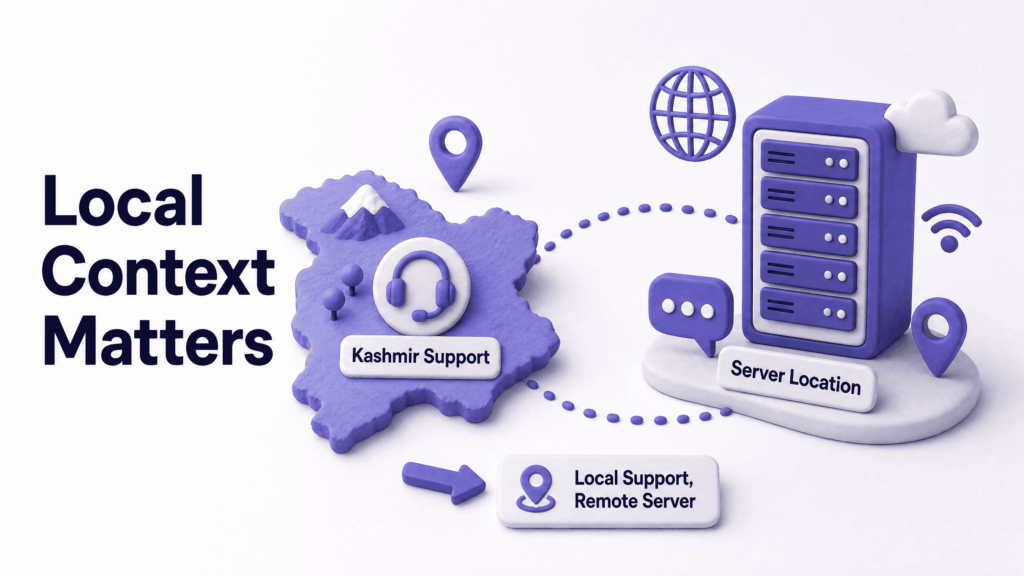
Here’s something most hosting guides skip: a company being “based in Kashmir” and that company’s servers being physically located in Kashmir are two different things. The difference matters more than it sounds.
Servers versus local shutdowns
J&K has gone through periods of internet restriction over the years, some brief, some prolonged. Data from Access Now, cited by VOA, found the region recorded more shutdown incidents than any other territory tracked worldwide in a recent year. That’s a planning factor for any business here, not a hypothetical one.
The good news: established Kashmir-based hosts almost never run their actual data centers inside the valley. Your files typically sit in Mumbai, Delhi, or an overseas facility, with a local team handling support. That setup works in your favor, customers outside J&K can still reach your site during a local restriction, while you get a support team that understands your billing and picks up the phone.
Billing and GST headaches
Hosts based outside India often bill in dollars, route support through ticket queues in mismatched time zones, and don’t always issue GST-compliant invoices without back-and-forth. If you need clean paperwork for your accountant, check this before you buy, not after your first renewal.
Common mistakes Kashmiri business owners make
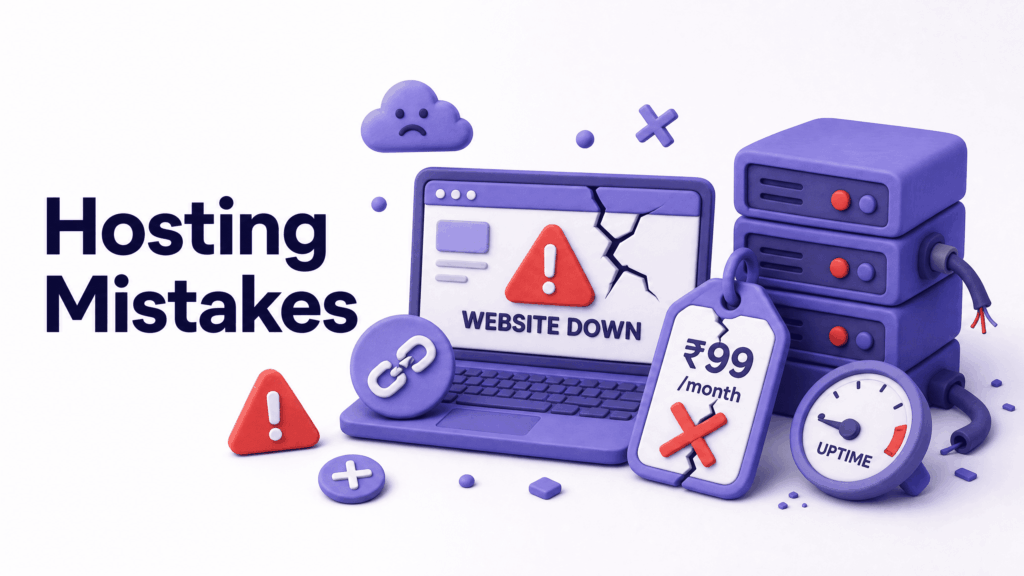
Chasing the cheapest renewal-trap plan. Those ₹99/year deals usually jump 5-10x on renewal, by which point your domain, email, and site are all locked to that provider.
Assuming “local” means “server in Kashmir.” Usually not true, and as covered above, not actually what you want.
Skipping backups because the host “probably” has them. Ask about the actual restore process before you need it, not while your site is down.
Treating email as an afterthought. A professional address at your own domain builds more buyer trust than most owners realize, and it’s rarely included in ₹99 plans.
Buying on a WhatsApp recommendation without testing support first. Call the number on a weekday before you pay. Time how long someone takes to answer.
Splitting domain and hosting across two providers and forgetting about it. If you lose access to either account, you can lose control of your entire website. Keep both with one provider, or keep the login details for both somewhere safe.
Never testing the site on mobile data before going live. Most of your customers are browsing on a phone, not a desktop on office fibre. A site that feels fast on your laptop in Srinagar isn’t automatically fast on someone’s phone in Anantnag.
What to actually check before you buy
- Server location or CDN: India-based infrastructure for Indian visitors, not a data center halfway across the world
- Real uptime history, not just a “99.9%” badge with no compensation policy behind it
- Support channel: phone or WhatsApp response time tells you more than a ticket portal ever will
- Free SSL and daily backups included, not sold as a paid add-on later
- A clear upgrade path from shared hosting to VPS or cloud, so growth doesn’t mean starting over
- WordPress-specific tools, if that’s your CMS; one-click installs, caching, and update management
- Free migration support, so switching later doesn’t cost you extra on top of what you’re already paying
Speed affects sales too. Google’s own Core Web Vitals research ties small load-time improvements directly to higher conversion rates on retail and ecommerce sites, this isn’t a nice-to-have, it shows up in the numbers.
Shared, VPS, or cloud: what your business actually needs

A brochure site or a starter WordPress blog runs fine on shared hosting. A shop selling online, a tour operator taking bookings, or anyone expecting seasonal spikes — Eid, tourist season, exam results if you’re in ed-tech — needs cloud or VPS hosting that absorbs sudden traffic instead of buckling under it. ElySpace’s cloud hosting guide for Kashmir businesses breaks this decision down further, and their domain registration guide is worth reading before you register anything new.
Getting your website migrated without losing anything
Switching hosts feels riskier than it actually is, which is the real reason most business owners stay stuck with a bad one for years. A proper migration copies your files, your database, and your email accounts to the new server first, and only points your domain to the new location once everything’s confirmed working. There’s no window where your site just disappears.
The question worth asking isn’t “can you migrate my site,” because almost every host says yes to that. Ask instead who’s actually doing the work, how long DNS propagation takes on their end, and what happens to your inbox during the switch. A provider that’s serious about this handles all three within a day, usually at no extra cost if you’re bringing over an active site with a live domain.
One thing worth knowing before you migrate anything: DNS changes can take anywhere from a few minutes to 24-48 hours to fully propagate, depending on your domain’s TTL settings. A host that plans around this, keeping your old site live until the new one is confirmed working everywhere, avoids the gap where some visitors see the new site and others still hit the old one.
WordPress hosting: why it needs its own checklist
A large share of small business sites in Kashmir, from tour operators to boutique exporters, run on WordPress. Generic shared hosting often isn’t built for it. Look for a plan with one-click WordPress installs, automatic core updates, and an actual caching layer, because an un-cached WordPress site on cheap hosting is one of the most common reasons small business sites feel sluggish even on a decent connection.
Plugins are the quieter problem. A host that lets you install unlimited plugins but never scans for outdated or vulnerable ones is setting you up for trouble down the line, most WordPress hacks trace back to an abandoned plugin nobody updated in two years. Ask whether WordPress-specific malware scanning comes included, or whether it’s something you only find out you need after your site’s already been compromised.
If your business runs on WooCommerce or takes bookings through a plugin, this matters even more. Those setups hit the database far harder than a static brochure site, and a host tuned for basic WordPress blogs will choke the moment your checkout page gets real traffic.
Security: what actually protects your site
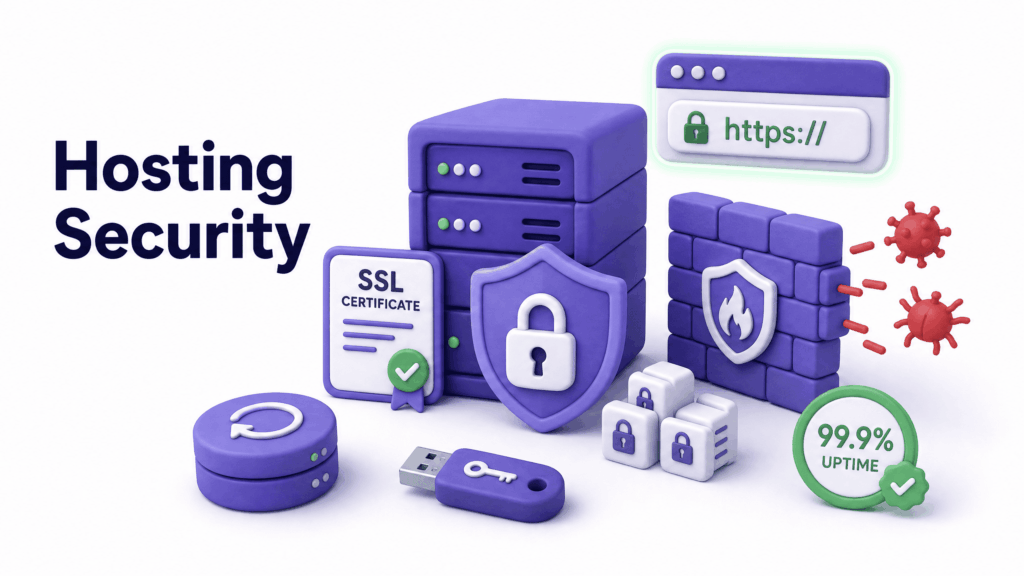
SSL is the baseline now, not a bonus feature. Browsers flag any site without it as “not secure,” and that warning kills trust instantly for anyone about to hand over payment details. Every legitimate host includes free SSL through Let’s Encrypt or an equivalent, so if a provider is charging extra for it, that’s worth questioning before you sign up.
Beyond SSL, ask about firewall-level protection and brute-force login protection, especially if you’re running WordPress or any admin panel reachable from the open internet. Every public server gets scanned and probed constantly, that’s just the internet, so a password alone isn’t enough. You want rate-limiting and monitoring happening at the server level, not a plugin trying to do the same job slower and after the fact.
None of this needs to become your daily problem. It just needs to already be handled by whoever you’re paying to host your site, so ask directly rather than assuming it’s covered.
FAQs (Frequently Asked Questions)
Is hosting different for businesses in Kashmir compared to the rest of India? Not technically. Local support, GST billing, and an understanding of regional connectivity issues make the practical difference.
How much should I budget? Basic shared hosting can start under ₹1,000/year. Anything running real ecommerce or bookings should budget for managed cloud or VPS instead; more upfront, far less downtime during your busiest weeks.
Will my website go down during an internet shutdown in Kashmir? Not if your host’s servers sit outside the valley, which is standard for established local providers. Only local access from inside the restricted zone is affected, not the site itself.
Do I need a dedicated server? Almost never for a small or growing business. VPS or cloud hosting gets you most of the same reliability for a fraction of the cost.
Should I move away from my current cheap host? If renewals keep jumping or support takes days to reply, yes. A decent host will migrate your site over for free.
Can I switch hosts without losing my email? Yes, if it’s planned properly. The new host sets up your email accounts first and only redirects your domain once everything’s tested and confirmed working.
Is shared hosting secure enough for taking payments online? For basic bookings or inquiries routed through a payment gateway redirect, yes, as long as SSL is active. If you’re handling card details more directly, you’ll want a more controlled setup, ask your host about this before you build that flow, not after.