 Live Chat
 Contact
 Shopping Cart
 Irfan Bhat
If you run a business in Srinagar, Baramulla, or anywhere in the Valley and your website keeps crashing the moment a few extra visitors show up, you already know the problem. You’re probably wondering if cloud hosting in Kashmir is the fix, or just another buzzword hosting companies throw around to sell a bigger plan.
Fair question. And it deserves a straight answer, not a sales pitch.
I’ve spent enough time around local businesses, from handicraft exporters to tour operators to small SaaS teams, to know that hosting in this region comes with its own set of headaches. Patchy connectivity in parts of the Valley, occasional service disruptions, and a market where most hosting advice is written for Delhi or Bangalore, not for a shop owner in Lal Chowk trying to take online orders during tourist season.
So let’s actually break down what cloud hosting is, why it matters here specifically, and whether it’s worth the switch for a growing business. No fluff, no jargon you need a dictionary for.
What Cloud Hosting Actually Means
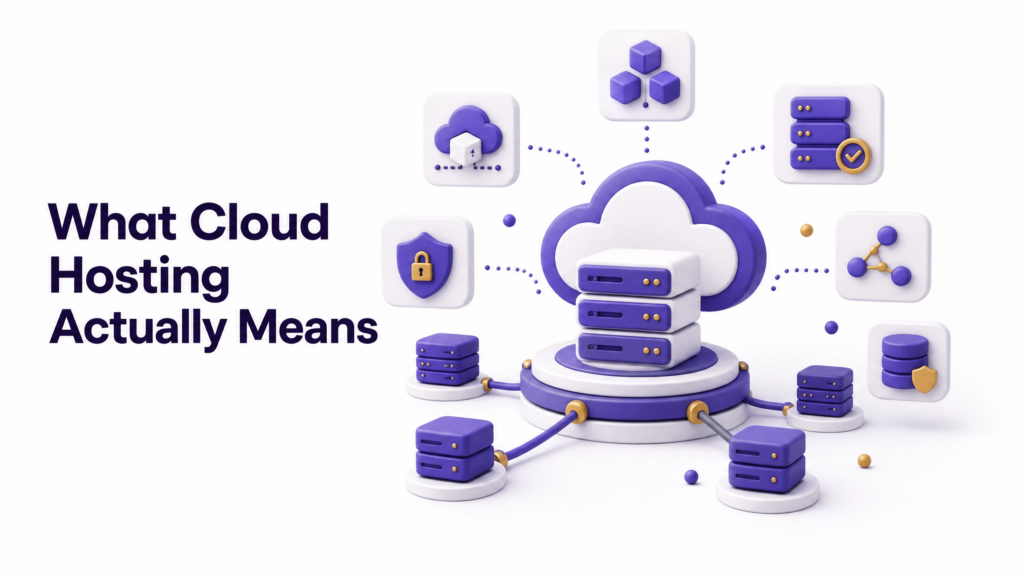
Forget the marketing diagrams with fluffy clouds and arrows going everywhere. Here’s the plain version.
Traditional hosting puts your website on one physical server. If that server is slow, overloaded, or down for maintenance, your site goes with it. Cloud hosting spreads your website across a network of connected servers instead. If one machine has a problem, another one picks up the load, usually without your visitors noticing anything at all.
That’s the whole idea. Redundancy and flexibility, built in from the start. You can read a more technical breakdown of the concept on Wikipedia’s cloud computing page if you want the textbook definition, but for a business owner, the practical takeaway is simpler: your site doesn’t depend on a single point of failure.
For a small blog, this might not matter much. For a business that takes orders, processes payments, or runs ads that drive traffic to a landing page, it matters a lot.
Why Hosting Feels Different in Kashmir
This is the part most generic hosting articles skip entirely, and it’s exactly why they don’t help anyone here.
Internet infrastructure in Jammu and Kashmir has come a long way, but it’s still catching up to the rest of the country. Government data shows India crossed over a billion internet subscribers earlier this year, with broadband growing at a healthy pace nationally, but that growth hasn’t been even across every district. A TRAI drive test published in August 2026 found massive gaps between operators in the Valley. One provider hit close to 280 Mbps on a stretch near Gulmarg, while another struggled to clear 7 Mbps on the Anantnag-Pahalgam route, with several dropped calls along the way.
That kind of gap changes how you should think about hosting. If your customers are connecting over a shaky mobile network from a smaller town, every extra second your site takes to load costs you a visitor. Cloud infrastructure with proper caching and load balancing can absorb some of that lag. A single overworked server usually can’t.
There’s also the region’s history with connectivity disruptions, which every local business owner remembers, whether they like it or not. Projects under the National Broadband Mission and BharatNet are actively laying fiber and expanding 4G towers across thousands of panchayats in J&K, which is genuinely good news for the region’s digital future. But until that infrastructure fully matures, businesses here are smart to build in extra resilience wherever they can, and hosting is one of the easiest places to do that.
None of this means cloud hosting magically fixes local internet gaps. It doesn’t touch the “last mile” connection to your customer’s phone. What it does fix is everything on your end: your server response time, your uptime, and how well your site handles a sudden spike in visitors, say, during Eid sales or peak tourist booking season.
Cloud Hosting vs Shared Hosting vs VPS
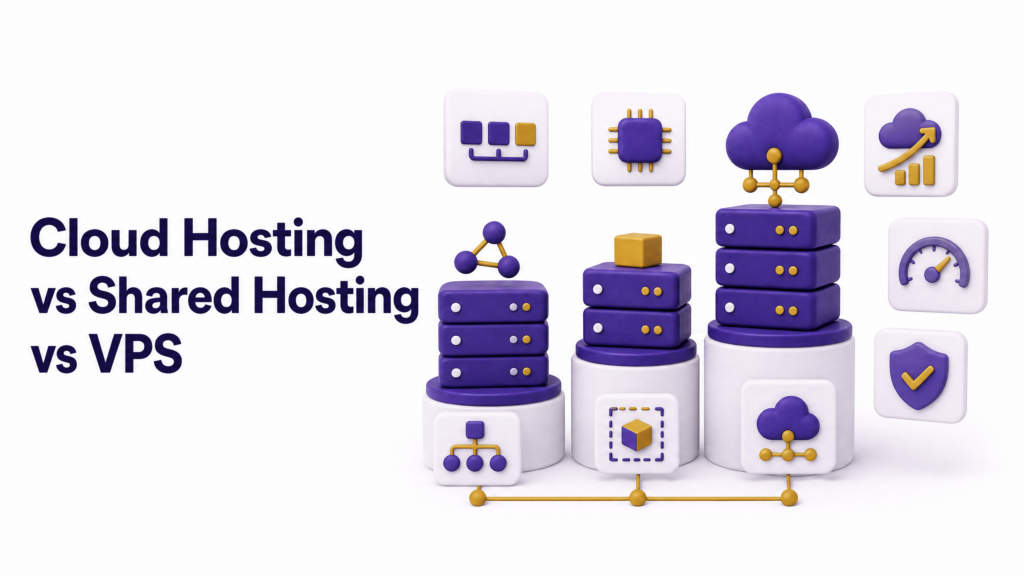
Let’s clear up the confusion, because a lot of business owners get sold the wrong plan simply because nobody explained the difference properly.
Shared hosting puts your website on the same server as dozens, sometimes hundreds, of other websites. It’s cheap, and it’s fine for a personal blog or a portfolio site. The catch is that if another website on that server gets a traffic surge or gets hit by a spam attack, your site can slow down too. You’re sharing resources with strangers.
VPS hosting gives you a dedicated slice of a server, walled off from other users. It’s a step up, more control, more consistent performance, but it still runs on one physical machine underneath.
Cloud hosting removes that single-machine dependency entirely. Your resources scale up automatically when traffic spikes and scale back down when things quiet down. You’re not paying for capacity you don’t use, and you’re not stuck when you suddenly need more.
Here’s a simple way to picture it. Shared hosting is like renting a desk in a crowded co-working space. VPS is your own private office in that same building. Cloud hosting is more like a serviced office network where you can walk into any available branch and get exactly the space you need, whenever you need it.
For a business that’s growing, that flexibility isn’t a luxury. It’s the whole point.
Is Cloud Hosting Really Better for Growing Businesses?
Short answer: for most growing businesses, yes. Here’s why, without the sales-page exaggeration.
Scalability without the panic. A shared server can choke the moment your Instagram ad goes viral or a local news outlet links to your site. Cloud hosting handles traffic spikes by pulling in more resources automatically, so you’re not refreshing your dashboard at midnight wondering why your checkout page went down during a flash sale.
Better uptime. Because your site isn’t tied to one physical server, a hardware failure somewhere in the network doesn’t have to mean your site is offline. For an e-commerce store or a booking platform, even twenty minutes of downtime during peak hours can mean real, direct revenue loss.
Pay for what you use. Small and growing businesses rarely have predictable, flat traffic. You might get quiet months and then a huge spike around Amarnath Yatra season or a wedding-industry rush. Cloud plans typically let you scale resources as needed instead of locking you into a fixed, oversized plan year-round.
Faster load times for a spread-out audience. If you’re selling handicrafts, pashmina, or dry fruits to customers outside the Valley, or even outside India, cloud infrastructure with content delivery built in serves your pages faster regardless of where the buyer is sitting. That directly affects conversions. Google itself has said page speed is a ranking and user-experience factor, not just a nice-to-have.
Security that doesn’t rely on one weak link. Cloud providers generally offer built-in firewalls, regular backups, and DDoS protection as part of the package. On budget shared hosting, that kind of protection is often an expensive add-on, if it’s offered at all.
None of this means every business needs to jump to cloud hosting today. A small local blog with a few hundred visitors a month is fine on shared hosting. But the moment you start taking online payments, running ad campaigns, or depending on your website as an actual sales channel, the math starts favoring cloud hosting pretty quickly.
Where Cloud Hosting Falls Short
I’m not going to pretend cloud hosting is perfect, because it isn’t, and any article that tells you otherwise is trying to sell you something.
It can cost more than basic shared hosting, especially if you’re not managing resources carefully. Pricing models vary a lot between providers, and some charge in ways that are genuinely confusing for a first-time buyer. It also assumes a certain level of technical setup. If you’re migrating an existing WordPress site or a custom-built platform, you’ll want a provider that actually helps with migration instead of leaving you to figure it out alone.
And again, no hosting plan fixes a poor local internet connection on the customer’s end. If your target audience is browsing on a weak 2G signal in a remote area, the fastest cloud server in the world won’t make their experience feel instant. Hosting improves your side of the equation. It’s not a cure for infrastructure problems outside your control.
How to Choose Cloud Hosting in Kashmir
If you’ve decided cloud hosting makes sense for where your business is headed, here’s what actually matters when comparing providers, beyond flashy homepage claims.
- Local or India-based support that responds fast. When something breaks at 11 PM before a big sale, you want someone who picks up, not a ticket queue that takes two days.
- Real uptime guarantees, not just a number on a landing page. Ask what happens if they miss it.
- Free migration assistance, so switching doesn’t mean days of downtime while you move files manually.
- Transparent pricing, with no surprise charges once you’re past the “starting from” price on the homepage.
- Backups included by default, not sold separately as a scary upsell after something goes wrong.
- SSL and basic security tools are bundled in, since Google flags non-secure sites and customers notice too.
If you want a starting point, ElySpace’s hosting plans built for the Kashmir market are worth comparing against whatever you’re currently using, purely on the basis of local support response times and pricing transparency. You can also read more about who’s behind the service on their About page before committing to anyone.
A Quick, Honest Example
Picture a small handicrafts export business based out of Srinagar. Their site sat on basic shared hosting for two years, and it worked fine until a feature in a national newspaper sent a sudden wave of traffic their way. The site buckled within an hour. Orders were lost, and worse, so was the trust of new customers who tried to check out and got an error page instead.
That’s the exact scenario cloud hosting is built to prevent. Not because it’s fancier, but because it’s designed to handle unpredictability, which is precisely what a growing business deals with constantly. You don’t always know when the spike is coming. You just need your site to survive it when it does.
FAQs
Is cloud hosting more expensive than regular hosting in Kashmir? It can be, but not always. Entry-level cloud plans are often priced close to VPS hosting, and you avoid paying for unused capacity the way you might with an oversized shared or dedicated plan.
Will cloud hosting fix slow internet speeds in remote parts of Kashmir? No. It improves how fast your server responds and how well it handles traffic, but it can’t change the quality of your visitor’s local internet connection.
Is cloud hosting harder to set up than shared hosting? Not with a good provider. Most reputable cloud hosts, including local ones, offer one-click installs and migration support so you’re not configuring servers manually.
How do I know when my business has outgrown shared hosting? If you’re seeing regular slowdowns during traffic spikes, running paid ad campaigns, processing online payments, or planning to scale beyond a handful of pages, it’s usually time to look at cloud or VPS options.
Conclusion
Cloud hosting won’t fix a bad website design, and it won’t write your product descriptions for you. What it will do is make sure your business doesn’t lose customers to a server that can’t keep up with your own growth. In a region where connectivity already throws enough curveballs, that’s not a small thing. It might be the one part of your online presence you can actually control completely.