 Live Chat
 Contact
 Shopping Cart
 Rashid Malla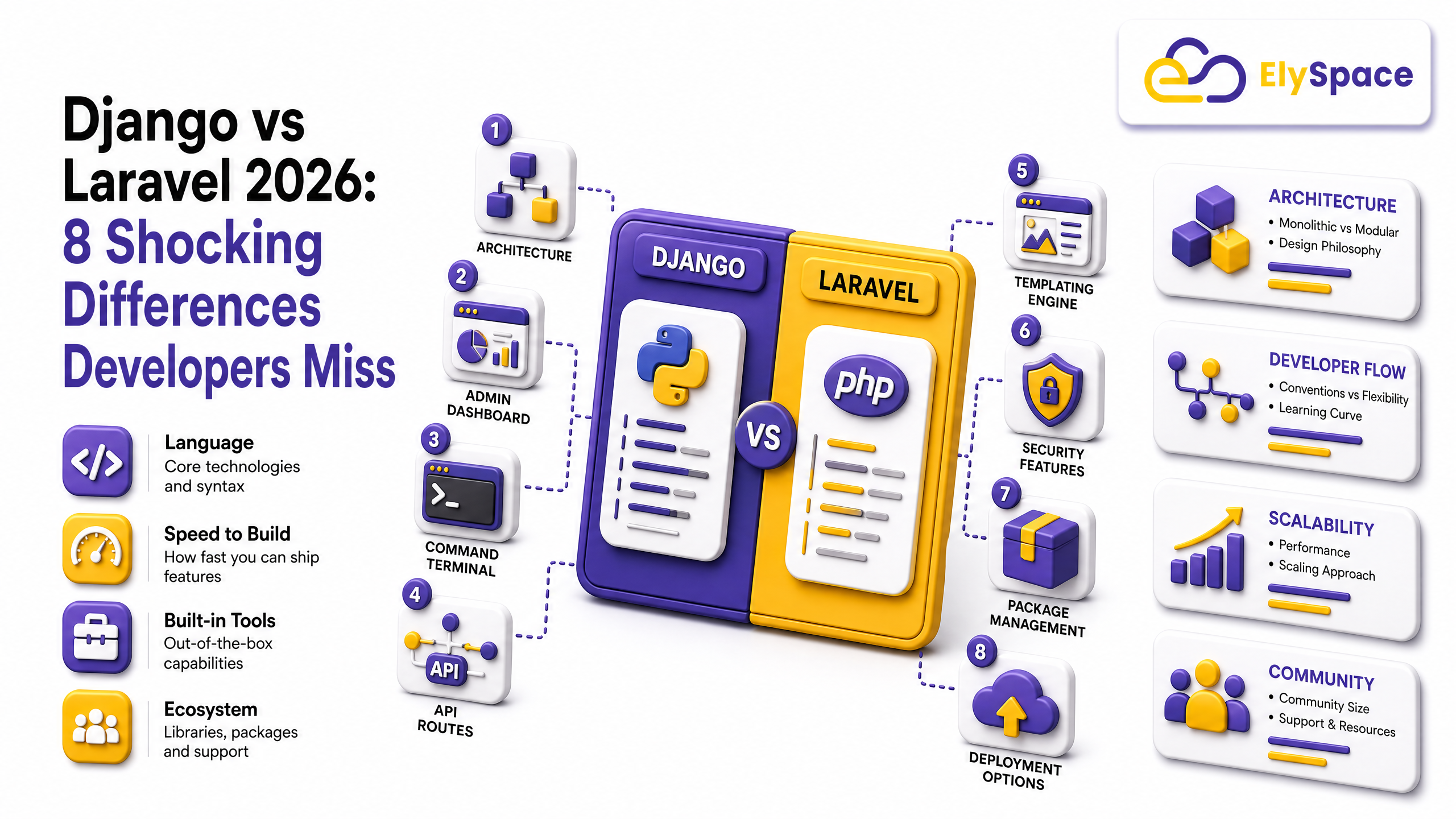
I’ve shipped production apps in both frameworks, and I still get asked the same question at least once a month: Django or Laravel? People expect a clean one-line answer. There isn’t one. The real answer to Django vs Laravel 2026 depends on your team, your stack, and honestly, what you’re trying to build.
What surprised me while writing this Django vs Laravel 2026 comparison is how many “comparison” articles online are years out of date. Laravel 13 shipped in March 2026 with a stable AI SDK and passkey authentication baked in. Django just moved to an annual release cycle starting in 2028, and Django 6.1 landed in August 2026 as the current stable branch. None of that context shows up in the recycled 2022-era comparisons still ranking on page one. So let’s fix that.
This isn’t a “both are great, pick whichever” cop-out. I’m going to tell you where each one actually wins, where it quietly loses, and where teams get burned picking the wrong one for their situation.
Django vs Laravel 2026: The Quick Verdict
If you want the short version before the details: Django tends to win for data-heavy applications, admin-panel-driven tools, and teams that already live in the Python ecosystem, especially anything touching machine learning. Laravel tends to win for teams that want to ship a full product fast, with less boilerplate and a friendlier learning curve for junior developers.
Neither one is objectively “better.” That framing is lazy, and it’s why so much content on Django vs Laravel 2026 gets ignored by readers who actually need an answer. What matters is fit.
Django vs Laravel Performance
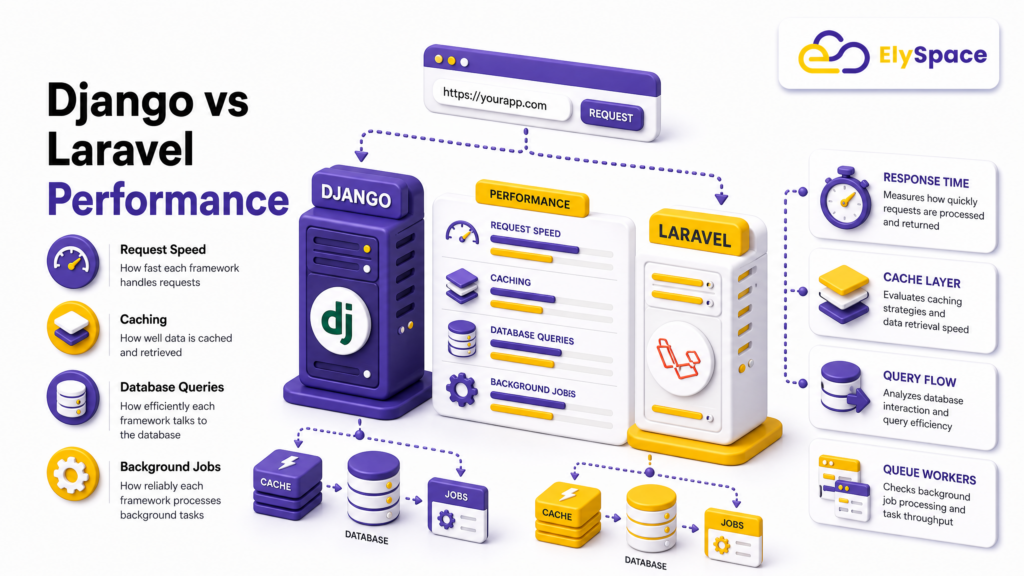
Raw benchmark numbers get thrown around a lot in this Django vs Laravel 2026 debate, and most of them are misleading. Here’s what actually holds up under real traffic.
PHP’s request lifecycle, especially with Laravel Octane running on Swoole or RoadRunner, closes a lot of the performance gap that used to exist between PHP and Python frameworks. Laravel without Octane runs on a traditional request-response cycle that spins up fresh on every request, which is fine for most apps but adds overhead under heavy concurrent load.
Django, running behind Gunicorn or Uvicorn with ASGI support, handles async views reasonably well now, though it’s still not as natively async-first as something like FastAPI. For most CRUD-heavy business apps, both frameworks perform close enough that database query optimization matters more than framework choice. I’ve seen more apps get killed by an N+1 query problem than by the framework itself.
Bottom line on Django vs Laravel performance: if your bottleneck is genuinely the framework and not your database or your architecture, you’re already doing something unusual. Optimize your queries first.
Django REST Framework vs Laravel API
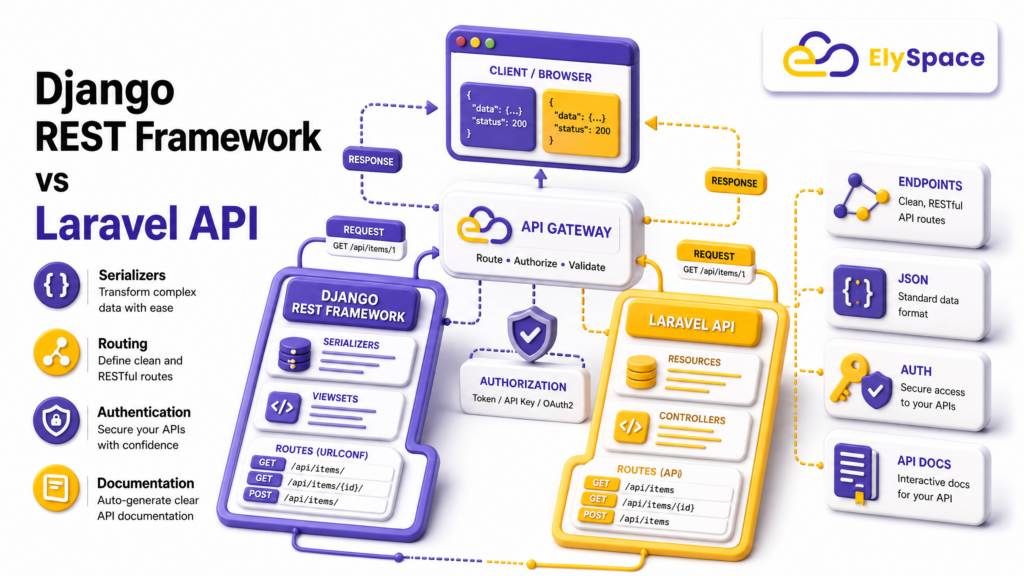
This is where the Django vs Laravel 2026 comparison gets genuinely interesting, because both ecosystems built dedicated tooling for API development instead of leaving it as an afterthought.
Django REST Framework, usually just called DRF, is mature, opinionated, and handles serialization, authentication, and permissions with very little custom code. Once you learn its patterns, building a consistent API across a large codebase gets fast. The tradeoff is a steeper initial learning curve. DRF has its own mental model that takes a week or two to click.
Laravel API development leans on Eloquent API Resources and Sanctum for token-based auth, and it feels noticeably lighter to get started with. You can have a working authenticated API endpoint running in under an hour on a fresh Laravel install. Whether that “faster to start” advantage still matters six months into a complex project is a fair question, and honestly, it depends on how disciplined your team is about structure.
If your API surface is genuinely complex, with nested permissions and heavy customization, DRF’s structure pays off long-term. If you need to ship a straightforward API fast, Laravel gets you there quicker.
Laravel Eloquent vs Django ORM
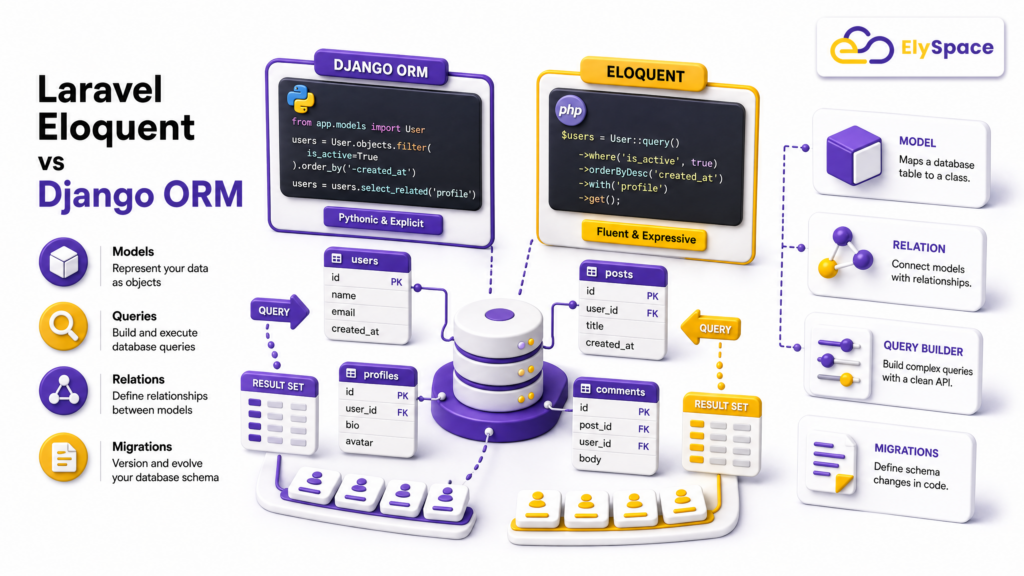
Both ORMs are excellent, and comparing them honestly for a Django vs Laravel 2026 breakdown means admitting neither one is “wrong.”
Eloquent’s ActiveRecord pattern feels intuitive almost immediately. You call methods directly on model instances, relationships read naturally in code, and the query builder syntax is genuinely pleasant to write. It’s one of the reasons Laravel wins over so many developers early.
Django’s ORM follows the data mapper pattern instead. It takes slightly longer to feel natural if you’re coming from Eloquent, but it scales cleaner on complex queries involving multiple joins and aggregations. Django’s select_related and prefetch_related give you explicit, fine-grained control over query performance in a way that feels more predictable once you understand it.
I lean toward Django’s ORM for data-intensive applications with genuinely complex relationships. For standard CRUD apps, Eloquent’s readability wins on developer happiness alone, and that matters more than people admit.
Learning Curve: Which One Onboards Faster
Be honest with yourself about your team before picking a framework based on features alone. This is the part most Django vs Laravel 2026 guides skip past too fast.
Laravel’s documentation is famously good, the conventions are consistent, and a junior developer with basic PHP knowledge can be productive within days. Laracasts alone has turned thousands of beginners into working Laravel developers.
Django expects a bit more from day one. Python fundamentals help, but Django’s project structure, its app-based architecture, and its “batteries included” philosophy mean there’s more to absorb before you’re truly comfortable. It pays off in the long run through consistency and fewer surprises, but the ramp is real.
If you’re hiring junior developers or running a bootcamp-trained team, Laravel usually gets people shipping faster. If your team already knows Python, Django’s learning curve barely registers as a curve at all.
Django vs Laravel for Enterprise
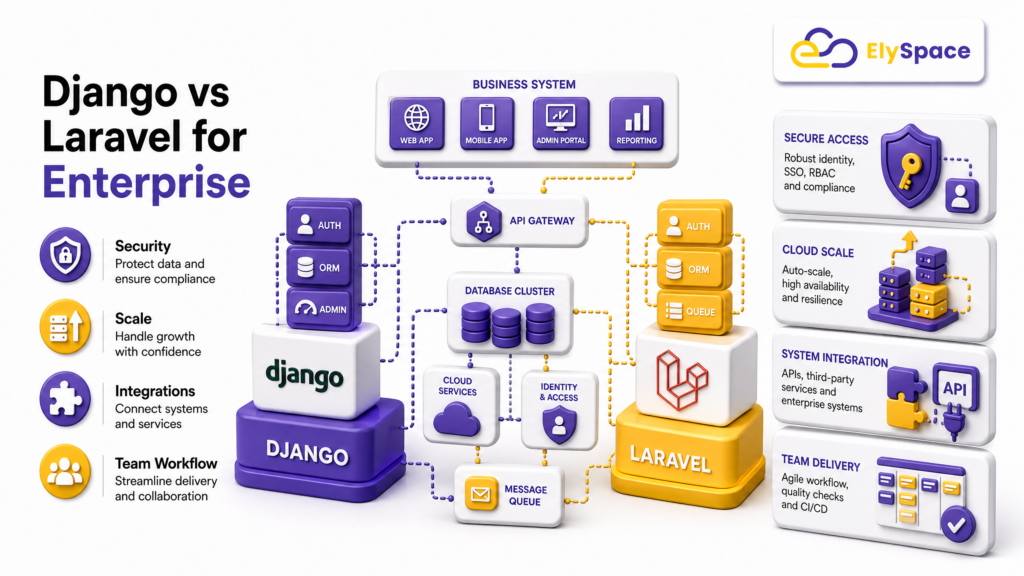
Enterprise decisions rarely come down to “which framework is cooler.” They come down to hiring pools, long-term maintenance costs, and how the framework plays with the rest of your infrastructure.
Django vs Laravel for enterprise often gets decided before a single line of code gets written, based purely on what language the rest of the company already runs. A company with a data science team already writing Python has an obvious pull toward Django, since it shares tooling, libraries, and hiring pipelines with the rest of that stack.
Laravel fits naturally into shops already running PHP for other systems, and it integrates smoothly with common enterprise needs like queue-based job processing through Laravel Horizon, and structured deployment through Laravel Forge or Vapor. Its LTS release cadence also gives enterprise teams a predictable upgrade path, which procurement teams tend to appreciate more than developers do.
Neither framework is a poor enterprise choice. The deciding factor is almost always what’s already running in your infrastructure, not the framework’s raw capability.
Best Backend Framework 2026: Job Market and Community
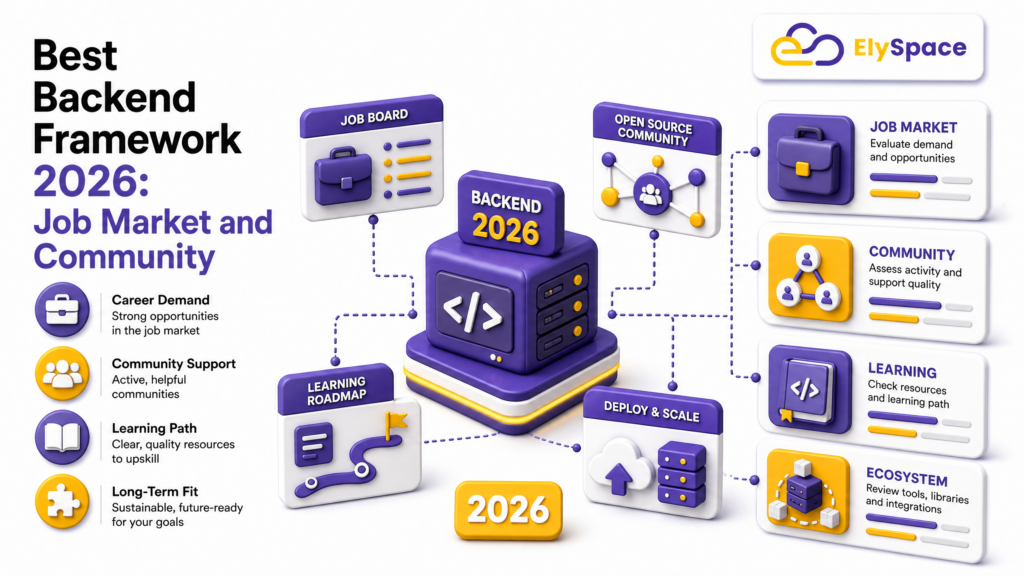
Nobody picks a framework in a vacuum. Hiring and community support matter just as much as technical merit, maybe more.
Python, and Django by extension, benefits from Python’s dominance across data science, automation, and AI tooling. That means a larger overall talent pool, even if not every Python developer specializes in Django specifically. Job postings mentioning Django have stayed steady, largely driven by companies that need both a web backend and access to Python’s machine learning ecosystem under one roof.
Laravel dominates PHP job listings almost completely at this point. If a company is hiring for PHP, there’s a strong chance Laravel is the framework behind that listing, since it’s become close to the default choice for new PHP projects. The community is active, well-organized around Laracon events, and genuinely welcoming to newcomers, which keeps the ecosystem healthy.
Calling either one the single best backend framework in 2026 misses the point. Both have strong, sustainable communities. The real question is which talent pool you want to hire from.
Security Comparison
Security posture matters more than most Django vs Laravel 2026 comparison articles bother covering, so let’s actually go there.
Django ships with a genuinely strong security-first philosophy baked into its defaults: automatic protection against SQL injection through parameterized queries, built-in CSRF protection, and clickjacking protection enabled out of the box. The Django Software Foundation also became a CVE Numbering Authority in 2026, meaning it can now assign vulnerability identifiers directly for Django and related projects, which speeds up how fast the community can respond to disclosed issues.
Laravel takes security seriously too, with built-in CSRF tokens, hashed and salted passwords by default, and Sanctum handling API token security cleanly. Where Laravel occasionally trips up newer developers is that its flexibility makes it easier to accidentally expose something through a misconfigured route or an overly permissive mass-assignment setup on a model.
Both frameworks are secure by default when used correctly. Django’s stricter conventions make it marginally harder to accidentally shoot yourself in the foot, while Laravel’s flexibility puts a bit more responsibility on the developer.
Which Should You Actually Pick
Here’s my honest take on Django vs Laravel 2026 after building real products in both.
Pick Django if you’re building something data-heavy, if your team already knows Python, or if you expect to eventually bolt on machine learning features without switching stacks. Pick Laravel if you want to ship a full-featured product fast, your team is comfortable in PHP, or you value Laravel’s ecosystem of first-party tools like Forge, Nova, and Horizon working together out of the box.
There’s no trophy for picking the “correct” framework. There’s only the question of whether your team can build and maintain the product well in the one you chose. Both Django and Laravel are mature, well-funded, and actively developed. You genuinely can’t go wrong on technical merit alone.
What you can get wrong is ignoring your team’s existing skills and picking based on hype instead. Don’t do that.
If you’re weighing which stack to run in production, hosting matters just as much as framework choice. Django apps need solid Python/WSGI support, and Laravel apps need clean PHP environments with proper queue and cron support. ElySpace’s business hosting plans support both stacks, so the framework decision doesn’t have to double as a hosting migration headache. For more comparisons like this one, check the ElySpace blog.
For the official word straight from the source, the Django release notes and Laravel release notes are worth bookmarking. They update far more often than most comparison articles do.