 Live Chat
 Contact
 Shopping Cart
 Eshan Riyaz
“Digital transformation” sounds like something that happens in a boardroom with consultants, a six-figure budget, and a three-year plan. For most small business owners, it sounds expensive, complicated, and not quite relevant to running a tour company, a local shop, or a services agency.
That’s a misunderstanding, and an expensive one.
Digital transformation for small businesses isn’t about replacing everything you do with technology. It’s about using the right digital tools to do what you already do; better, faster, and with less friction. It’s the difference between chasing down payments manually and having them tracked automatically. Between answering the same customer questions repeatedly and having a system handle them. Between relying entirely on referrals and having a website that brings in enquiries while you sleep.
Small businesses adopting digital tools grew revenue at nearly twice the rate of those that did not. That gap is why this matters, and why the businesses that understand it are quietly pulling ahead of the ones that don’t.
What Digital Transformation Actually Means
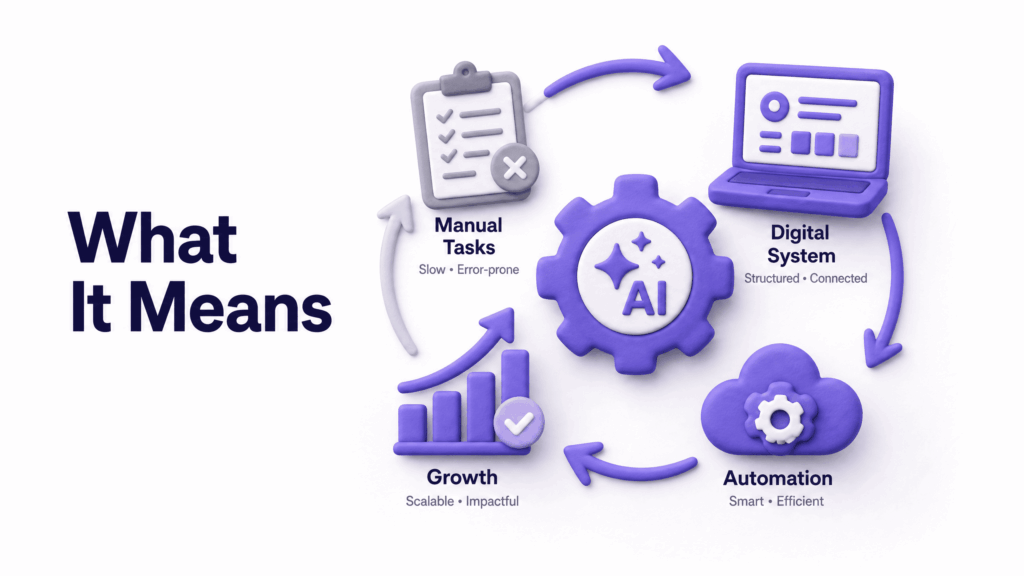
Strip away the jargon and digital transformation for small businesses means one thing: using technology to remove friction from your operations and improve the experience for your customers.
It’s not a single project. It’s not buying expensive software. Digital transformation is a continuous process of adaptation and improvement rather than a destination you reach and then stop.
For a small business, it might look like:
- Moving from paper invoices to automated digital billing
- Building a website that brings in enquiries instead of just existing online
- Using a simple CRM to track customer conversations instead of relying on memory
- Automating follow-up messages instead of manually chasing leads
- Publishing consistent blog content that ranks on Google rather than relying entirely on referrals
None of these individually constitute a transformation. Together, applied progressively, in the right order, they fundamentally change how the business operates and competes.
Digital transformation small business efforts have crossed a structural threshold. What was once an optional competitive upgrade has become an operational necessity for businesses competing in markets where customers expect digital interaction.
Why It’s No Longer Optional
The pressure to transform isn’t theoretical. It’s coming from specific, measurable directions.
75% of small and medium businesses are investing in AI, and 78% of SMB (Small and Medium Businesses) leaders consider it a strategic priority for their business. These aren’t tech companies, they’re the businesses competing in your category, in your market, for your customers.
79% of customers switch providers after a poor digital experience. That’s the consequence of not transforming, not a gradual decline, but an active loss of customers who expected something your business couldn’t deliver.
According to market data, small and medium-sized businesses spent a combined $1.7 trillion on IT globally in 2025, with SMB technology spending projected to grow 6.1% in 2026.
The businesses not in that number are increasingly visible in their absence. Customers notice when a competitor’s booking process is seamless and yours requires a phone call. When a competitor’s website answers their question and yours doesn’t. When a competitor’s response comes instantly and yours comes the next morning.
The business world right now looks nothing like it did five years ago. Customers expect a seamless digital experience before they ever walk through your door. For small businesses, this shift is not a distant trend to plan for; it is happening right now.
The 5 Pillars of Digital Transformation for Small Businesses
Pillar 1: A Professional Web Presence
Everything starts here. Before any other digital tool matters, your business needs a website that works; fast-loading, mobile-friendly, clearly communicating what you offer and who it’s for, with a visible way to contact you.
Building a strong web presence is the foundation of digital transformation, meeting customers on mobile with a thoughtful digital experience and opening revenue channels that work around the clock.
A website isn’t just an online brochure. Done properly, it’s a 24-hour lead generation system. It answers customer questions when you’re unavailable, builds trust before first contact, and appears in Google search results when potential customers are actively looking for what you sell.
Without this foundation, every other digital investment is weakened. Social media points people somewhere that doesn’t convert. Ads drive traffic to a site that loses them. SEO efforts have nowhere to land effectively.
Pillar 2: Digital Customer Communication
How customers reach you and how you respond to them is one of the highest-leverage areas for digital transformation in a small business.
This includes:
- A professional email address at your own domain rather than a free service
- A WhatsApp Business account with structured quick replies and automated greetings
- A contact form on your website that actually delivers submissions reliably
- A simple system for tracking enquiries so nothing falls through the cracks
Setting up a customer feedback system or automating responses to common enquiries is one of the most immediately impactful digital transformation steps a small business can take.
For service businesses in particular; tour operators, agencies, clinics, consultants, response speed directly affects conversion rates. Customers asking the same question to three businesses often go with whoever responds first. Digital communication systems remove the lag.
Pillar 3: Automation of Repetitive Tasks
Accounts payable automation, appointment scheduling, and invoice processing deliver payback periods under six months; the fastest ROI category in digital transformation.
These are the tasks that drain hours every week without requiring your expertise: sending payment reminders, confirming appointments, following up with leads who went quiet, generating monthly invoices. All of them can be automated with tools that cost far less than the time they replace.
The practical starting points for most small businesses:
- Automated invoice generation and payment reminders
- Appointment booking systems with automatic confirmations and reminders
- Email sequences that follow up with leads at defined intervals
- Social media scheduling so content goes out consistently without daily manual effort
Each automation frees up time that can go toward work only you can do.
Pillar 4: Cloud-Based Operations
Small businesses moving core operations to cloud infrastructure reduce IT costs by 30–40% and eliminate the capital expense cycles that constrain growth.
Cloud tools replace physical infrastructure with accessible, scalable, pay-as-you-go services. Cloud accounting replaces desktop software. Cloud storage replaces physical drives. Cloud hosting replaces owned servers. Cloud CRM replaces spreadsheets and memory.
The top IT investment priorities for small and medium businesses are cybersecurity, cloud migration, AI and automation, data analytics, and remote and hybrid work infrastructure.
The immediate benefits: lower upfront cost, automatic updates, access from any device, built-in backup, and the ability to scale without purchasing new hardware. For a small business, these advantages compound quickly into real operational efficiency.
Pillar 5: Data-Driven Decision Making
Most small businesses make decisions based on gut feel and memory. Digital transformation creates the infrastructure to make decisions based on actual data, without requiring a dedicated analytics team.
Simple analytics dashboards integrating sales, marketing, and operational data are increasingly standard among small businesses with digital transformation strategies in place. These tools do not require a dedicated data team and display trends visually in near-real time.
At minimum, this means:
- Google Search Console showing which searches bring people to your website
- Google Business Profile insights showing how customers find and interact with your listing
- Basic website analytics showing which pages perform and which lose visitors
- Simple financial tracking showing which services or products generate the most revenue
According to Google’s Small Business resources, free tools like Google Analytics and Google Search Console give small businesses access to the same quality of data insight that large companies pay significant amounts for. The data is freely available, the transformation is in using it to make decisions.
The Right Order to Transform: A Practical Roadmap
This is the question most guides skip: what do you do first?
62% of small business digital transformations fail because companies buy technology before understanding their process gaps. A readiness assessment prevents most implementation failures.
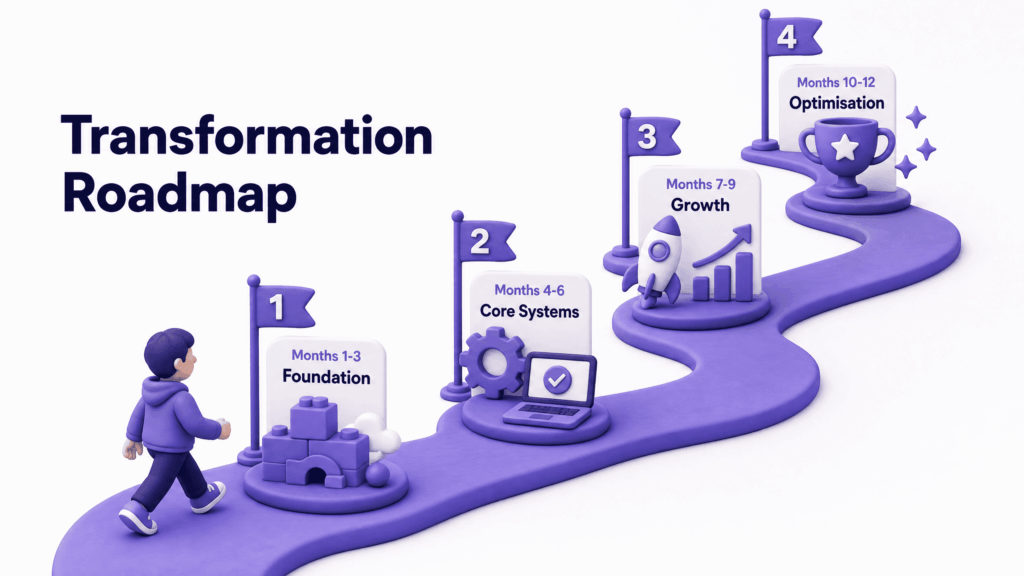
The correct sequence:
Month 1–2: Foundation Get your web presence right. A fast, mobile-friendly, SEO-ready website with proper hosting, SSL, a professional email address, and a complete Google Business Profile. Without this, nothing else delivers its full value.
Month 3–4: Communication and Capture Set up your customer communication systems. WhatsApp Business, reliable contact forms, a simple system for tracking and following up on enquiries. Ensure every lead that comes in gets a response within a defined timeframe.
Month 5–6: Automate the Repetitive Identify the three to five tasks that consume the most time with the least expertise required. Invoice reminders, appointment confirmations, lead follow-ups. Automate one at a time, measure the time saved, then move to the next.
Month 7–9: Content and Visibility Start building your SEO and content foundation. Blog posts answering real customer questions, consistent social media presence on one or two platforms, active management of your Google Business Profile with regular posts and prompt review responses.
Month 10–12: Measure and Optimise Review what’s working. Which pages bring the most traffic? Which services generate the most enquiries? Which automation saves the most time? Use what the data tells you to invest more in what works and adjust what doesn’t.
There is no perfect plan, if you wait for ideal circumstances, you will never begin while your rivals are already making progress.
What It Costs And What It Returns
The most common misconception about digital transformation for small businesses is that it requires significant upfront investment. The reality is more nuanced.
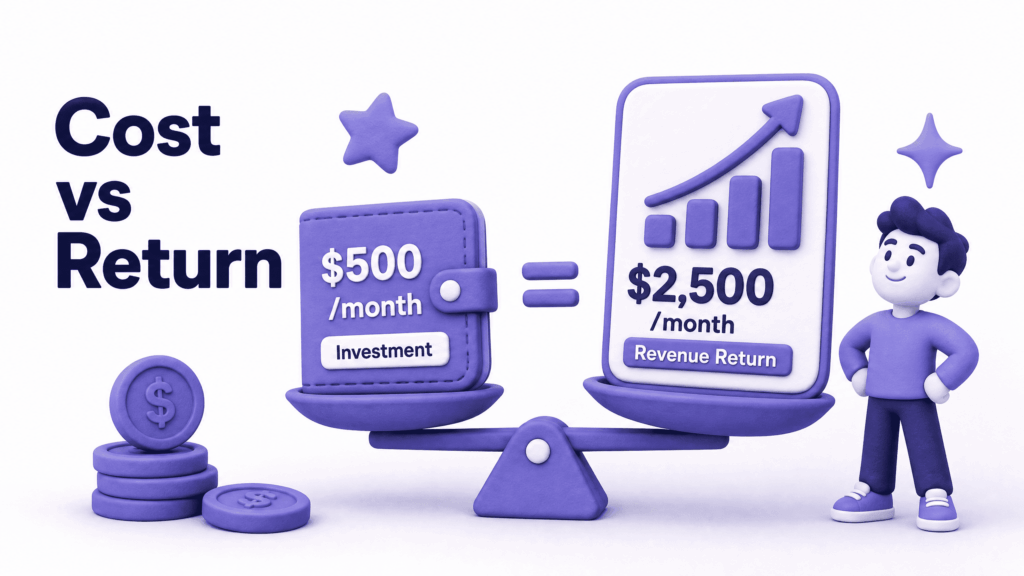
The foundation; a professional website, Google Business Profile, professional email, can be established for ₹15,000 to ₹40,000 in one-time setup cost plus modest monthly hosting and maintenance fees. The ongoing tools; cloud accounting, automation, scheduling, typically cost ₹500 to ₹3,000 per month in subscriptions.
The return, measured properly, is rarely in doubt. A website that generates two additional leads per month at a conversion rate of 50% and an average client value of ₹15,000 returns ₹15,000 per month from the investment, far exceeding the setup and maintenance cost within the first few months.
Customer experience improvements, not cost reduction, generate the highest ROI in digital transformation for small businesses. CX (Customer Experience) improvements generate returns that justify the entire transformation investment on their own.
The businesses that approach digital transformation as an investment with a measurable return, not a cost to be minimised, consistently see better outcomes than those looking for the cheapest possible tools.
The Mistakes That Derail Small Business Transformation
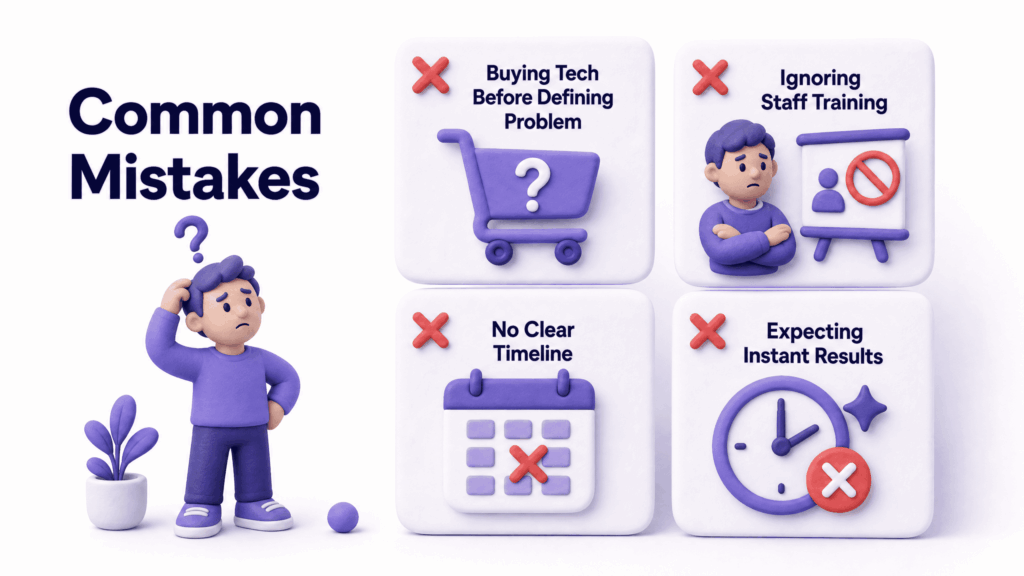
Buying technology before understanding the problem. A CRM doesn’t help a business that doesn’t have a clear process for handling leads. Automation doesn’t help a business that hasn’t defined what it wants to automate. Tools solve defined problems, identify the problem first.
Trying to transform everything at once. The businesses that succeed at digital transformation do it in stages. Trying to implement a new website, a new CRM, new accounting software, and a new communication system simultaneously creates confusion, resistance, and cost overrun.
Measuring the wrong things. The number of social media followers is not a transformation metric. Number of enquiries generated, time saved per week, and revenue attributed to digital channels are. Measure what actually moves the business forward.
Neglecting the human side. As small businesses plan, the emphasis is on upskilling existing people rather than simply adding tools. When employees understand why a new system exists and how it helps them, adoption succeeds. When it’s imposed without context, it fails.
Treating it as a project rather than a process. A business that finishes a website and considers its digital transformation complete will fall behind a competitor that keeps improving. Digital transformation is ongoing; not a box you tick once.
How to Measure Whether It’s Working
Transformation without measurement is just spending. Here are the metrics worth tracking:
Website enquiries per month: are more people contacting you through your website than before?
Time spent on manual tasks: how many hours per week are going to tasks that could be automated? Is that number decreasing?
Customer response time: how long from first enquiry to first meaningful response? Faster response times correlate directly with higher conversion rates.
Revenue from digital channels: what percentage of your revenue can be attributed to customers who found you online? Is that percentage growing?
Google Search Console data: are more people finding your website through search? Is the number of queries you appear for growing over time?
These don’t require sophisticated analytics tools. A simple spreadsheet reviewed monthly tells you whether the direction is right.
What You Can Do This Month
- Audit your current digital presence: search your business name on Google, open your website on your phone, check whether your Google Business Profile is complete and active
- Identify your three biggest time-wasters: the tasks that consume hours every week without requiring your specific expertise, these are your first automation targets
- Check your response time: how long does it take to respond to a new enquiry? If it’s more than a few hours, a communication system upgrade should be your first priority
- Pick one pillar from the five above that your business is currently missing entirely and make it your focus for the next 60 days
- Set one measurable goal for your digital transformation, not “be more digital” but “generate 3 additional enquiries per month through my website by month 6”
At ElySpace, we help small businesses build the digital foundation that makes everything else possible; from professionally built, SEO-ready websites to digital marketing and content strategies that bring in consistent leads. If you’re not sure where your business currently stands or which step to take first, we can assess your current setup and give you an honest, prioritised roadmap. No jargon, no overselling, just a clear picture of where the highest return on your effort actually lies.
FAQs (Frequently Asked Questions)
What is digital transformation for small businesses in simple terms? It’s the process of using digital tools and technology to improve how your business operates and serves customers, progressively replacing manual, paper-based, or disconnected processes with systems that are faster, more reliable, and more scalable. It’s not a single purchase or project. It’s an ongoing shift in how the business runs.
Where should a small business start with digital transformation? With the foundation: a professional website that works properly on mobile, a complete Google Business Profile, and a professional email address at your own domain. These three elements are what make everything else possible. Without them, other digital investments deliver a fraction of their potential value.
How much does digital transformation cost for a small business? The foundation can be established for ₹15,000 to ₹40,000 in initial setup. Ongoing tools and subscriptions typically run ₹500 to ₹3,000 per month. The return, measured in leads generated, time saved, and revenue from digital channels, consistently exceeds the investment when the transformation is done in the right order with the right priorities.
Do I need technical skills to digitally transform my business? For the tools most relevant to small businesses; website management, Google Business Profile, cloud accounting, scheduling and automation platforms, technical skills are not required. Most modern tools are designed for non-technical users. Where genuine technical work is needed; website building, SEO setup, system integration, working with a partner who handles that is more efficient than trying to build the skill yourself.
How long does digital transformation take? There’s no endpoint; it’s ongoing. But meaningful, measurable results from the first round of transformation typically appear within three to six months of consistent implementation. The businesses that start now will have six months of advantage over those that start in six months.
Can digital transformation help a very small or one-person business? Especially so. Digital transformation is a continuous process that applies at every scale, and solo operators often have the most to gain because every hour saved goes directly back to the business owner rather than being absorbed by a larger team. The tools available today are designed to help small teams do what previously required large ones.
What’s the biggest risk of not transforming digitally? 79% of customers switch providers after a poor digital experience. The risk isn’t a dramatic collapse, it’s a gradual erosion of new customer acquisition as competitors with better digital presence capture the customers who would otherwise have found you. By the time the impact is visible in revenue, the gap has been building for months or years.