 Live Chat
 Contact
 Shopping Cart
 Eshan Riyaz
There’s a version of this topic that talks about robots taking over industries and algorithms replacing entire departments. That version isn’t relevant to most small business owners, and honestly, it’s not what’s actually happening.
What is happening is far more practical. A tour company owner in Kashmir using AI to draft WhatsApp responses to enquiries at midnight. A small shop automates their invoice reminders so they stop chasing payments manually. A solo service provider using AI to write a week’s worth of social media content in 45 minutes instead of three hours.
What was once available only to large enterprises with dedicated IT departments is now accessible to startups, local retailers, agencies, consultants, restaurants, and family-owned businesses. The biggest shift isn’t that AI exists; it’s that it’s become practical.
This is the honest guide to how AI helps small businesses, not the theoretical version, but the version about what’s actually working right now, what it costs, and where to start without wasting time on tools that don’t deliver.
The Part of Your Day AI Can Actually Replace
Before getting into specific tools, it helps to understand which types of tasks AI is genuinely good at, and which ones it still struggles with.
AI works best on tasks that are:
- Repetitive: doing the same thing over and over with minor variations
- Pattern-based: following a recognisable structure or format
- Time-consuming but not deeply creative: things that take human effort but don’t require unique insight or relationship
It works poorly on tasks that require:
- Deep knowledge of your specific local context
- Genuine human relationships and trust
- Judgment calls with real stakes and nuance
- Creativity that has to be genuinely original
The practical implication: AI is best at replacing the parts of your day that drain your time without requiring your full expertise. Writing the first draft of a message, sorting enquiries, generating a report format, answering the same question for the hundredth time, these are the tasks AI can handle, freeing you to focus on the work only you can do.
Where Small Businesses Are Using AI Right Now
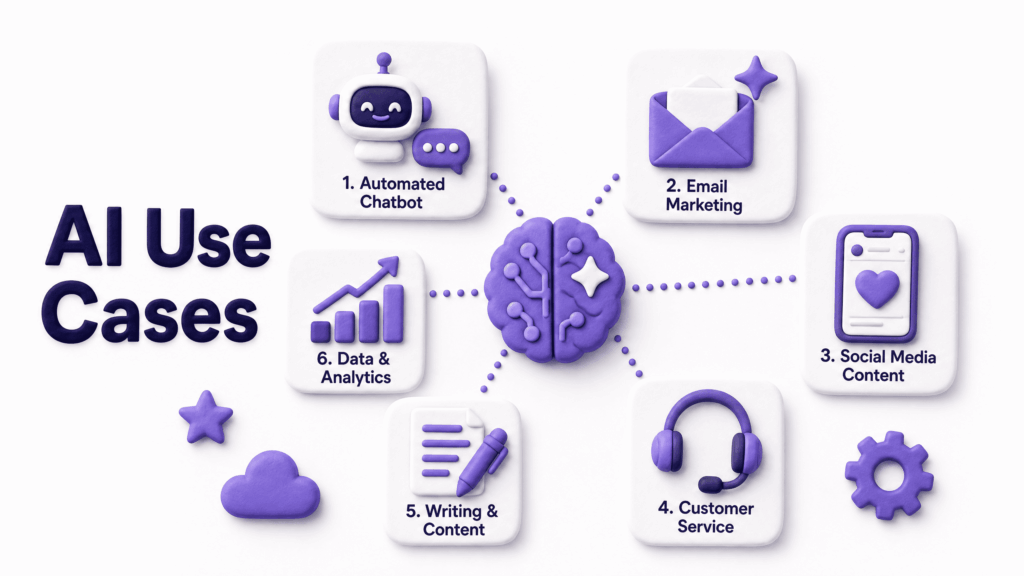
Investment in AI among small and medium businesses increased to 57% in 2025, up from 42% in 2024, a significant jump in just 12 months.
The businesses leading this shift aren’t the most technical ones. They’re the ones who identified specific, painful time-wasters in their day and found AI tools that addressed those exact problems. The most popular AI use cases among small businesses include workflow and administrative automation, streamlining repetitive tasks such as scheduling, invoicing, payroll processing, and resource planning.
The pattern is consistent: small businesses are using AI to do more with the same team, not to replace people, but to remove the parts of the job that shouldn’t require a person in the first place.
How AI Helps Small Businesses Save Real Money
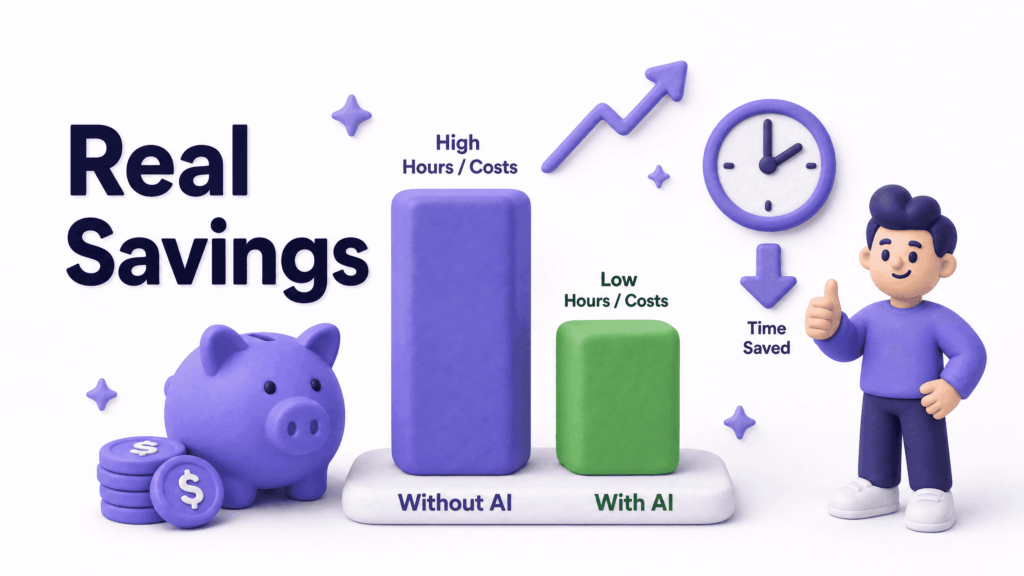
The Thryv survey shows cost savings of $500–$2,000 per month and time savings of 20+ hours per month for many small businesses using AI. In India, 66% of small businesses whose technology investments include AI reported improved profitability.
Those numbers aren’t from businesses with tech departments. They come from owners and small teams who started using AI tools for specific tasks and measured the difference.
The savings come from two places:
Direct cost reduction: tasks that previously required paying a contractor, a part-time employee, or an agency are handled by AI. Content writing, basic customer support, data entry, invoice processing, all of these have AI alternatives that cost a fraction of human labour for routine work.
Time recovered and redirected: the 20+ hours per month that AI saves are hours that can go toward selling, building client relationships, or simply stepping back from the business rather than being consumed by it.
By adopting AI, businesses can streamline operations, reduce costs, and accelerate decision-making, creating space for innovation and relationship-building.
8 Practical Ways AI Saves Time Every Week
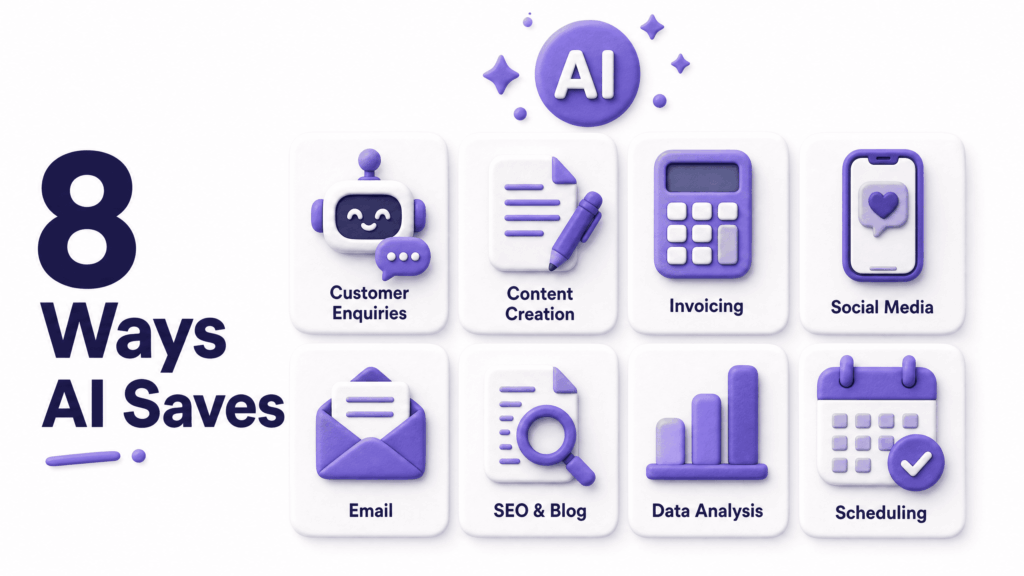
1. Customer Enquiry Responses
How much time do you spend answering the same enquiries? “What are your packages?” “What’s your price?” “Do you do custom orders?” “Are you available in August?”
One of the most effective uses of AI for small businesses includes AI chatbot tools that answer similar questions automatically at any time of day or night; increasing response speed, reducing staff workload, and guaranteeing that customers are answered immediately.
For a Kashmir tour company or any local service business, an AI-powered WhatsApp or website chatbot can handle first-response enquiries around the clock, capturing leads and answering basic questions even when you’re unavailable.
2. Content Creation
Writing Instagram captions, blog posts, email newsletters, product descriptions, and ad copy consistently is one of the most time-consuming marketing tasks for small business owners who aren’t natural writers.
AI writing tools can produce a solid first draft in seconds. It needs editing; your voice, your specific details, your local knowledge, but starting from a draft rather than a blank page cuts the time spent on content by more than half for most business owners.
3. Invoice and Payment Reminders
Modern billing platforms use AI to generate invoices automatically, track due dates, and send professional payment reminders without manual effort, reducing admin work and improving payment collection efficiency.
Chasing unpaid invoices manually is uncomfortable and time-consuming. AI-powered billing tools do it automatically, at the right intervals, with professional language, removing the awkwardness and recovering payment faster.
4. Social Media Scheduling
Planning, writing, and posting social media content consistently takes hours every week. AI tools can generate post ideas based on your business type, draft the copy, suggest optimal posting times, and schedule everything in advance.
The result: a week of social media content handled in one focused hour rather than daily micro-interruptions that fragment your concentration.
5. Email Drafting and Management
AI email tools can draft responses based on the context of incoming messages, categorise and prioritise your inbox, and help you write professional communications faster. For a business owner managing a high volume of enquiries, especially in peak season, this saves significant time without sacrificing response quality.
6. SEO and Blog Content
Writing blog posts that rank on Google requires keyword research, structured writing, and consistent publishing, all of which take time most small business owners don’t have. AI can assist with keyword research, generate structured outlines, and produce first drafts that a human then refines.
The combination of AI speed and human expertise produces content faster than either could alone, and the SEO benefit compounds over time as new pages accumulate in Google’s index.
7. Data Analysis and Reporting
AI expands your sphere of knowledge by analysing data sets, crunching through sales figures, customer behaviour patterns, market trends, and more; finding patterns that would take hours to identify manually.
For small businesses tracking their own sales, enquiry volumes, or advertising performance, AI tools can identify trends, flag anomalies, and generate readable summaries that help you make better decisions without spending hours in spreadsheets.
8. Appointment and Schedule Management
Restaurants, salons, and service businesses use AI to predict busy periods and optimise employee schedules accordingly.
AI scheduling tools reduce the back-and-forth of booking appointments, automatically confirm and remind customers, and flag scheduling conflicts before they become problems. For any service business running on appointments, this removes an entire category of administrative friction.
What AI Cannot Do: The Honest Part
Most AI articles skip this entirely. It’s worth being direct.
AI cannot replace your local knowledge. A tour operator who knows which Gulmarg route is actually best in October, or which hotel genuinely delivers on its promises; that knowledge is irreplaceable. AI can help you communicate it faster, but it can’t generate it.
AI makes mistakes confidently. AI tools produce wrong information with the same tone they use to produce correct information. Every piece of AI-generated content needs human review before it goes anywhere near a customer.
AI doesn’t understand relationships. A long-term client relationship, a difficult negotiation, a sensitive complaint, these require human judgment and emotional intelligence that AI cannot replicate.
AI output sounds generic without human editing. Unedited AI content is recognisable as AI content, and increasingly, customers notice. It needs your voice, your specifics, and your expertise layered on top to be genuinely useful.
Many small business owners believe “real human voices” remain important, and putting human voices and perspectives at the forefront builds trust.
The businesses getting the best results from AI use it as a tool that amplifies human work, not as a replacement for it.
How Much Does AI Actually Cost for a Small Business?
Less than most people expect.
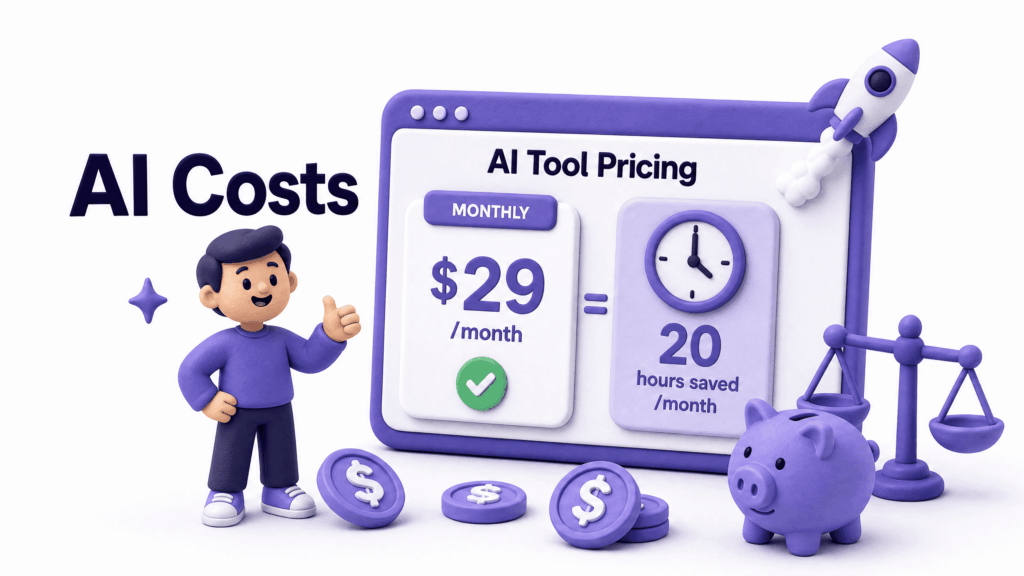
Most AI writing and productivity tools offer free tiers with meaningful functionality. Paid plans for most tools start between ₹800 and ₹2,500 per month, significantly less than the hourly cost of the tasks they replace.
The calculation is straightforward: if an AI tool saves you five hours of content creation per month, and your time is worth ₹500 per hour, the tool saves you ₹2,500 in time for a monthly cost that’s often below that. The ROI is usually immediate.
According to Google’s own guidance on AI for business, the most impactful first step for most small businesses is identifying one repetitive task and testing a specific AI tool against it, not trying to transform everything at once.
Where to Start Without Feeling Overwhelmed
Instead of top executives deciding which AI tools everyone should use, managers should encourage their teams to find small, tedious parts of their jobs that AI can help with. When employees discover those wins themselves, they see the value right away — and that’s how trust in AI really grows.
The same principle applies to solo business owners. Start with one task that:
- Takes more time than it should
- Follows a consistent pattern
- Doesn’t require deeply personal expertise
For most small businesses, content writing or customer enquiry response is the easiest starting point. Use one AI tool for that task for 30 days. Measure the time saved. Then decide whether to expand.
At ElySpace, we help small businesses identify where AI tools can support their digital operations; from AI-assisted content for their website and blog to smarter customer communication tools. If you’re not sure where to start, we can look at your current setup and suggest specific tools that match your actual workflow. The best part: we also build AI agents and have already developed many, let’s connect and find the best one for your business.
Common AI Mistakes Small Business Owners Make
Trying too many tools at once. The AI tools landscape is overwhelming. Jumping between five tools in a month means mastering none of them. Pick one, learn it properly, and measure the results before adding more.
Publishing AI content without editing. Unreviewed AI output is often generic, sometimes inaccurate, and occasionally completely wrong about your specific business. Every piece of AI-generated content needs a human pass before it reaches customers.
Expecting AI to replace strategy. AI can execute tasks efficiently. It cannot decide which tasks are worth doing. The strategic thinking; what to write about, which customers to target, how to position your service, still requires you.
Paying for tools they don’t use. Many business owners subscribe to AI tools, use them twice, and forget to cancel. Only pay for tools you’re actively using and getting consistent value from.
Using AI for customer relationships. Automated responses to initial enquiries can work well. Using AI to handle ongoing client relationships or complaints without human oversight creates problems that cost more than the time saved.
What You Can Do This Week
- Identify one repetitive task in your week that takes more time than it should and follows a consistent pattern, that’s your AI starting point
- Test a free AI writing tool: spend 30 minutes generating draft content for one piece you’ve been putting off
- Review your customer enquiry process: are there common questions you answer repeatedly? An AI-assisted response template could save hours each week
- Calculate your actual time cost: how many hours per week do you spend on tasks AI could assist with? Multiply by your effective hourly rate to see the real cost of not using these tools
The businesses winning with AI today aren’t the most technical ones. They’re the ones who identified specific pain points and applied AI tools strategically; one task at a time.
FAQs (Frequently Asked Questions)
Is AI useful for very small businesses or solo operators? Especially so. The businesses seeing the best results from AI aren’t necessarily spending the most money — they’re simply using it strategically. A solo operator has the most to gain from AI assistance because every hour saved goes directly back to the business owner rather than being absorbed by a larger team.
Do I need technical skills to use AI tools? Not for most tools available today. AI writing, scheduling, and customer support tools are designed with non-technical users in mind. If you can use WhatsApp and Google, you can use most AI tools that would benefit a small business.
Will AI replace my employees? As small businesses plan, the emphasis is on upskilling existing employees rather than reducing staff. AI works best alongside people, handling the repetitive, pattern-based parts of a job so the humans can focus on the work that requires judgment, relationships, and expertise.
How do I know if an AI tool is worth paying for? Measure it. Use the free version for 30 days and track how much time it saves you per week. If the time saved is worth more than the subscription cost, and for most useful AI tools it is; the investment makes sense.
Is AI-generated content penalised by Google? Google’s position is that it evaluates content quality and helpfulness, not whether AI was involved in creating it. AI-assisted content that is genuinely helpful, accurate, and edited by a human performs well in search. Pure AI output published without review tends to be generic and lower quality, which performs poorly regardless of how it was created.
Can AI help with customer service in regional languages or Roman Urdu? Yes. Many AI tools support multiple languages and can assist with drafting responses in Hindi, Urdu, and Roman Urdu, helpful for businesses communicating with customers in local languages on WhatsApp and social media. The output requires local review but significantly reduces the time spent drafting from scratch.
What’s the biggest risk of using AI in a small business? Publishing inaccurate information. AI tools can generate confident-sounding content that is factually wrong. Any AI output that goes to customers; whether in content, responses, or marketing, needs human review before it’s used. This is the single most important discipline when introducing AI into your workflow.