 Live Chat
 Contact
 Shopping Cart
 Eshan Riyaz
Ask three web designers what a website costs and you’ll get three completely different answers. $2,500. $7,500. $30,000. Same deliverable on paper, “a five-page website”, wildly different numbers.
That’s not dishonesty. Most of the time, anyway. It’s the fact that website cost in the USA varies enormously based on who builds it, what they actually include, and what the site is supposed to do for your business.
A website that exists is not the same thing as a website that works. And the price gap between those two things is wider than most people expect before they start shopping around.
This guide cuts through the noise. Real 2026 numbers, honest explanations of what you get at each level, and the things nobody puts in their pricing page.
Why Nobody Gives You a Straight Answer
Here’s the thing, “how much does a website cost” is genuinely one of those questions where the honest answer really does depend.
It depends on whether you’re building a five-page service site or a 200-product eCommerce store. Whether you want a customised template or something nobody else has. Whether the agency writes your copy or you hand them a Google Doc. Whether post-launch support is included or you’re on your own the moment the site goes live.
So when someone quotes you $2,000 and someone else quotes $12,000 for “the same thing”, they’re almost certainly not describing the same thing. The scope, the quality, the depth of SEO work, the platform, the hosting, the post-launch arrangement, all of it differs.
What you actually need is a way to understand what you’re buying at each price point. That’s what this is.
The Real Price Ranges for 2026
Based on current market data across the US, here’s where things actually sit:
DIY website builders; $200 to $600/year Self-built on a drag-and-drop platform. No developer involved. You handle everything; design, content, updates. Fast to get online, limited in flexibility and SEO capability.
Freelance designer/developer; $1,500 to $8,000 One person handles your project. Quality varies enormously depending on experience. Good for simple projects on tighter budgets. The main risks are inconsistent quality and limited post-launch accountability.
Boutique agency or specialist studio; $5,000 to $20,000 A small team with a defined process. Usually better design, more reliable delivery, and some form of post-launch support. Most professional small business websites fall somewhere in this range.
Full-service agency; $15,000 to $75,000+ Larger team, more layers of strategy, design, development, and sometimes ongoing marketing. Justified for complex projects, eCommerce platforms, or businesses where the website is the primary sales channel.
Enterprise or custom application; $50,000 to $250,000+ Custom-built everything. Multi-stakeholder projects, complex integrations, SaaS platforms, heavily custom functionality. Not relevant for most small businesses.
Most professional small business websites in the US land between $4,000 and $15,000. The 2026 Clutch survey found 61% of small business buyers spent under $10,000 on their most recent website project. That number has shifted upward compared to a few years ago, buyers are demanding better design and conversion-focused features, which costs more.
What You Actually Get at Each Price Level
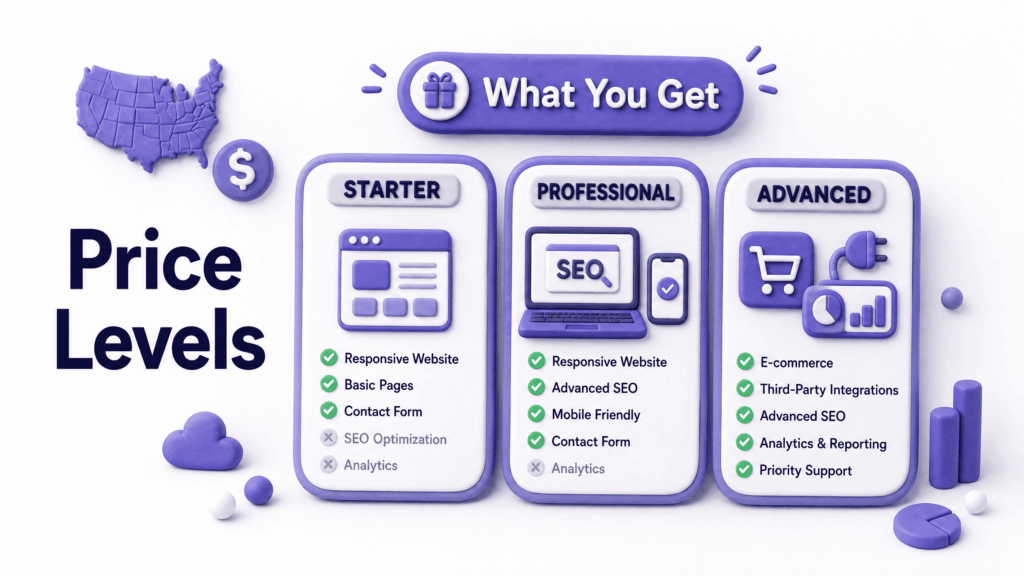
This is where the real information lives. Not the headline number, what’s behind it.
Under $1,000
You’re either building it yourself or paying someone to install a template with your logo and copy pasted in. There’s no real design work happening. No SEO configuration. No speed optimization. Probably cheap shared hosting included.
It’ll look like a website. It won’t perform like one. Fine if you need a URL to put on a business card and have zero expectation of Google traffic or online enquiries.
$1,500 to $4,000
Freelance territory. At the lower end, you’re still getting mostly template work, but with someone else doing the technical setup. At the higher end, you might get some genuine customisation and a freelancer who actually thinks about your business goals.
The risk here is variability. Some freelancers at this price range are excellent and undercharging. Others are new, learning on your project, and will disappear when you need support. There’s no easy way to tell from a proposal.
$4,000 to $10,000
This is where most solid small business websites live. A professional team, a defined process, custom or heavily customised design, proper on-page SEO setup, speed-optimised build, Google Analytics and Search Console configured, and some level of post-launch support.
Done well at this budget, a website genuinely works as a business tool; it ranks, converts, and represents your brand properly. Done poorly, it looks nice and does nothing else.
The difference between good and bad at this price range? Almost always comes down to the SEO and conversion thinking built into the structure. Ask any agency you’re considering what their specific SEO approach is during the build. The quality of that answer tells you a lot.
$10,000 to $25,000
Custom design. Stronger content strategy. More considered conversion architecture. Businesses where the website is expected to generate serious revenue and where the competitive landscape demands something distinctive.
At this level, you should also be getting meaningful post-launch support included, proper onboarding on how to use and update the site, and an agency that treats you as a long-term client rather than a completed project.
Above $25,000
eCommerce at any real scale, custom web applications, member portals, booking systems with complex logic, multi-location service businesses, SaaS products. The price reflects complexity, not just effort.
A senior engineer who ships a complete feature in six hours is materially cheaper than a generalist who takes 20 hours and introduces bugs. At this level, evaluate vendors on delivery rate and quality, not just quoted hourly rate.
The Hidden Costs That Catch Everyone Off Guard
The number on the proposal is only part of what you’ll actually spend. Here’s what most agencies don’t mention upfront, and what adds up significantly over the first year or two.
Domain; $10 to $20/year Cheap, but it needs annual renewal. Miss the renewal and your website disappears. Set auto-renewal from day one.
Hosting; $25 to $120/month depending on quality Basic shared hosting costs almost nothing. Quality managed WordPress hosting costs more. The difference shows up directly in your page speed and uptime, both of which affect your Google rankings. Don’t let an agency put your site on the cheapest available server to keep their headline price low.
SSL certificate; $0 to $75/year Should be free from any reputable host. If it’s being quoted as a separate line item in 2026, that’s worth questioning.
Ongoing maintenance; $50 to $500/month WordPress and its plugins release security updates regularly. An unmaintained site accumulates vulnerabilities. Basic care plans covering hosting, backups, and software updates run $50 to $150 per month. Hands-on plans with performance monitoring, security scanning, and actual human support run $150 to $500.
Content writing; $500 to $3,000+ Most web quotes assume you’ll provide all your own text. Professional copywriting improves conversion rates significantly. If it’s not in scope, you’re either writing it yourself or paying separately.
Post-launch SEO; $500 to $3,000+/month On-page SEO setup at launch is the starting point. Ongoing SEO; blog content, link building, rank tracking; is a separate, ongoing investment. Be clear on what’s included in the build versus what requires a retainer.
Reserve 30 to 45 percent of your initial build budget for ongoing costs in the first year. A $12,000 build can cost $23,000 to $42,000 across three years once maintenance, hosting, and support are factored in. That’s not a reason not to invest, it’s a reason to budget honestly from the start.
What Drives the Price: 6 Real Factors

1. Design originality: Template customisation versus fully custom design. The gap between a $3,500 small business site and a $14,000 one sits almost entirely here, in design originality and conversion depth. Custom design takes more time, costs more, and produces something genuinely distinctive rather than recognisably template-based.
2. Number of pages and complexity: Five clean pages with similar layouts cost less than 15 pages with different structures, custom sections, and varied content types. Every additional page is additional design and development time.
3. Functionality required: A contact form is standard. A booking system with availability calendar, automated confirmations, and payment processing is a development project. Custom functionality adds cost, usually significantly.
4. Who you hire: A senior agency with a defined process and proven results costs more than a junior freelancer learning on your project. Both can produce good work. The pricing reflects skill, process maturity, and accountability, not just hours.
5. Content responsibility: Who writes the copy? Who provides photos? Who manages the brand assets? Agencies that handle content creation charge for it. Those that assume you’ll handle it are cheaper upfront but leave you with a website full of placeholder copy if you don’t deliver.
6. Post-launch arrangement: A quote that ends at delivery is cheaper than one that includes three months of support, revisions, and monitoring. The cheaper quote often costs more in the long run when problems need fixing and there’s nobody accountable.
Freelancer vs Agency vs Remote: Cost Comparison
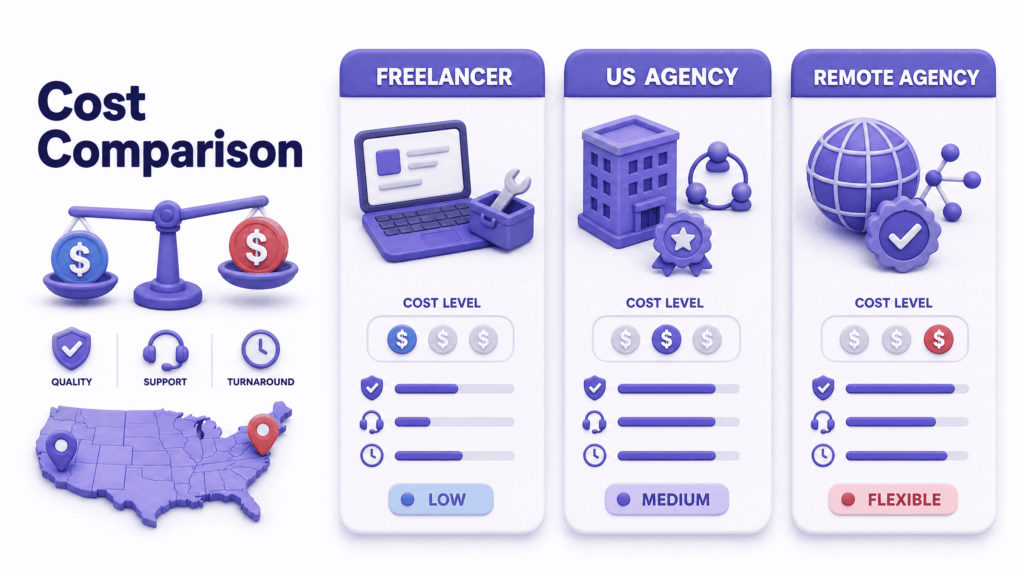
| Freelancer | US Agency | Remote Agency (ElySpace) | |
| Typical cost | $1,500–$8,000 | $6,000–$30,000+ | $2,000–$12,000 |
| Design quality | Variable | Generally high | Consistently professional |
| SEO included | Often limited | Usually yes | Yes, built in |
| Post-launch support | Rare | Usually yes | Yes |
| Accountability | Low | High | High |
| US market knowledge | Varies | Strong | Strong for remote work |
Remote agencies have changed the calculation significantly. Quality remote partners deliver professional-grade work at substantially lower cost than US agencies, not because they’re cutting corners, but because their operational costs are lower. The risk is in selection: you need to evaluate live portfolio work, client references, and process documentation before committing.
What You Should Never Cut Corners On
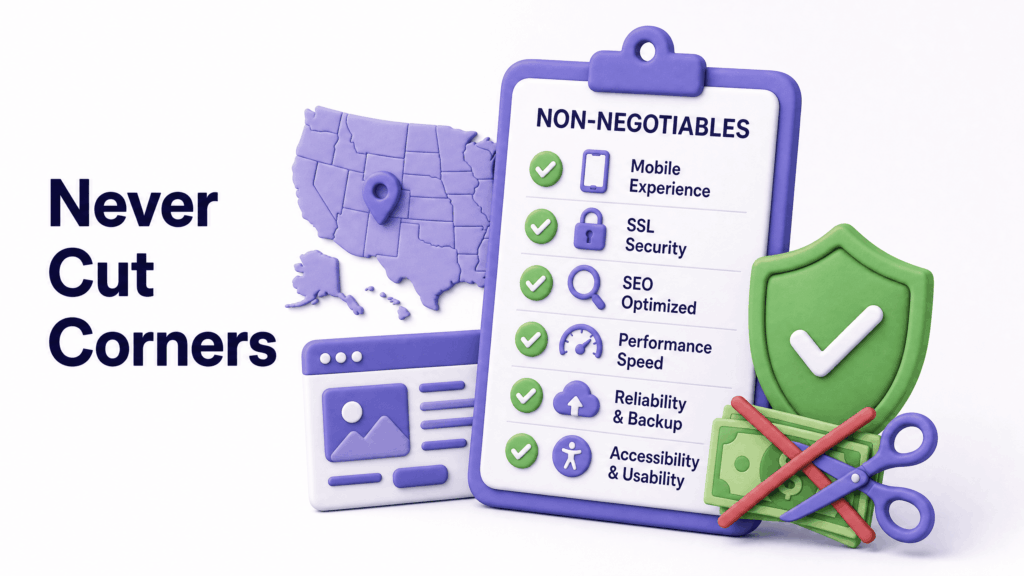
Some budget compromises are fine. These are not.
Mobile performance. The majority of your visitors are on phones. A website that works on desktop but breaks on mobile is failing most of its audience and being penalised by Google simultaneously. Run any portfolio site through Google PageSpeed Insights on mobile before hiring anyone.
SSL and HTTPS. Free from any reputable host. Non-negotiable. A site without it gets labelled “Not Secure” before visitors read a word.
On-page SEO setup. Page titles, meta descriptions, heading structure, image alt text, Google Search Console setup, these should be included in every professional build. If they’re an add-on, find a different agency.
Ownership of your own assets. Your domain, your hosting account, your code. All of it should belong to you. If an agency builds on a proprietary platform you don’t control, you’re dependent on them for everything going forward.
Post-launch communication. Know who you call when something breaks before you sign anything.
Is a More Expensive Website Actually Better?
Not automatically. But an under-invested one almost always underperforms.
A $500 website that generates no business isn’t a bargain compared to a $5,000 website that produces leads for years. The math matters, and it’s not just about upfront cost, it’s about what the site returns.
At the same time, spending $30,000 doesn’t guarantee a good website. Poor strategy, bad briefing, and weak post-launch support can produce an expensive website that performs no better than a cheap one.
The right question isn’t “how little can I spend?” or “how much should I invest?” It’s “what’s the minimum investment that gets me a website that actually does its job?” For most small businesses in the US, that answer sits between $5,000 and $15,000 when working with a professional agency.
According to Google’s Core Web Vitals documentation, the technical performance of your website directly affects your search rankings, which means the quality of your hosting, your page speed, and your mobile experience aren’t just user experience concerns. They determine whether Google shows your site at all.
Why ElySpace Is Worth Considering for US Businesses
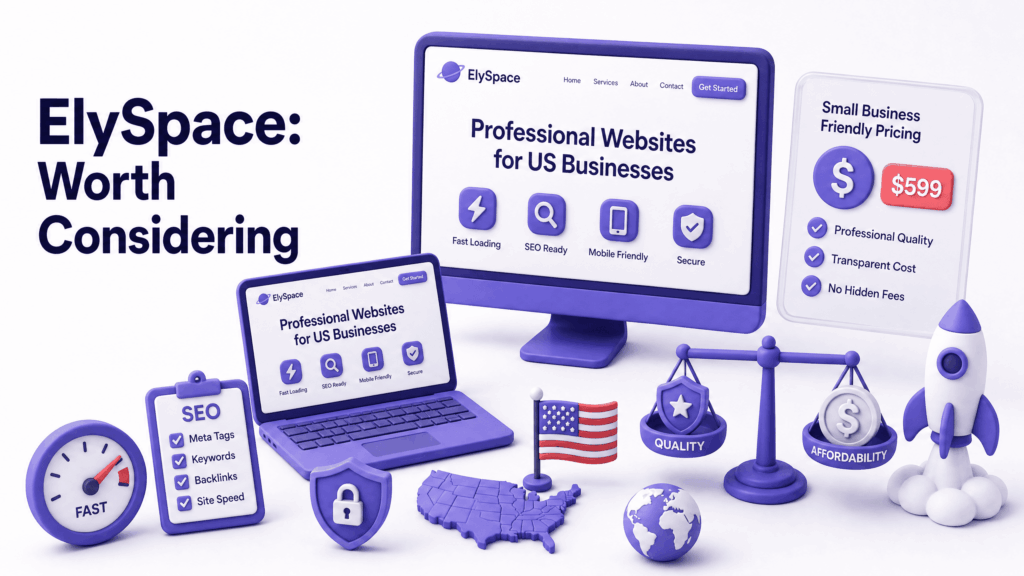
At ElySpace, we build websites for US businesses at a cost structure that makes genuine professional quality accessible at small business budgets.
A project that would run $15,000 to $20,000 at a US boutique agency typically costs $4,000 to $10,000 with us; for equivalent quality, the same performance standards, the same SEO foundations, and the same post-launch accountability. Not because we cut corners. Because our operational costs are lower and we pass that directly to clients.
If you’re looking for professional quality at a budget that actually makes sense for a small business, and you’re comfortable working with a remote team that has a clear process and verifiable results, we’re worth a conversation. Reach out at elyspace.com and we’ll tell you honestly whether we’re the right fit before either of us commits to anything.
Common Budget Mistakes US Business Owners Make
Comparing quotes without written scopes. Three proposals for “a website” are meaningless if they cover different things. Get written scopes from everyone and compare what’s actually included.
Forgetting the ongoing costs. The build price is one number. Hosting, maintenance, content updates, SEO, these continue every month. Budget for the real total, not just the launch cost.
Choosing the cheapest option and rebuilding 12 months later. This happens constantly. A $2,000 website that generates nothing gets replaced with a $10,000 one a year later. The total spend is $12,000 and a year of lost leads. Starting right is almost always cheaper than starting cheap.
Not testing portfolio work on mobile. Screenshots look fine on any device. Open portfolio URLs on your phone and run them through PageSpeed Insights. That’s the real product, not the presentation.
Paying for features they don’t need yet. A startup doesn’t need a full CRM integration, a member portal, and custom animations. Start with what you need now. Build in what makes sense later.
What You Can Do Right Now
- Test three portfolio websites: from any agency you’re talking to on your phone, run them through Google PageSpeed Insights and note the mobile scores
- Write down what your website needs to do: generate leads, sell products, book appointments, before approaching anyone for a quote
- Get at least two written scopes: with specific deliverables listed, not just a price and a general description
- Ask every agency what the year-two cost looks like: hosting, maintenance, support, before signing anything
- Check ownership terms: confirm you’ll own the domain, hosting account, and all website files when the project is done
Want an honest quote for your specific project? Visit elyspace.com and tell us what you need. We’ll give you a straight answer on what it costs and what you’ll actually get.
FAQs (Frequently Asked Questions)
How much does a website cost in the USA in 2026? Most professional small business websites cost between $4,000 and $15,000 from a boutique agency or specialist studio. DIY platforms run $200 to $600 per year. Freelancers charge $1,500 to $8,000. Full-service agencies start around $15,000. What you pay depends heavily on who builds it, what’s included, and what the site needs to do for your business.
Why are some website quotes so much cheaper than others? Because they’re not the same product. A $2,000 quote often means a template installation with no real SEO work, cheap hosting, no post-launch support, and minimal design customisation. A $10,000 quote from a professional agency typically includes custom design, performance optimisation, on-page SEO, and ongoing accountability. Compare scopes, not just numbers.
What are the ongoing costs after a website is built? Plan for domain renewal ($10–$20/year), hosting ($25–$120/month), basic maintenance ($50–$500/month), and any ongoing SEO or content work. Over three years, a professionally built website typically costs two to three times its initial build price when these are factored in. Budget for this from day one rather than discovering it later.
Is a DIY website builder good enough for a small business? For a very simple informational site with no expectation of Google traffic or direct lead generation, possibly. For any business where the website is expected to generate enquiries, rank on Google, or represent the brand to serious clients, generally no. The limitations on SEO, performance, and customisation become visible quickly.
Can a remote agency deliver the same quality as a US agency? Yes, when chosen carefully. Evaluate live portfolio work on mobile, check client references specifically, confirm the communication process, and ensure a written contract covering ownership and deliverables. The quality difference between a well-chosen remote agency and a US boutique agency is often minimal to zero, at significantly lower cost.
What’s the single biggest mistake people make with website budgets? Starting too cheap and rebuilding a year later. A website that doesn’t generate business has a negative ROI at any price. Investing properly the first time; in a site that loads fast, ranks on Google, and converts visitors, almost always costs less over two to three years than starting cheap and fixing it later.
Does a higher price mean better SEO? Not automatically. SEO has to be specifically scoped and intentionally built in. Some expensive agencies treat SEO as a separate upsell. Some affordable ones include it properly as standard. Ask specifically what SEO work is included in the build, the answer matters more than the price.