 Live Chat
 Contact
 Shopping Cart
 Eshan Riyaz
Your domain name is the one part of your online presence you genuinely cannot easily change.
You can redesign your website. You can rewrite your content. You can switch hosting providers, change your logo, and pivot your services. But changing your domain name means starting over on SEO, updating every link and listing, reprinting every business card and brochure, and rebuilding the trust that search engines placed in your old address.
This is why the decision to choose the right domain name deserves far more thought than most business owners give it. Many people spend ten minutes on it and spend years regretting it.
This guide covers everything that actually matters, in the right order, so you make a decision you’re confident about from year one through year ten.
What a Domain Name Actually Does for Your Business
Before the rules, it’s worth understanding what you’re actually choosing.
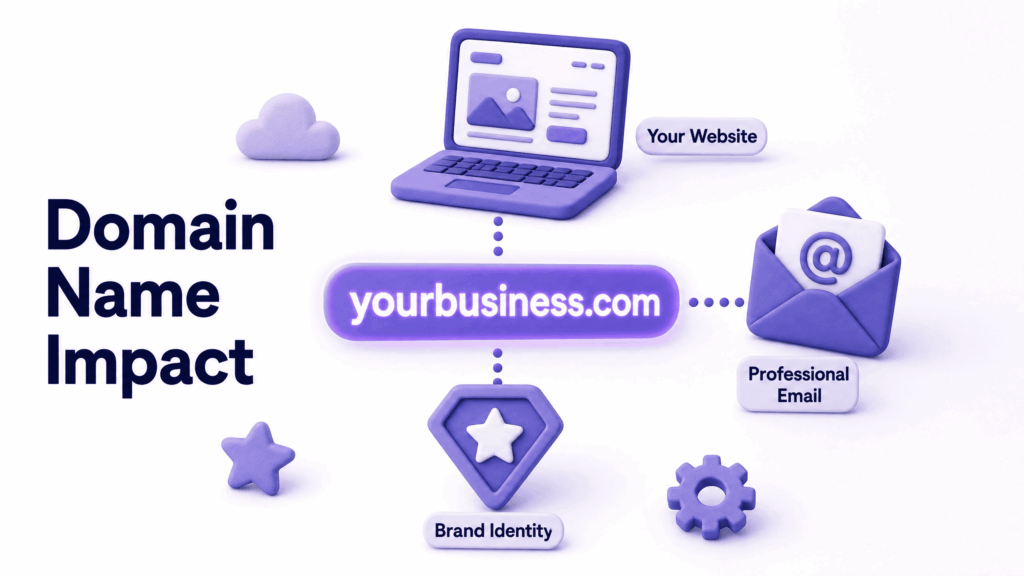
Your domain name is your web address; yourbusiness.com. It’s what people type to find you, what appears in your email address, what sits at the top of every browser tab when someone visits your site, and what Google reads when deciding what your website is about.
A professional, polished domain name signals reliability. Customers are more likely to visit and trust businesses with clear and easy-to-identify domain names compared to vague or overly long ones.
It’s also the foundation of your email address. [email protected] carries a completely different weight than [email protected]. Every email you send, every proposal you submit, every invoice you issue, the domain is always visible.
Get this right and you’ll never have to think about it again. Get it wrong and it will quietly work against you in ways that compound over time.
Rule 1: Keep It Short and Typeable
A long and complex domain name increases the risk of customers mistyping or misspelling it. Every character you add is another opportunity for error, and every typing error is a visitor who lands on a blank page or someone else’s website instead of yours.
The ideal domain name is under 15 characters. Some of the strongest business domains are under 10. This isn’t always achievable, especially if you’re starting later and shorter names are taken; but it should be the goal.
A useful test: can you say your domain out loud in conversation and have the other person type it correctly without asking you to spell it? If yes, you’re in good shape.
Rule 2: Make It Easy to Say Out Loud

This rule gets skipped constantly, and causes real problems when someone tries to share your website verbally.
“Our website is kashmir-e-travel.net”, how do people spell that? Is there a hyphen? Is it .net or .com? Do they spell out the ‘e’ or type it as a letter?
Your domain should be shareable in speech without any clarification needed. If someone hears it once, they should be able to type it correctly. Avoid complex words, unusual spellings, or confusing elements. Ensure your name is intuitive, don’t leave your audience guessing its spelling or pronunciation.
Say your domain candidates out loud to someone who hasn’t seen them written down. What they type back is what your customers will type.
Rule 3: Avoid Hyphens and Numbers
Both seem harmless. Both cause consistent problems.
Hyphens are almost never remembered. Someone who hears travel-adventures.com verbally will type traveladventures.com, and if that version is owned by someone else, you’ve just sent your customers to a competitor or a dead page.
In a domain name, hyphens are often associated with phishing. They send a negative signal to search engines, which may interpret them as an attempt at over-optimisation.
Numbers create the same confusion verbally, do you mean the numeral 4 or the word four? Does 2 mean “to,” “two,” or “2”? Every ambiguity is a lost visitor.
The only exception: if your business name itself contains a number and is already well-known. Otherwise, avoid both.
Rule 4: Choose .com First, Here’s Why

There are hundreds of domain extensions available; .net, .org, .io, .co, .online, .store, and many more. Some are genuinely useful. But .com remains the default expectation for most people.
Prioritise names that are short, simple, memorable, easy to spell, and brandable. When people hear a business name and think of its website, they instinctively type .com. If your site is yourbusiness.net and someone types yourbusiness.com, they’re either landing on a competitor’s site or hitting an error.
That unconscious default costs real traffic over time.
If your preferred .com is genuinely not available, .co.in or .in are credible alternatives for India-based businesses, covered in a separate section below. .io works well for tech businesses. But .com should always be the first choice you try, and worth some creative thinking to make work.
Rule 5: Don’t Box Yourself In
This is the long-term thinking rule that most beginners miss because they’re focused on where they are now, not where they might be in three years.
Choose a domain that remains relevant as your business grows. Avoid using years, trendy terms, or overly specific descriptions that could limit future expansion.
kashmirhoneymoonpackages.com is very specific. What happens when you start offering adventure tours, corporate retreats, and family packages? The domain still works technically, but it narrows perception. Clients looking for something beyond honeymoons might not take you seriously.
kashmirexplorer.com covers every type of tour without limiting anything.
The same applies to geography. If you’re currently serving only Srinagar but might expand to other cities, srinagar-webdesign.com becomes a constraint. elyspace.com doesn’t.
Don’t lock your business identity into its current smallest version.
Rule 6: Make It Brandable, Not Just Descriptive
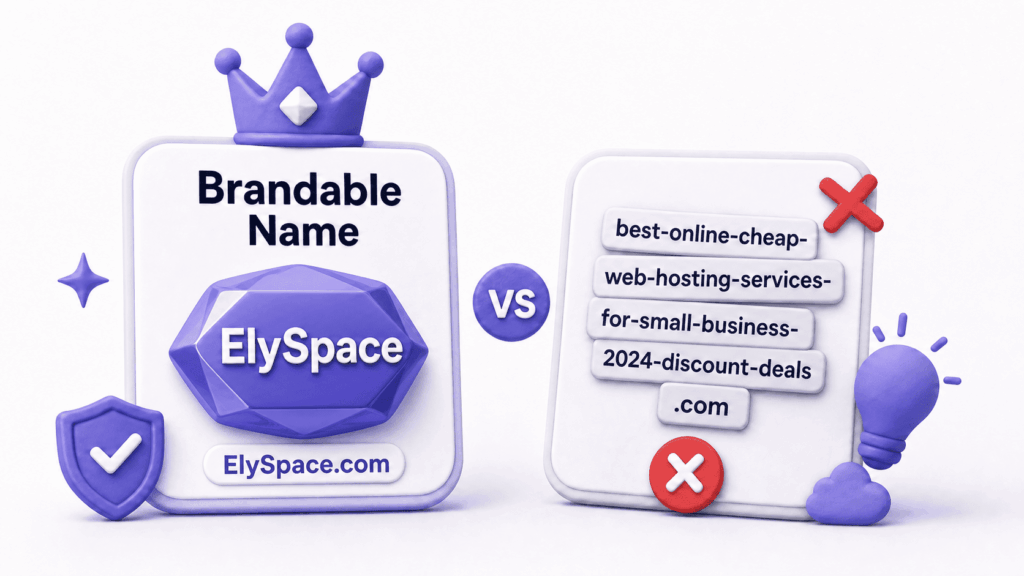
There’s a temptation, especially when you hear that keywords in domains help SEO, to pick a purely descriptive domain. kashmir-tour-packages-cheap.com. best-web-design-srinagar.com.
This approach has two problems.
First, keyword-stuffed domains look spammy. Overly stuffed names look spammy and reduce long-term brand equity. Focus on clarity and relevance, not just gaming the algorithm.
Second, they’re forgettable. A brandable domain, one that sounds like a real company name; sticks in memory. It builds an identity. It looks professional in an email address and on a business card.
naayla.com is memorable and brandable. kashmir-budget-tour-deals-packages.com is not.
Descriptive keywords are helpful when they fit naturally, kashmirtrekkers.com works because it’s clear and memorable without being stuffed. The goal is clarity and identity together, not keyword density in your URL.
Rule 7: Check Social Media Availability Too
Your domain name and your social media handles should ideally match, or be close enough that people can find you consistently across platforms.
If your domain is kashmircraft.com but @kashmircraft is taken on Instagram by someone in a different industry, you’ll be @kashmircrafts_official or some variation that doesn’t match your web address. That inconsistency creates friction every time someone tries to find you.
Before registering a domain, search for the same name on Instagram, Facebook, YouTube, and LinkedIn. Consistency between your domain name and your brand name is vital. It’s worth adjusting your domain slightly to land one that’s available across your primary platforms.
Rule 8: Avoid Trademark Problems
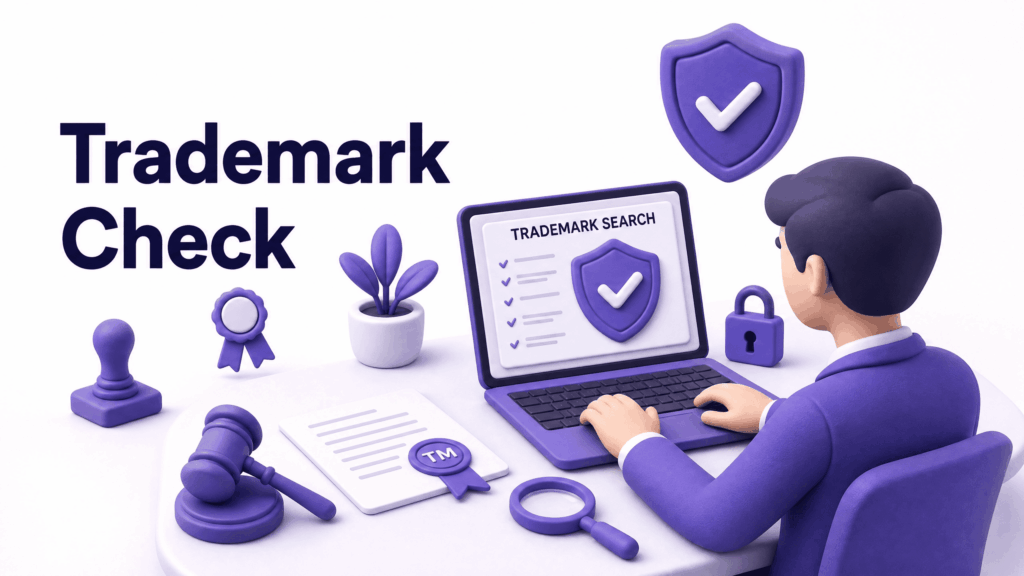
A domain name that matches or closely resembles a registered trademark, even without any intent; creates legal risk. You can be forced to give up a domain you’ve built your business on, lose it without compensation, and face legal costs in the process.
Before registering, do a basic search for your domain name as a trademark. In India, the Trademark Registry (ipindia.gov.in) lets you search registered marks. Internationally, a quick Google search for the name as a business, combined with a trademark database check, catches most obvious conflicts.
This takes 15 minutes. Skipping it can cost you far more.
Rule 9: Think About How It Looks in an Email Address
Your domain name won’t just be your website. It will be the second half of every email you send.
[email protected]; clean, professional, and clear. [email protected]; unwieldy, hard to remember, difficult to type.
Read your potential domain as an email address before registering it. If it looks clunky, it will feel clunky to every person who receives an email from you. Since your email address is visible on every proposal, invoice, and message you send, it’s one of the highest-frequency uses of your domain.
Rule 10: Register It Today, Not Tomorrow
Good domain names disappear fast. Domain names sell quickly. Register your favourite domains as soon as possible.
If you’ve found a domain name that meets most of these rules, register it now, even if your website isn’t ready yet. Holding a domain costs almost nothing annually. Losing a domain you wanted to a competitor or a domain speculator costs significantly more, either in the premium you’d pay to buy it back, or in settling for a worse option.
Register through your hosting provider, most reputable hosting plans include a free domain for the first year, making this a natural first step when you’re setting up your website.
Good News For You: “ElySpace provides a free domain for the first year when you buy hosting from us”.
Domain Name Mistakes That Haunt Businesses Long-Term
Choosing a name that was trendy but hasn’t aged well. Anything with “digital,” “360,” or a year in the name feels dated quickly. Aim for timeless over contemporary.
Picking a name because it was available, not because it was right. Availability is a starting point, not a reason. A creative approach to your actual business name almost always yields a better result than settling for what’s left.
Using your personal name when building a business brand. ahmedweb.com works if Ahmed is the brand. But if you ever want to grow, hire, or sell the business, a personal name domain creates complications. Brand domains scale better.
Registering only one variation. If you register kashmirtours.com, it’s worth considering whether kashmirtour.com (without the ‘s’) should also be registered to prevent confusion. Protecting your primary domain with common variations costs very little.
Letting the domain expire accidentally. Set up auto-renewal from day one. A lapsed domain can be purchased by someone else within days of expiry, including competitors or domain speculators who will then charge significant money to sell it back.
What About .in and .co.in for Indian Businesses?
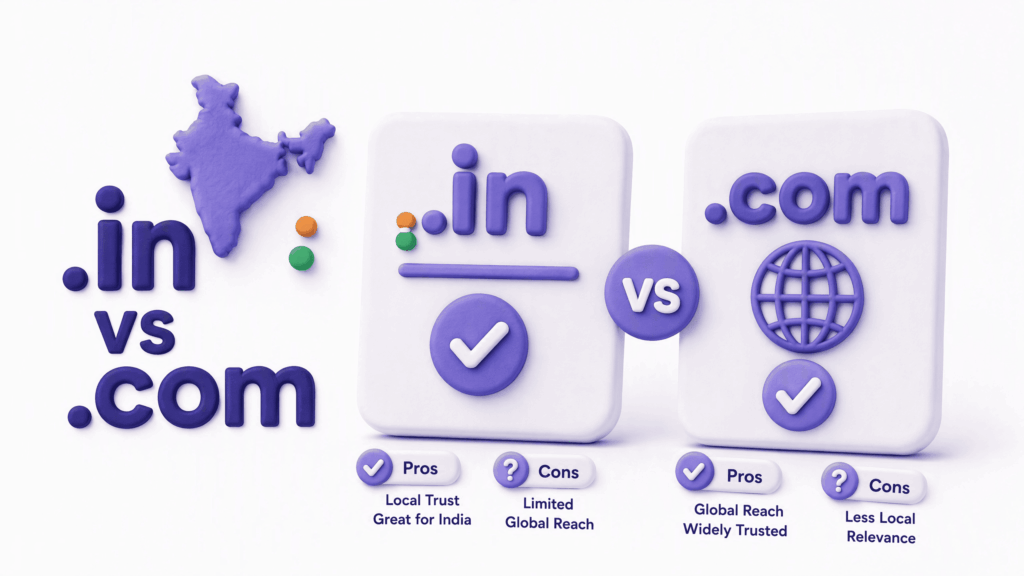
This question comes up often for businesses in India, and the honest answer depends on your audience and goals.
.in and .co.in are credible, established extensions for Indian businesses. They signal local presence and are trusted by Indian customers. If your preferred .com is unavailable and your business primarily serves Indian customers, .in is a completely legitimate alternative.
The consideration is reach. If you have any ambition to work with international clients, or simply want the broader trust signal; .com remains the stronger choice. Many Indian businesses register both: the .com as the primary domain and the .in as a redirect to protect the brand locally.
What to avoid: choosing a .net, .biz, or obscure extension just because it’s available. These carry less inherent trust and create the kind of confusion that costs you visitors over time.
What You Can Do Right Now
- Brainstorm 10 domain name candidates using your business name, your service, your location, and combinations of these; aim for options under 15 characters
- Check availability through your hosting provider’s domain search, most will show you immediately which options are available
- Search each candidate on Instagram, Facebook, and LinkedIn to see if matching handles are available
- Say each domain out loud and ask someone nearby to type what they heard, see whether what they type matches what you intended
- Check for trademark conflicts using a basic web search and the Indian Trademark Registry at ipindia.gov.in
- Register your top choice today, don’t leave it for next week
If you’re building a new website and need help with domain registration, hosting setup, and everything that comes after, ElySpace handles the full setup for small businesses; from domain to live website. We make sure the foundation is right from the start so you never have to rebuild it later.
FAQs (Frequently Asked Questions)
Does my domain name affect my Google rankings? Somewhat, but not as much as it once did. Having a relevant keyword in your domain helps establish context, but Google evaluates hundreds of other factors more heavily. A brandable domain on a well-built, well-optimised website will outrank a keyword-stuffed domain on a poor website every time. Focus on clarity and memorability over gaming the algorithm.
What if my preferred domain name is already taken? Try natural variations, adding your city name, a relevant descriptor, or a slightly different arrangement of the words. If the .com is taken, check .in or .co.in for Indian businesses. Avoid hyphens or number substitutions as a workaround, they create more problems than they solve.
How much does a domain name cost? A standard .com domain costs approximately ₹800–₹1,500 per year. Many hosting providers include a free domain for the first year as part of their plan; But you don’t need to go anywhere, contact ElySpace, and get your free domain for the first year. Premium or previously owned domains can cost significantly more, sometimes thousands or lakhs of rupees for highly desirable names.
Can I change my domain name later? Technically yes, but practically it’s a major undertaking. You’ll need to redirect all old URLs, update every listing and directory, rebuild trust with search engines, and inform all existing contacts. It’s possible, but expensive in time and potentially in lost SEO. Getting the domain right the first time is far more efficient.
Should my domain match my business name exactly? Ideally yes, consistency between your business name and domain builds brand clarity. If your exact business name isn’t available as a .com, a close variation is usually better than a completely different name. Consistency helps customers find you and trust that they’ve found the right business.
Is it worth buying multiple domain variations? For your primary business domain, yes, it’s worth registering the most likely alternative spellings and extensions to prevent confusion and protect your brand. The annual cost is small compared to the risk of a customer landing on the wrong site or a competitor registering a similar name.
How long should I register a domain for? Most providers offer registration in one to ten year blocks. Registering for multiple years has a small SEO benefit, it signals to Google that your site is a long-term presence rather than a temporary one. Two to three years is a sensible starting point for a business domain.