 Live Chat
 Contact
 Shopping Cart
 Irfan Bhat
Choosing a host feels simple until your site goes down during a product launch, or your “unlimited” plan suddenly throttles your traffic. That’s usually the moment people start Googling what reliable web hosting actually looks like and by then, they’ve already lost time, visitors, or sales.
At Ely Space, we’ve hosted everything from single-page portfolios to stores handling thousands of daily checkouts. That experience taught us one thing clearly: reliable web hosting isn’t a marketing phrase. It’s a specific set of measurable qualities uptime, speed, security, support, and honest scalability that either show up when you need them or don’t.
This guide breaks down exactly what to look for, in plain language, so you can judge any hosting provider including us with a clear head.
What “Reliable” Actually Means in Hosting
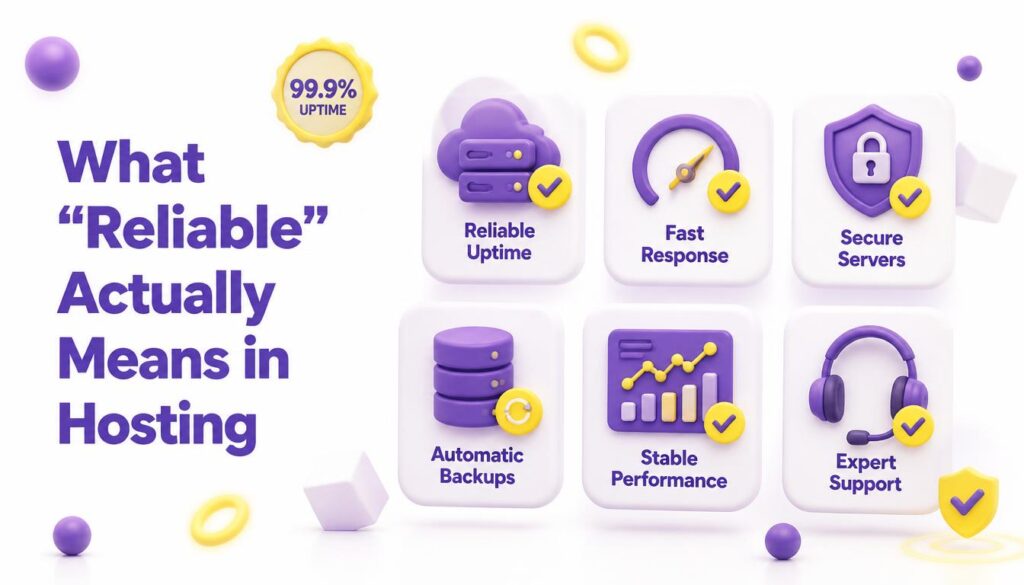
Every hosting company claims to be reliable. Almost none define it. So let’s define it properly.
A reliable web hosting provider consistently delivers three things: your site stays online, it loads fast, and your data stays safe. That’s it. Everything else dashboards, one-click installs, free domains is a nice bonus, not a substitute.
The problem is that reliability is invisible until it fails. You don’t notice good hosting; you notice bad hosting the moment your checkout page times out. That’s why judging a provider on real, checkable metrics matters more than judging it on its homepage promises.
Uptime: The Non-Negotiable Metric
Uptime is the percentage of time your site is actually accessible. Industry standard for reliable web hosting is 99.9% uptime or higher, which allows for roughly 8.7 hours of downtime a year not per month.
Here’s what to actually check:
- Does the provider publish a Service Level Agreement (SLA) with a real uptime number, not just a claim?
- Do they offer compensation (credits or refunds) if they miss that number?
- Can you find independent monitoring data, not just the provider’s own dashboard?
Third-party monitoring tools track this publicly, and organizations like the Uptime Institute publish broader data center reliability benchmarks worth knowing if you want context on what “good” looks like at scale.
At Ely Space, we publish our uptime SLA openly and back it with credits because a reliability promise without accountability isn’t really a promise.
Page Speed and Server Performance
Speed and reliability are more connected than people think. A slow server under light load is a strong signal it’ll buckle under real traffic. Google has confirmed page speed directly affects both user experience and search rankings, which you can read about in Google’s Core Web Vitals documentation.
What actually drives speed on the hosting side:
- SSD or NVMe storage instead of older HDD drives
- Server location relative to your main audience
- Resource allocation shared hosting splits power across many sites, while VPS or dedicated plans reserve it for you
- Built-in caching at the server level, not just plugin-based caching
If a provider can’t tell you which of these they use, that’s a red flag, not a technicality.
Security Standards That Matter
Reliable web hosting also means your site and your visitors’ data is protected by default, not as a paid add-on you have to discover exists.
Baseline security features worth checking for:
- Free SSL certificates included on every plan
- Regular malware scanning and automatic patching of server software
- DDoS protection at the network level
- Isolated environments on shared hosting, so one compromised site can’t affect neighbors
The Cybersecurity and Infrastructure Security Agency (CISA) publishes general web security guidance that’s useful background if you want to understand why these baseline protections exist in the first place.
Customer Support You Can Actually Reach
This is where a lot of “reliable” providers quietly fail. Support quality only gets tested during a crisis server down at 2 a.m., a hacked plugin, a DNS misconfiguration and that’s exactly when slow responses hurt most.
Look for:
- 24/7 availability, not just business-hours chat
- Multiple channels live chat, ticketing, and phone, not just a contact form
- Real technical staff, not a script-reading first line that escalates everything
A quick way to test this before signing up: message pre-sales support with a specific technical question. How they answer tells you more than any testimonial page.
Scalability Without the Surprise Bill
Your hosting needs today aren’t your hosting needs in a year. A reliable web hosting provider should let you grow more traffic, more storage, more resources without forcing a painful migration or a surprise invoice.
Ask providers directly:
- Can I upgrade my plan without downtime?
- Are resource limits (CPU, RAM, bandwidth) clearly stated, not vague?
- Is there a clear path from shared hosting to VPS to dedicated servers?
Providers that hide these answers behind “contact sales” are usually hiding a less flexible system than they let on.
Transparent Pricing and Fair Policies

Cheap renewal-year pricing that jumps 300% at renewal isn’t reliability it’s a bait-and-switch. Trustworthy hosts show renewal pricing upfront, not buried in fine print.
Also check the refund policy. A confident provider offers a real money-back guarantee, typically 30 days, with no complicated conditions attached. That confidence is itself a signal of reliability.
Data Backups and Disaster Recovery
Even the most reliable web hosting setup can face an unexpected failure hardware faults happen to everyone. What separates good providers is how they recover.
Check for:
- Automated daily backups, stored off the same server
- One-click restore, so recovery doesn’t need a support ticket and a two-day wait
- Backup retention of at least 7–30 days, so you’re not stuck with only yesterday’s copy
If backups are an expensive add-on rather than a standard feature, treat that as a warning sign, not a minor detail.
How to Actually Test a Host Before You Commit
You don’t have to take any provider’s word for it. Before committing:
- Run a free trial or use the money-back window as a real test period.
- Check independent review platforms like Trustpilot for verified user experiences, not just the provider’s testimonials.
- Ping their support with a real question and time the response.
- Search for the provider’s name plus “downtime” to see if there’s a public history of outages.
This kind of hands-on testing is the difference between choosing hosting based on marketing copy and choosing it based on evidence.
Final Thoughts
A reliable web hosting provider isn’t the one with the flashiest homepage it’s the one that performs consistently when nobody’s watching: strong uptime, fast servers, real security, responsive support, and honest pricing.
If you’re evaluating providers right now, use this as a checklist rather than a gut-feeling decision. Reliability is measurable so measure it before you commit, not after something breaks.
Want to see how ElySpace stacks up against this checklist? Explore ou web hosting plans or read our complete guide to choosing a host in 2026 for a deeper comparison.