 Live Chat
 Contact
 Shopping Cart
 Mehran Majeed
A founder I spoke with had already been through two failed attempts before the project she was building finally shipped. The first developer disappeared mid-project. The second delivered something technically functional but unusable, built without ever really understanding what her business needed. Neither failure was really about coding skill. Both came down to picking a partner based on price and a polished portfolio rather than how the company actually worked with clients day to day.
That pattern shows up constantly among software development companies, and it’s exactly what makes evaluating custom software development companies in the USA more complicated than comparing quotes on a spreadsheet. The technical ability to write code is genuinely common now. What actually separates a good outcome from a frustrating one is process, communication, and whether a company treats your project as a partnership or a transaction.
This guide walks through what to actually look for, what changes when you widen the search beyond companies physically based in the USA, and the specific questions worth asking before signing anything.
What to Look For in Custom Software Development Companies
Short answer, if you’re pressed for time: the biggest differences between custom software development companies usually aren’t technical skill. Most established companies can write functional code. What actually varies is discovery process (do they ask real questions before quoting a price), communication cadence (specific updates versus vague reassurances), and what happens after launch (ongoing support versus disappearing once the invoice is paid).
A company that jumps straight to a price quote without asking detailed questions about your actual business problem is a warning sign worth taking seriously. The projects that go well almost always start with the company genuinely trying to understand what you’re building and why, not just what features you’ve listed.
Team stability matters too. A company that rotates developers on and off your project frequently, even if each individual developer is competent, tends to produce inconsistent code and repeated ramp-up time as each new person gets up to speed. Asking directly whether the same core team stays on a project from start to finish is a reasonable, specific question that a confident company should be able to answer clearly.
It’s also worth watching how a company talks about its own process during the sales conversation itself. Custom software companies that are genuinely good at what they do tend to talk specifically about how they’ve solved problems similar to yours before, rather than relying on generic language about being “agile” or “innovative” without backing it up with anything concrete.
One simple way to test this is to ask the company to walk you through what happens between your first call and the first version of the software. If the answer is something specific discovery, requirements, architecture, milestones, development, testing, review, deployment that’s useful information. If the answer stays at the level of “our team will take care of everything,” keep asking questions.
Software Development Companies USA: What the Local Option Actually Offers
Software development companies USA-based often come with a genuine time zone advantage for real-time collaboration, and in some cases, a simpler legal and contractual process for U.S.-based businesses working entirely within one jurisdiction. That convenience typically comes at a meaningfully higher hourly or project cost, since local labor rates in the U.S. are generally higher than those in many other regions with strong technical talent.
That doesn’t automatically make a local company the better choice, it makes it a different set of tradeoffs. A company handling highly sensitive data with strict compliance requirements might genuinely need the simplicity of one jurisdiction. A company building a straightforward internal tool on a tight budget might find that consideration largely irrelevant, and get considerably more value looking beyond companies based only in the USA.
Working with a team based elsewhere, India in particular, has become common enough that it’s no longer unusual for U.S. businesses to evaluate international development partners alongside local providers. The tradeoff isn’t “better or worse,” it’s cost efficiency and access to a broad technical talent pool, weighed against a time zone gap that requires more deliberate communication planning than working with a team down the street.
It’s worth being precise rather than making a blanket claim here: neither option is inherently the smarter business decision. What actually determines success in either case isn’t geography, it’s whether the specific company, wherever it’s based, has a genuine process for discovery, communication, and support. A poorly run local team fails projects just as often as a poorly run offshore one, and a well-run offshore team can outperform a mediocre local option by a wide margin.
The important question isn’t simply, “Where is this company based?” It’s “How does this company make the location work for the project?”
If you’re considering an international team, ask how meetings are scheduled, how quickly questions are answered, who is available during your working hours, and what happens when something needs urgent attention. A time zone difference is manageable when the communication process is designed around it. It becomes a problem when nobody has thought about it beforehand.
What Makes a Company Genuinely “Custom,” Not Just Generic
The word “custom” gets used loosely in this industry, so it’s worth being specific about what it should actually mean. Custom software companies earn their fee when your business has a genuinely specific workflow that generic software doesn’t handle well, a booking system with unusual rules, an internal tool tied to a specific operational process, something that doesn’t map cleanly onto an existing product.
Before comparing specific companies, it’s worth asking whether your business actually needs custom development at all, or whether an existing, off-the-shelf tool would solve the problem for a fraction of the cost and time. If your need is closer to “we need basic inventory tracking” or “we need a simple booking calendar,” an established off-the-shelf tool is very likely faster, cheaper, and more thoroughly tested than building something from scratch. A capable developer can still deliver a well-built solution to a problem that never needed custom software to solve in the first place.
A useful test is asking whether an existing tool would work with minor workarounds, or whether it would require constantly fighting the software’s basic design to fit your process. Minor friction is normal and usually cheaper to live with. Constant, fundamental friction is a genuine signal that custom development is the right call.
A good development company should be willing to have this conversation with you, too. If a company recommends custom development immediately without asking whether an existing product could solve the problem, that’s worth questioning. The right partner should be trying to solve your business problem, not simply sell you development hours.
How to Tell a Good Development Partner From a Risky One

Portfolios are useful, but they’re not enough on their own. Almost every established development company can show attractive screenshots and completed projects. The more useful question is what happened behind those screenshots.
During the evaluation stage, pay attention to how the company behaves before you’ve signed a contract. That sales process is often the closest preview you’ll get of the communication style during the actual project.
For example, compare these two approaches.
A stronger signal:
“Before we estimate the project, we’d like to understand your current workflow, who will use the software, what systems it needs to connect with, and what a successful first version looks like.”
A warning sign:
“Send us your feature list and we’ll give you a fixed price tomorrow.”
The second company might still be capable of doing good work. But quoting a complex custom project without understanding the underlying problem creates unnecessary risk for everyone involved.
The same applies to communication. “We’ll keep you updated” doesn’t tell you much. A stronger answer sounds more like, “You’ll have a weekly project call, progress will be tracked in [project-management tool], and we’ll send a written update every Friday.”
Specificity is what you’re looking for.
Questions Worth Asking Before You Sign

A short, direct set of questions during the evaluation stage tends to reveal more than a portfolio ever will. Ask how the company handles discovery before quoting a price, since a real discovery process is one of the clearest signals of quality. Ask what communication looks like during the project, specific tools, specific frequency, not a vague “we’ll keep you updated.” Ask what happens after launch, whether ongoing support is included or a separate arrangement, since a lot of disputes happen exactly at this handoff point. And ask for references you can actually contact, not just testimonials already published on their site.
Here are a few additional questions worth putting directly into your evaluation:
- Who will actually work on the project? Ask for the roles and experience of the people likely to be involved, not just the company’s overall team size.
- Will the same core team stay involved? If developers frequently rotate, ask how knowledge transfer is handled.
- How do you handle changes to the original scope? You want to understand how additional features affect cost and timelines before you’re halfway through the project.
- Who owns the source code and intellectual property? Make sure ownership is clearly addressed in the contract.
- How is the software tested? Ask who performs QA, when testing happens, and how bugs are tracked and resolved.
- What happens if a key developer leaves? A mature company should have a process for documentation and knowledge transfer.
- What happens after launch? Ask specifically about bug fixes, maintenance, monitoring, security updates, and response times.
- Can we speak with previous clients? A company that is confident in its relationships should be able to provide relevant references where appropriate.
Independent review platforms like Clutch’s B2B research can add a useful outside data point here, since client reviews can surface communication and reliability issues that a company’s own marketing materials naturally won’t mention.
But don’t treat any review platform as the final answer. Look at several sources of evidence: independent reviews, case studies, references, the company’s process, and the actual people you’ll be working with.
A Simple Checklist Before Choosing a Company
Before signing with any custom software development company, you should be able to answer “yes” or have a clear answer to most of these:
- Has the company understood our actual business problem?
- Did they ask meaningful questions before giving us a final estimate?
- Is the project scope documented?
- Are milestones and deliverables clear?
- Do we know who will actually work on the project?
- Will the core team remain involved?
- Do we know how often we’ll receive updates?
- Do we know which tools we’ll use for communication and project tracking?
- Is there a clear process for scope changes?
- Is ownership of the source code and intellectual property clear?
- Do we understand how QA and testing will be handled?
- Do we know what happens if a developer leaves?
- Do we understand what’s included after launch?
- Do we know how ongoing support is priced?
- Can we speak to previous clients or review relevant case studies?
- Are there any likely costs beyond the initial development estimate?
You don’t need every answer to be perfect before starting a conversation. But if a company can’t give you clear answers to basic questions like these before you sign, it’s worth slowing down.
Where a Company Like ElySpace Fits Into This Comparison
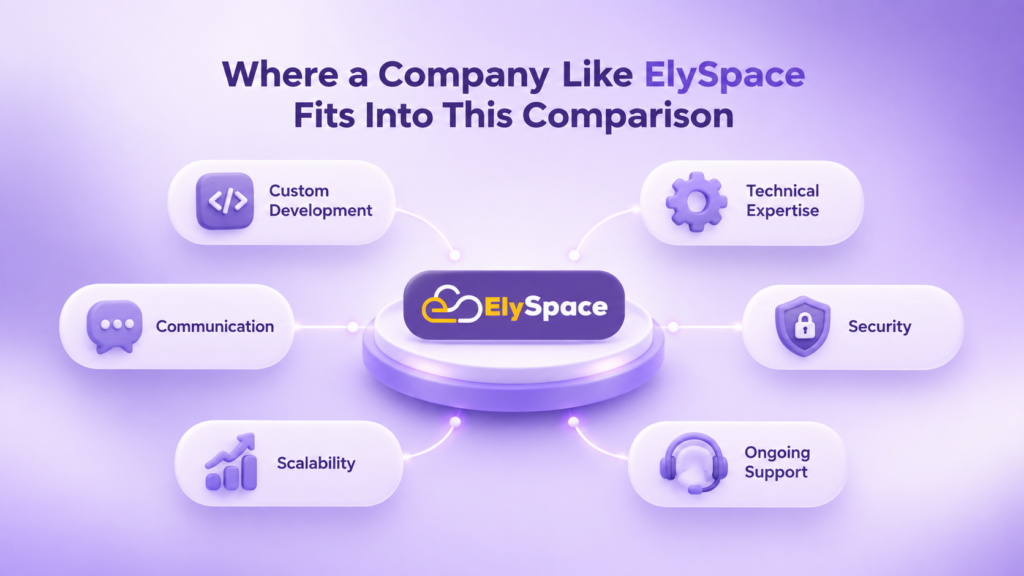
We approach custom software work from Kashmir, and we’re upfront about what that location shapes: cost-efficient development without cutting corners on process, genuine discovery conversations before any quote goes out, and ongoing support after a project ships rather than treating launch as the finish line.
For us, that means the development process isn’t simply “send us your requirements and we’ll start coding.” We first want to understand the workflow behind the requirements, the people who will use the software, the systems it needs to interact with, and what the first useful version actually needs to accomplish.
That approach matters particularly when working with U.S. businesses from a different time zone. Communication has to be deliberate. Meetings need to be scheduled around overlapping working hours, project progress needs to be visible without requiring someone to ask for an update, and questions shouldn’t sit unanswered simply because the teams are in different countries.
If you want more detail on how a project actually moves from an idea to something running in production, we’ve walked through that process step by step in our guide on custom software development.
We’re not the right fit for every project, no company genuinely is. But for a U.S. business weighing cost-efficient custom development against a fully local option, it’s a comparison worth making with real numbers, clear expectations, and an understanding of how the development process will actually work.
The same evaluation criteria in this article apply to us, too. Ask about our process. Ask who will work on your project. Ask how communication works. Ask what happens after launch. A good development partnership should be able to answer those questions clearly.
Frequently Asked Questions
Are custom software development companies in the USA more expensive than international options?
Generally yes, since local labor rates are higher than in many other regions with comparable technical talent. That cost difference can buy time zone convenience and, in some cases, simpler legal arrangements, rather than automatically better quality work.
The important comparison isn’t simply the hourly rate. Look at the total project cost, expected timeline, communication requirements, team experience, and what happens after launch.
Is it risky to hire a software development company outside the USA?
It carries different risks than working locally, mainly around time zone coordination, communication, contracts, and data handling, rather than inherently higher risk overall. A company with a genuine, documented process can manage these issues well regardless of where it’s based.
Before signing, ask specifically how the company handles your working hours, data security, intellectual property, communication, and support.
How do I know if I need custom software or an existing tool?
If your workflow is unusual enough that existing tools require awkward workarounds to fit your process, custom software likely makes sense. If your need is fairly standard, an existing tool is usually faster and cheaper to implement.
A good development partner should be willing to tell you when custom software isn’t necessary.
What’s the biggest red flag when evaluating custom software development companies?
A company that quotes a price without asking meaningful questions about your actual business problem first. Genuine discovery is one of the clearest signals that a company will build the right thing rather than just something.
Other warning signs include unclear ownership terms, vague communication processes, constantly changing project teams, and no clear plan for post-launch support.
Should I only consider companies based in the USA?
Not necessarily. Location matters less than whether the specific company has a real process for discovery, communication, security, and post-launch support.
Limiting your search to one country can mean missing genuinely strong options elsewhere, but choosing an international company should be an informed decision rather than simply a way to lower the quoted price.
Conclusion
Evaluating custom software development companies in the USA comes down to less mystery than it might seem. Look for genuine discovery, clear communication, stable teams, transparent scope management, and real commitment past launch. Treat cost and location as practical tradeoffs rather than automatic dealbreakers in either direction.
The technical ability to write code is common. The process and honesty around how that code gets built is what actually determines whether a project succeeds.
If you’re currently comparing options for your own project, it’s worth having a direct conversation with a shortlist of two or three companies about their actual process before requesting final quotes, rather than deciding on price or location alone.
Ask the uncomfortable questions early. Who owns the code? Who will actually build it? What happens when requirements change? How do you handle bugs? What happens after launch?
The answers will tell you considerably more about a software development company than a polished portfolio ever will.