 Live Chat
 Contact
 Shopping Cart
 Rashid Malla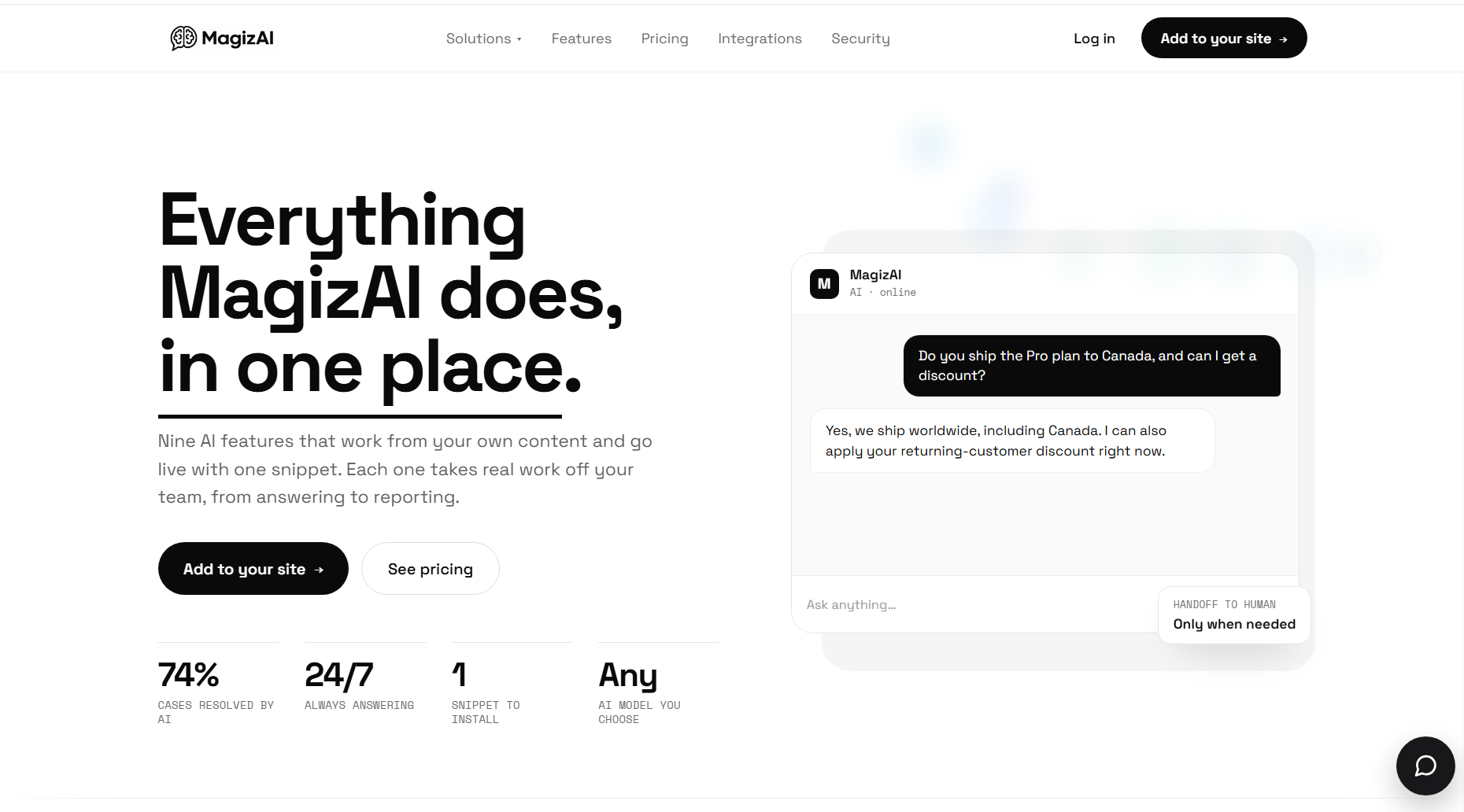
If you have ever waited twenty minutes on hold to repeat your problem to three different agents, you already understand why AI customer support has become one of the most talked-about shifts in modern business. Companies are no longer asking whether they should use AI in their help desk; they are asking how fast they can do it well. This is where supporting customers with AI agents, and specifically how Magizai builds and deploys them, becomes worth a closer look.
I have spent time researching, testing, and writing about support technology. One pattern keeps showing up: the businesses winning on customer experience right now are the ones that treat AI customer support as a real operating strategy, not a chatbot bolted onto an old system. Magizai’s approach to AI agents fits squarely into that category, and this article breaks down exactly what that means in practice.
What AI Customer Support Actually Means Today
AI customer support is no longer a single chatbot that answers three canned questions and then hands everything else to a human. In 2026, it means software that can read a ticket, understand the intent behind it, pull data from your CRM or order system, and actually resolve the issue without a person touching it.
Adoption has moved fast. Salesforce’s State of Service research found that 66% of customer service organizations are now running AI agents, up from just 39% a year earlier a jump of nearly 1.7 times in twelve months, according to Salesforce’s own tracking cited by DigitalApplied. That is not a niche trend anymore. It is close to becoming the default way support teams operate.
At the same time, Gartner has reported that 91% of customer service leaders are under direct executive pressure to implement AI this year. So when a brand talks about AI customer support, it usually is not experimenting. It is responding to real business pressure to move faster and spend less while keeping customers happy.
The Problem With Traditional Customer Support
Before looking at what Magizai does differently, it helps to be honest about what traditional support struggles with. Most support teams deal with the same three issues on repeat.
First, response times balloon during peak hours, and customers do not care why. Second, agents burn out answering the same fifteen questions all day, which leads to slower, lower-quality responses over time. Third, knowledge lives in scattered tools: a CRM here, a spreadsheet there, so agents waste minutes just finding the answer before they can even help.
Traditional automation tried to patch this with rigid decision trees. Type “1” for billing, “2” for returns, and hope the customer’s issue fits neatly into a box. It rarely does, which is exactly why customer trust in older bots is so low, and why a smarter form of AI customer support was needed.
How Magizai Approaches AI Customer Support
Magizai’s AI agents were built around a simple idea: support should feel like talking to someone who already knows your account, your order history, and your problem because the AI genuinely does. Instead of scripted flows, the agents use context from your existing systems to reason through a request the way a trained human agent would.
This is the heart of supporting customers with AI agents at Magizai. The system does not just deflect tickets to reduce a number on a dashboard. It aims to actually close the loop, answering the question, updating the order, or issuing the refund in one pass, without forcing the customer to repeat themselves to a second person.
That distinction matters more than it sounds. Many platforms report high “resolution” numbers that really just mean the bot stopped talking to the customer, not that the problem was solved. Magizai’s model is judged on whether the customer’s actual issue got fixed, which is a much higher bar and a much more honest one.
Supporting Customers With AI Agents: What Changes Day to Day
For a support team, the shift to AI customer support with Magizai shows up in a few concrete ways.
Tickets get triaged instantly, so urgent issues like payment failures or account lockouts do not sit in a queue behind simple “where is my order” questions. Repetitive queries password resets, shipping status, subscription changes get resolved by the AI agent directly, often in under a minute. Complex or emotionally sensitive cases get routed to a human agent, but with full context already attached, so the customer never has to explain the problem twice.
For customers, the experience feels faster and less scripted. They can ask a question in their own words, and the AI agent understands intent rather than requiring exact keyword matches. This is what real support with AI agents should feel like — helpful, quick, and not obviously robotic.
Real Benefits Businesses See From AI Agents
The numbers behind AI customer support back up why so many businesses are moving quickly. The global AI customer service market is on track to hit $15.12 billion in 2026, growing at a 25.8% compound annual rate, according to Lorikeet’s 2026 industry roundup.
Businesses using AI agents typically report a 30–40% reduction in support costs, since routine tickets no longer require a human agent from start to finish. Response times drop from hours to minutes for common requests, which directly improves customer satisfaction scores. Support teams also get more consistent quality, since an AI agent does not have an off day or forget a policy detail the way a tired human sometimes might.
For a company like Magizai, this translates into a support operation that scales without a proportional increase in headcount. A business can handle a traffic spike during a sale or product launch without scrambling to hire and train temporary agents.
How Magizai’s AI Agents Work Behind the Scenes
It is worth explaining the mechanics briefly, because trust in AI customer support depends on understanding how decisions get made, not just what the marketing promises.
Magizai’s agents connect directly to a business’s existing tools: help desk software, order management systems, and knowledge bases — so the AI is always working from current, accurate information rather than a static script. When a ticket comes in, the agent identifies intent, checks account and order data, and decides whether it can resolve the issue on its own or needs to escalate.
Every resolution is logged and reviewable, which supports both quality control and compliance. This matters for regulated industries like finance or healthcare, where an AI agent handling customer support needs a clear audit trail, not a black box.
Common Concerns About AI Customer Support
It would not be honest to write about AI customer support without addressing where trust is still shaky. Industry research shows a real gap: even as adoption rises, a notable share of customers say they would prefer companies use less AI in support, not more, particularly when it feels impersonal or gets stuck in a loop.
Magizai’s design tries to close that gap directly. The agents are built to recognize their own limits and hand off to a human quickly rather than trapping a frustrated customer in an endless chat. Customers can also ask for a human at any point, and that request is honored immediately rather than buried behind another automated prompt.
The other common concern is job loss. Most organizations are not replacing their entire support team; they are shifting agents toward the complex, high-empathy cases where a human genuinely adds more value than automation ever could. AI customer support, done well, is meant to remove drudgery, not eliminate the role of skilled people.
Getting Started With AI Customer Support at Magizai
Businesses exploring AI customer support with Magizai usually start small. A common first step is deploying the AI agent on a narrow set of high-volume, low-complexity requests order status, returns, or account questions before expanding into more complex workflows.
From there, the agent’s performance is reviewed against real resolution data, not just deflection counts, so a business can see exactly how many issues were genuinely solved. Once that trust is established, teams typically expand the AI agent’s scope to cover more of the support queue, while keeping human agents focused on escalations and relationship-sensitive conversations.
If your team already uses a help desk platform, check out our related guide on choosing the right customer support stack for context on how AI agents fit alongside your existing tools.
Final Thoughts
AI customer support is not a passing trend; it is quickly becoming the standard way businesses handle the volume and speed customers now expect. Magizai’s AI agents represent a version of this shift that prioritizes actual problem-solving over surface-level automation, which is exactly the distinction that determines whether an AI agent earns customer trust or loses it.
The businesses that get the most value from supporting customers with AI agents are the ones that treat the technology as a genuine extension of their support team, not a replacement designed purely to cut costs. That is the model Magizai has built toward, and it is worth watching closely as AI customer support continues to mature through the rest of 2026.