 Live Chat
 Contact
 Shopping Cart
 Eshan Riyaz
You write one article. You publish it. Then you go back to running your business.
Three months later, someone in a different city finds that article on Google, reads it, trusts what you said, and calls you to ask about your services. You didn’t run an ad. You didn’t post about it on Instagram that day. You didn’t even remember writing it.
That’s how blogs bring customers to your business quietly, automatically, and repeatedly. It’s one of the few marketing tools that keeps working long after you’ve moved on to other things.
Most small business owners either don’t blog at all, or they blog occasionally without a clear strategy and wonder why it’s not doing anything. This article explains how the whole thing actually works and why it’s worth taking seriously.
How Blogs Bring Customers Without You Lifting a Finger
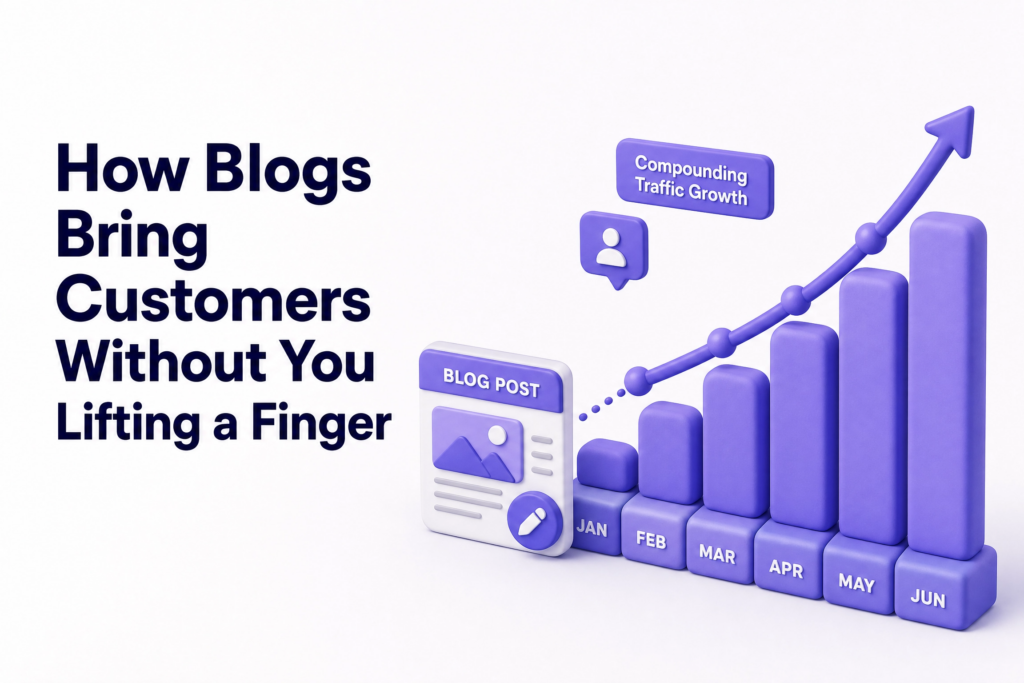
Every time you publish a blog post, you’re creating a new page on your website that Google can index and rank. Each page is essentially a new opportunity to show up in search results for a different question, a different keyword, and a different type of customer.
Websites with active blogs have 434% more indexed pages on search engines, and 97% more inbound links than those without. More indexed pages means more doors into your website. More inbound links means more authority in Google’s eyes.
And unlike a paid ad that disappears the moment your budget runs out, a well-written blog post keeps ranking and bringing in traffic for months, sometimes years after you publish it.
That’s the automatic part. One hour of writing today can generate inquiries next quarter. That kind of compounding return is almost impossible to get from any other marketing channel at the same cost.
What Makes a Blog Different From Social Media
This is a question worth answering directly, because a lot of business owners treat them as interchangeable.
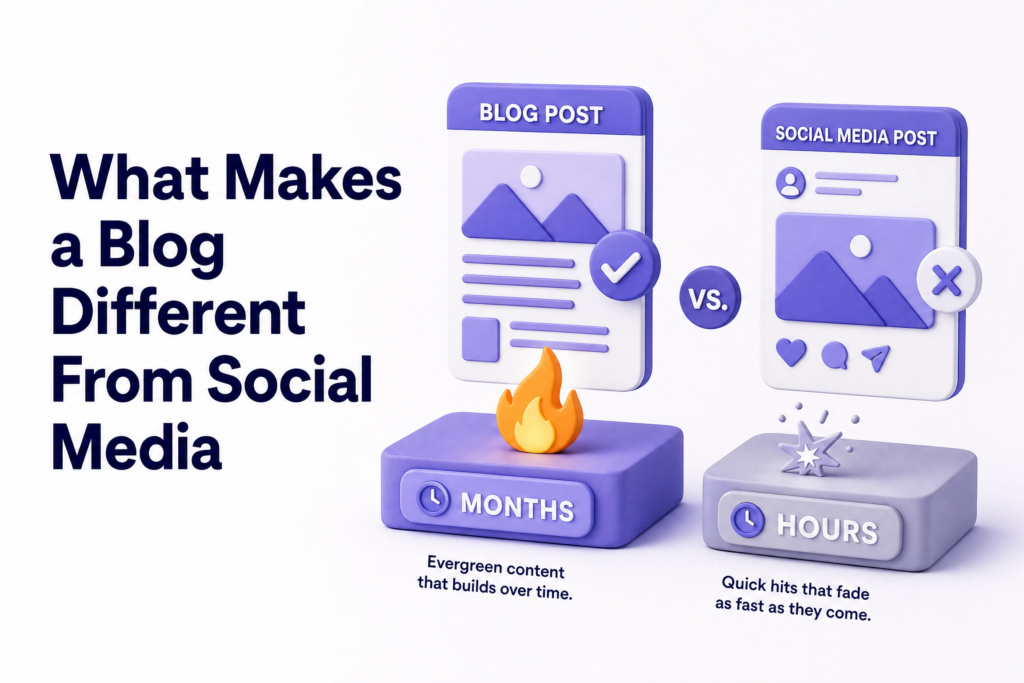
Social media posts are rented visibility. You post, it shows to some percentage of your followers for a few hours, and then it’s buried. If you stop posting, your visibility drops immediately. The platform controls who sees your content and when.
A blog post lives on your website which you own completely. It doesn’t expire. It doesn’t get buried by an algorithm. While social media algorithms are constantly shifting and changing the rules, your website is the one digital asset you actually own.
Both have their place. But if you’re a small business with limited time and budget, blogging gives you far more durable returns for the effort invested.
7 Proven Ways Blogs Bring Customers to Your Business Automatically
1. They Answer the Questions Your Customers Are Already Typing
Before someone buys something, they search. They type questions into Google: “how much does web design cost,” “what documents do I need for a tour booking,” “is shared hosting okay for a small business.”
If you’ve written a clear, helpful answer to that question, your article shows up. They read it. You’ve now helped them before they’ve even contacted you and that matters enormously for trust.
Blogs bring customers to your business by meeting them at the exact moment they’re looking for answers, not interrupting them with an ad while they’re trying to do something else.
2. Each Post Is a Long-Term Traffic Asset
A Facebook post from six months ago is invisible. A blog post from six months ago, if it ranks, is still bringing in readers today.
Blog content continues attracting visitors months and even years after publication, while PPC ads disappear the moment you stop paying. That’s the core economic argument for blogging. The return on a single well-optimised post isn’t measured in days, it’s measured in years.
3. Blogging Builds Trust Before First Contact
Think about your own behaviour as a buyer. When you’re considering a higher-ticket purchase, you research first. You read articles. You form an opinion about which businesses seem knowledgeable and which seem like they’re just after your money.
Your blog is your chance to come across as the knowledgeable one. A person who reads your content regularly may start feeling familiarity toward your brand, they’ll trust you more than a random competitor, and might choose you even if your offer isn’t objectively the cheapest.
That kind of pre-built trust is something no ad can manufacture. It has to be earned, and a helpful blog earns it quietly, post by post.
4. They Generate Leads Around the Clock
Your blog doesn’t take weekends off. It doesn’t sleep. A potential customer searching at midnight on a Sunday can find your article, read about your service, and fill out your contact form all without you being involved.
Every blog post is an opportunity to capture leads through strategic calls-to-action and content that works around the clock. The key is making sure each post has a clear next step, a link to your services page, a contact form, or an offer to get in touch. Without that, you’re educating readers but not converting them.
5. Blogs Dramatically Improve Your SEO
Every new blog post gives search engines more content to crawl, more keywords to associate with your site, and more reasons to consider you an authority in your field.
Small businesses that blog experience 126% more lead growth than those that don’t, and businesses focusing on blogging are 13 times more likely to see a positive ROI.
This is especially powerful for small, local businesses. Writing about topics specific to your area: “best time to visit Kashmir,” “what to look for in a Kashmir tour operator,” “web design for small businesses in India”, targets the exact searches your ideal customers are making. You can verify how your posts are performing using Google Search Console, which is free and shows exactly which queries are bringing visitors to your site.
6. They Work as a Sales Tool Without Feeling Like One
A good blog post doesn’t sell, it informs. But informing the right person about the right thing at the right time is exactly what selling is, done well.
When someone reads your article on “how to choose a web designer for your business” and your company name is naturally woven throughout as the author and source, they’ve been introduced to you, seen your thinking, and assessed your credibility. By the time they click your services link, the sale is half-made.
That’s a fundamentally different dynamic than a cold ad saying “hire us.” Blogs bring customers to your business in a warmer, more considered way and those customers tend to be better quality leads as a result.
7. Your Blog Content Feeds Every Other Channel
One blog post is not just a blog post. It’s the source material for your social media captions, your email newsletter, your YouTube script, your WhatsApp status update, your Instagram carousel.
Businesses that blog consistently never run out of content ideas across their other channels because the blog is the engine. Everything else becomes a shorter version of something that already exists and already has depth behind it.
What Kind of Blog Posts Actually Work
Not every post will rank. Not every post will bring leads. But these types consistently perform well for small businesses:
How-to articles: “How to plan a Kashmir trip in 5 days” or “How to choose the right hosting plan for your website.” These attract mid-research people who have clear intent.
Comparison posts: “Shared hosting vs managed hosting: which is right for small businesses?” People searching comparisons are close to making a decision.
Answer posts: Direct answers to questions your customers actually ask. If five clients have asked you the same question over email, that question belongs on your blog.
Local content: Articles relevant to your specific region or industry that bigger national sites won’t bother writing. This is where small local businesses have a genuine advantage.
According to HubSpot’s Content Marketing research, companies that publish 16 or more blog posts per month get nearly 3.5 times more traffic than those publishing four or fewer. You don’t need that pace to start but it shows that consistency matters more than perfection.
Common Blogging Mistakes Small Business Owners Make
Writing for Google instead of people. A post stuffed with keywords and no real insight helps nobody. Google is now sophisticated enough to tell the difference.
Publishing once and disappearing. One post does very little. A library of posts builds authority. Consistency over several months is where the real traffic gains come from.
No call-to-action at the end. If someone reads your post and there’s nowhere to go next, you’ve created awareness without direction. Every post should guide the reader toward the next step.
Covering topics nobody is searching for. “A message from our founder” and “we attended an event last week” are not blog strategies. Write about the questions your customers actually type into Google.
Expecting immediate results. Blogs bring customers to your business but on a timeline measured in months, not days. The businesses that quit after six weeks never see the return that was already starting to build.
What You Can Do This Week
- Write down five questions your customers have asked you more than once, those are your first five blog topics
- Search each question on Google and look at what currently ranks, understand what already exists before writing
- Publish one article this week, with a clear heading structure, natural keyword usage, and a call-to-action at the end
- Set up Google Search Console so you can track which queries bring people to your posts
- Aim for one post per week or two posts per month as a sustainable starting pace
If writing isn’t your strength, or time is the real constraint, professional blog content that’s properly researched and SEO-optimised is one of the services ElySpace offers for small businesses. Done-for-you blog content means you get the long-term traffic benefits without the time investment and every post is written to actually rank.
FAQs (Frequently Asked Questions)
How long does it take for a blog to bring in customers? Typically three to six months before you see meaningful organic traffic from blog posts. Some posts rank faster depending on competition. The key is publishing consistently, results compound over time rather than arriving all at once.
How long should a business blog post be? For SEO purposes, posts between 800 and 1,500 words tend to perform well for most business topics. Depth and usefulness matter more than hitting a specific word count. A focused 900-word post that fully answers a question will outperform a padded 2,000-word post that says the same thing twice.
Do I need to post every day to see results? No. Consistency matters more than frequency. One well-written post per week is far more valuable than seven rushed ones. Many businesses see strong results from publishing two to four quality posts per month.
Can blogging replace paid advertising? Not immediately, and they serve different purposes. Paid ads bring immediate traffic. Blogging builds long-term organic traffic that doesn’t depend on ongoing spend. Most smart businesses use both: ads for short-term results, and blogging for long-term compounding growth.